
 AUS
AUS
 NZ
NZ
 UK
UK
 CA
CA
 USA
USA
 IND
IND







Changing pattern of climate with rising temperature is a significant concern, as we witnessed the prolonged effect of bushfire on the grappling Australian economy, devastating lands and livelihood. As per the United States Environmental Protection Agency, the transportation sector ranked top in CO2 emissions in 2017, accounting for around 29% of the total emissions, followed by other sources of greenhouse gas emissions including electricity production and industry.
In the milieu of which, there is a global movement towards electric vehicles (EVs), courtesy to the Paris agreement, country-level regional policies towards EVs, subsidies and growing awareness among consumers to mention few.
Moreover, the Australian government has launched the Green Vehicle Guide (GVG) to guide consumers about environmental performance and fuel consumption. It also delivers figures from noise and air pollution to fuel consumption to give flexibility to consumers to analyse, thereby creating awareness among them.
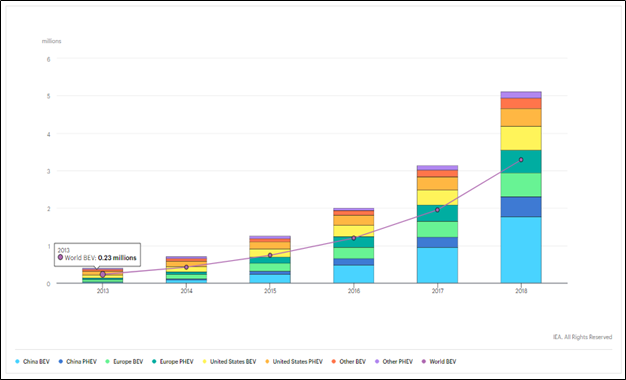
The market attractiveness of EVs has proliferated, passing 5 million electric passenger cars in 2018, a 63% increase from the previous year. Also, it is worth mentioning that ~45% share in total electric passenger cars in 2018 was contributed by China, followed by Europe with 24% and the United States with 22%.
With growing demand for EVs, the market will face challenges such as technologies’ evolution, launch of new products, and threat of competition to already established automotive players. The growth in fuel efficiency regulation is also expected to boost the share of EVs to majority in the total automobile fleet.
Thus, it is quintessential to know the commodities that are required to support the growth of cleaner mobility. The battery metals such as cobalt, nickel, lithium and vanadium are needed to meet the demand coming from EVs. Also, the copper requirement will increase due to its usability from EVs to charging stations and infrastructure because of its durability, conductivity and efficiency.
Interestingly, all these commodities are present at the assets of Perth-based gold & base metal exploration company, Great Western Exploration Limited (ASX: GTE). GTE owns its assets in the Northern Yilgarn area, namely Yandal West Gold Project, Yerrida South Project, Yerrida North JV Tenure, Lake Way Potash and Lithium Brine Project, and Fairbairn Project.
The projects such as Yerrida South Project, Yerrida North JV, and Lake Way Potash and Lithium Brine Project possess attractive commodities like copper, vanadium, cobalt, nickel, potash and lithium, the major winners in the revolution of EVs.
How GTE’s projects are located? Do Read Gauging Nearby Infrastructure For Great Western Exploration’s Yandal West Gold Project
- Yerrida South Project: The project is 100% owned by the Company and has numerous vanadium gossans with rock chip samples grade of ~1.6% V2O5 along with large areas of laterite with surface sampling in the range of 0.3% to 1.0% V2O5. The use of vanadium pentoxide in Vanadium Redox Flow Batteries (VRFBs) poses a significant prospect for energy storage capabilities due to immense recycling capabilities.
Further, there exists identified potential for sedimentary hosted copper target, adding complete package to the green-energy application. The Company believes the project to be sulphide mineralisation and thus expects it to be low operating and low capital extensive project.
- Yerrida North JV Tenure: It is a joint venture through an earn-In agreement with Sandfire Resources NL (ASX: SFR) – which enables SFR to earn up to 70% share by funding exploration. The prospect is expected to contain copper, nickel and cobalt commodity since the project consists of copper-gold, copper-cobalt, nickel-cobalt and gold mineralisation.
- Lake Way Potash and Lithium Brine Project: The project is 100% owned by the Company. It is worth mentioning that the project was originally acquired post the Geoscience Australia identifying the area as possibly prospective for lithium brines. Recently, GTE was granted with the Native Title Land Access Agreement for the Lake Way Potash project.
To know more about GTE projects: Do Read Assessing Great Western Exploration’s Projects Vis-À-Vis Market Opportunities
Hence, the presence of these commodities aids GTE prospects, given the expected surge in demand from battery development and greener mobility in the future.
The other very crucial project of the company is Yandal West Gold Project - a high-grade gold mineralisation prospect. The Company is presently continuing the assessment of VMS potential across the Yandal West Gold project.
Interesting Read: Gold Dynamics; Great Western Exploration With High-Grade Yandal West Gold Project
Stock Price Information – The share price of GTE was noted at $ 0.003 on 11 February 2020, with a market cap of $ 5.01 million. The last one-month return of the stock stood at 33.33%.
