
 AUS
AUS
 NZ
NZ
 UK
UK
 CA
CA
 USA
USA
 IND
IND




_07_03_2026_03_50_21_133108.jpg)



Summary
- London equities marked a rough patch in the very beginning 2021
- The reopening-led optimism steered an upside of over 11% in FTSE 100
- The index has effectively returned to the three-month-old level of 7,123.68
Even after the slew of relaxations extended by the government of the United Kingdom and the positive developments showcased by the macroeconomic indicators, the markets have remained highly volatile in the present calendar year so far.
Topsy-turvy ride
London equities marked a rough patch in the very beginning of the new calendar year with the FTSE 100 falling by nearly 7% after the Downing Street administration imposed the third national lockdown, bringing all the sectors to a standstill in a desperate attempt to contain the spread of coronavirus and its rapidly originating strains.
The reopening-led optimism steered an upside of more than 11% in the market index between February and May. Businesses filled with orders, services, manufacturing and construction sectors reporting back-to-back record numbers, thoroughly supported the equities and helped the partly-battered sentiments to recover.
Also Read | Deliveroo shares surge with the entry of German Delivery Hero
Of late, the markets have seen some of the wildest moves. The headline FTSE 100 has registered a year-to-date (YTD) closing high of 7,184.95 (16 June), while it also succumbed to a three-and-half month low of 6,844.39 (19 July).
FTSE 100 (3-month performance)
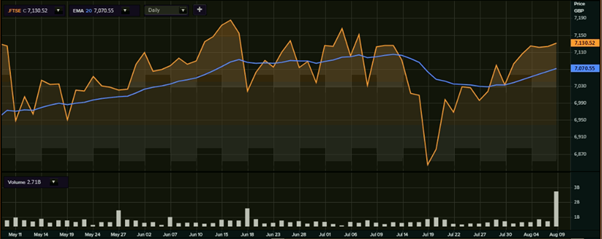
Image Source: REFINTIV
The index has effectively returned to the three-month-old level of 7,123.68 after a bunch of position sessions and several successive losses.
Delta variant & the ‘pingdemic’
There are not a large number of reasons for the elongated jittery amidst the domestic market participants, as well as the foreign investors associated with London’s equity landscape. The one and only factor to be blamed is the rising cases of the Delta variant across Great Britain. This has single-handedly brought down the pace of bounce back as it is the sole reason for the increasing rate of daily hospitalisations.
The daily rate of hospital admissions in the UK has more than quadrupled in July as compared to the rate persisting in early May. Higher the number of cases in each jurisdiction, relatively higher the number of people in close contact with the infected person.
In order to avert a major outbreak in the country, the healthcare department started notifying the people who came into the close contact of an infected person through the National Health Service’s mobile application.
This gave rise to ‘pingdemic’ as hundreds of thousands people were told to stay at home, obligating a mandatory quarantine, as a result of which, the businesses that were eyeing a massive reopening started facing acute shortages of staff and the adequate workforce required to get back the pre- pandemic level operations.
Almost every sector got hit with the so-called pingdemic situation, while the enterprises operating within the hospitality industry and other sectors with direct interaction with the consumers, were the worst hit, functionally slowing down the pace of economic activity.
Also Read | 10 FTSE Stocks at the forefront of fighting climate change
All of this, alongside the global fears of rising inflationary pressure, ticked up the prices of finished products as manufacturers have to deal with the shortage of manpower, as well as undersupply of raw materials. The week-after-week surge of the coronavirus cases linked to the Delta variant and its sub-lineages has moderated recently as the government left no stone unturned to avoid any chances of further disruption, be it in terms of health or the economic progress.
The already-battered situation got hammered by the lower-than-expected quarterly results of a bunch of heavyweights, as well as mid-sized corporations.
What’s ahead?
With only five-and-a-half months left in 2021, the present quarter will remain crucial for businesses and national health. The total number of fully-jabbed people at the end of September 2021 will likely help in gauging the expected outcome of sectors in the holiday season.
Investors are eagerly looking forward to some worthwhile breakthroughs in the national economic growth and the response towards Covid-19 that can help in withstanding the upcoming challenges by the time furlough scheme and complete benefits under the stamp duty holiday terminate at the end of 30 September 2021.
