
 AUS
AUS
 NZ
NZ
 UK
UK
 CA
CA
 USA
USA
 IND
IND


_02_06_2025_07_05_23_538703.jpg)




(Image credit: Twitter/@Sept11Memorial)
Summary
- Stock markets around the world fell drastically in the wake of the 11 September 2001, terror attacks.
- European stock markets saw an even sharper decline after the US stock markets opened post-9/11, a likely result of spillover.
- In the aftermath of the attacks, US markets rebounded relatively quickly due to the country’s financial resilience, while markets in European countries took longer to bounce back.
Apart from the staggering levels of loss of lives and infrastructure, the 11 September 2001 terror attacks had a huge impact on the financial markets worldwide. The attacks, which brought down two towers of the World Trade Centre and partly destroyed the Pentagon, were a strike at the US’ and global financial system in itself. Although the impact was not as colossal as that of the ongoing coronavirus pandemic, it was still quite substantial. And not a short-term one.
Impact of 9/11 on Global Equity Markets
Immediately after the first plane crashed into the World Trade Center’s North Tower, the New York Stock Exchange (NYSE) opening was held up. When the news of a second plane hitting the South Tower came, trading for the day was completely called off. Most major financial buildings, including NYSE, were evacuated in the US and across the world in the fear of subsequent terror attacks. The NYSE, which remained closed for nearly a week following the attacks, saw such a long closure for the first time in decades – after World War 1 and the Great Depression in 1933. Nasdaq, like NYSE, stayed closed till September 17. The Dow Jones Index, as result, fell almost 700 points, and went on to incur losses exceeding 7 per cent when the markets finally opened. The MSCI World Index, meanwhile, fell by more than 4.5 per cent.
The attacks led to swift and steep falls at stock markets across the world. European stock markets, which had started trading before the US exchanges, declined sharply after the US stock markets finally opened on September 17. The pan-European Dow Jones Euro STOXX index shed 17.3 per cent between September 11 and 21, as per an International Monetary Fund (IMF) study. The study also points that in comparison to major 2004 Madrid train bombings terror plot, the 9/11 attacks had a much deeper impact on the financial and capital market. The Dow Jones Euro STOXX lost around 3 percent on 11 March 2004 after the attacks in Spain, but subsequently rebounded to its near pre-attack levels by the end of the month.
On the first day of the US stock markets opening post-9/11, the NYSE doffed record 684 points or 7.1 per cent. The gains made in the last 19 years were once again wiped out in the recent pandemic-led market crash, which saw the NYSE plunge to new record lows.
In the 9/11 fallout, stocks of airlines and insurance companies felt the maximum heat. Gold prices, meanwhile, galloped from U$ 215.50 an ounce to U$ 287, as investors rushed to seek safe assets in the wake of the tragedy.
Prices of oil and gas also shot up in the US amid the fear of international trade being affected. Commodity prices subsequently fell back close to their pre-attack levels within a week’s time as import of crude oil continued.
Abnormal Returns in the Wake of 9/11
The ripples of the 9/11 attacks were felts across worldwide banking and financial sectors. A table shared by an IMF report represented the massive negative impact it had on capital markets across the world.
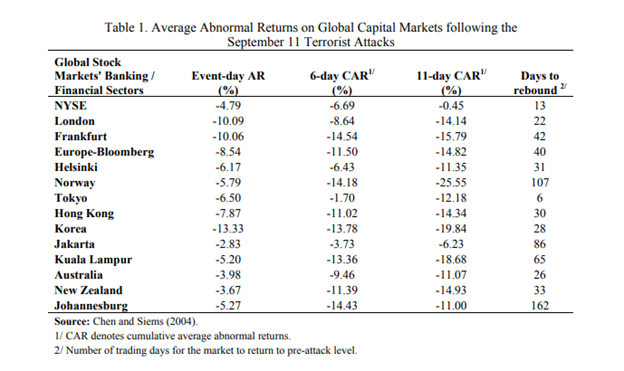
(Source: International Monetary Fund)
As this IMF table shows, the attacks had a relatively lower impact on the US market and quicker recovery, while markets in European countries took longer to bounce back.
A likely reason for US markets’ quick rebound was Federal Reserve’s robust accommodative policy, despite the country being the very target of the attacks. The IMF report adds that the country’s financial sector provided resilience to the markets with adequate liquidity. Another 2001 US Securities and Exchange Commission (SEC) report on the attack claims that the American markets had “assessed, and responded to the crisis rationally” as capital markets have the capacity to absorb shocks faster than people.
Global Economic Response to 9/11
Amid the widespread panic following the 9/11 attacks, the US Federal Reserve announced that it was “open and operating”. It announced measures to inject liquidity so that payment systems continue to function. The liquidity injections were estimated to be over US$ 100 billion. The Fed also worked with the European Central Bank and the Bank of England to arrange reciprocal currency facilities of up to US$ 80 billion, in case foreign financial institutions face liquidity shortage.
Countries like Canada, Japan, Switzerland, the United Kingdom and other nations also provided liquidity in a bid to boost confidence and help the US financial markets in the wake of the tragedy. Following the Fed’s move of lowering interest rates by 50 basis points, these economies also slashed their interest rates. Similar actions were subsequently taken by other countries, such as Denmark, Sweden, Korea, New Zealand, etc.
Impact of 9/11 on the US Economy
The US economy was already dealing with the recession triggered by the dotcom bubble when the 9/11 terror attacks hit. However, as much as the markets and the economy suffered from 9/11, they recovered relatively quickly due to the country’s financial resilience. The Organization for Economic Cooperation and Development said that the tragedy’s direct cost was approximately US$ 27.2 billion – a quarter of the country’s annual Gross Domestic Product (GDP).
By the end of 2001, the US GDP even increased by about 1 per cent from the previous year. And its fourth quarter saw a rise of 2.7 per cent.
Remembering 9/11 in COVID-19 Times
The September 11 attacks left an unforgettable mark in the history of humankind and otherwise. The ongoing COVID-19 pandemic not only jogged those memories but has also dealt a severe blow to the markets worldwide. The pandemic-triggered lockdowns and constrains pulled stocks down to new lows. Almost every sector including airlines, housing, hospitality, etc have suffered a graver hit this time around. For example, a report by Tourism Economics and the US Travel Association says that the impact on the US travel industry from the coronavirus has been nine times greater than the 9/11 attacks. The pandemic, in fact, has even gone on to mar the 9/11 commemoration plans this year, which would have marked its 19th anniversary.
