
 AUS
AUS
 NZ
NZ
 UK
UK
 CA
CA
 USA
USA
 IND
IND








Summary
- S&P Global Ratings has recently stated that Australia’s AAA credit rating is rock solid.
- S&P has slashed the ratings of Victoria and NSW from ‘AAA’ to AA and AA+, respectively.
- The global rating agency has taken into account the budget deficit of the states and their mounting debt burden to ascertain credit ratings.
- The state governments of NSW and Victoria intend to foster spending to boost economic situation of their respective states.
Although S&P Global Ratings recently maintained the stance that Australia’s AAA credit rating is rock solid, the rating agency has downgraded the long-term credit ratings of Victoria and New South Wales (NSW).
Australia’s two economic powerhouses, Victoria and New South Wales, continue to remain in deep waters with the seemingly long-term implications of COVID-19 restrictions. Taking into account the economic repercussions of the lockdown, global rating agency S&P Global Ratings has revised the credit ratings of the two states.
Victoria that resumed operations after 28-days of rigorous lockdown saw its ratings falling from AAA to AA. Besides, NSW has also been slapped with the rating demotion, with rating declining from AAA to AA+. These rating downgrades may indicate huge bearing for the two states, both of which have maintained the top-tier AAA rating since the early 2000s.
Nevertheless, when the Reserve Bank governor Mr Philip Lowe was questioned regarding the rating cuts for the two states, he stated that a downgrade of credit ratings is not an economic concern. He believes that credit ratings have more significance on the political front than on the economic front.
ALSO READ: RBA Monetary Policy Decision: No Changes to Policy Setup
Against this backdrop, let us explore the fiscal scenario for Victoria and NSW along with their respective economic recovery prospects.
Why the Ratings Went Downhill?
The onset of the COVID-19 pandemic set off a chain reaction of economic woes, with the second wave of infection in NSW and Victoria further exaggerating virus implications. The impact of COVID-19 restrictions has been evident on business transaction volumes and employment situation, eventually leading to significant pandemic-induced economic shocks.
While the state and federal governments have been quick to respond with significant fiscal stimulatory initiatives, these initiatives escalated government debt levels substantially.
The fiscal shock triggered by the budget deficit of the states and their debt burden appears to have induced S&P to downgrade credit ratings of Victoria and NSW.
In a statement, S&P indicated that it expects the path to fiscal repair to be incredibly challenging and lengthy for Victoria compared to other states. The rating agency further anticipates NSW’s debt burden to soar for three years, with the state observing its largest after-capital-account deficit in the current fiscal year. However, the deficit is likely to narrow down in the future years.
Furthermore, Moody’s has also placed the AAA rating of Victoria under review, considering the material risks around Victoria’s credit profile with anticipation of ultra-high net direct and indirect debt. However, the credit rating agency has maintained an AAA credit rating for NSW.
ALSO READ: Is the decline in JobKeeper aid receivers a signal for the Australian economy’s recovery?
Lens through Victoria’s Fiscal Scenario
High Fiscal Deficit
Moody's foresees Victoria's net direct and indirect debt to surpass 200% of revenue in the fiscal year 2024 as against 79% in the fiscal year 2020. The recently released 2020-21 Victorian State Budget anticipates $23.3 billion budget deficit for the state in the next financial year. Besides, the budget expects the net debt to reach $155 billion by 2024, owing to the severe repercussions of the pandemic and lockdown in Victoria.
The Victorian Government has so far allocated billions of dollars for battling the pandemic in a bid to provide support to the state’s health system and enable businesses to remain afloat during critical times.
Record Spending
The pandemic-induced spending significantly added another burden on the state, which was already borrowing a significant amount to support its major project before the onset of coronavirus. Victorian government has decided to spend an average of ~$19.6 billion each year until 2024 towards infrastructure to accelerate the economic recovery.
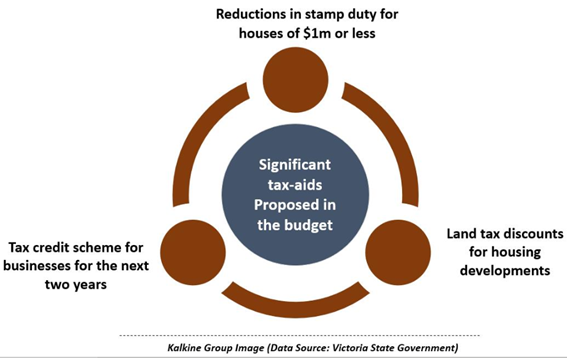
Although the state’s tax revenue fell by 11.9%, the government is planning for further tax waivers and cuts in the budget to create around 0.2 million new jobs over the next two years. Moreover, the record-low interest rate could come as a relief for the Government, which intends to provide financial assistance for supporting the economic recovery in Victoria.
NSW Economic Landscape
In 2019-20, NSW witnessed a $6.9 billion deficit that is projected to reach approximately $16 billion in 2020-21. Albeit it is the largest deficit ever seen by a state, NSW Treasurer Dominic Perrottet has indicated that NSW Government will ponder on borrowing to facilitate the economic recovery. The current low borrowing cost is also expected to back the government’s spending plans.
Significantly, spending is likely to be focussed on infrastructure and property tax support. However, the recently unveiled Voucher Scheme also appears to hold lucrative appeal to the Australians. Under the Voucher Scheme of the government, every individual over 18 years is eligible for four vouchers each worth $25 that could be spent on eating out and entertainment. Apart from this, infrastructure, childcare, education, health services are also under key areas of focus under the state government’s budget.
ALSO READ: How is Australia's property market scenario panning out?
Are there any Bright Spots for the States?
Despite the doom and gloom of the fiscal scenario of the two states, the recent transformations have been stimulating new hopes for the economic revival.
Importantly, both Victoria and NSW have achieved noteworthy success in the infection scenario. Moreover, the significant development in COVID-19 vaccines is bolstering the growth prospects of the states. The successful roll-out of vaccine is expected to support the stabilisation of the situation, allowing the states to focus on economic reboot.

The relaxations of restrictions are already giving positive vibes to the Australian property markets where buyer’s response remained tepid due to lockdown. For instance, despite CoreLogic’s home values remaining low, the November Home Value Index has shown 0.7% MOM rise in November 2020.
Meanwhile, the rising consumer sentiments amid the approaching Christmas and New Year is expected to put the economy on the healing mode with Treasurers eyeing increased spending. Western Australia recently opened its state borders for NSW and Victoria, paving the way for travel for Australians with vagabond spirits or those who are looking forward to spending their holidays with the loved ones.
