
 AUS
AUS
 NZ
NZ
 UK
UK
 CA
CA
 USA
USA
 IND
IND








Summary
- The level 3 lockdown in Auckland caused a slump in retailer confidence in August, with sales falling substantially after the new lockdown started.
- As per NZ Retail Radar Survey report, retailers who were confident that their businesses would survive in the next 12 months fell to 64% from 75% noted earlier.
- About 10,000 retail businesses stand at serious risk in the next 12 months, showing the instability of the market.
- The August ANZ business outlook survey revealed that the business confidence fell to -41.8% in August from -31.8% in July but did not deteriorate noticeably as August progressed.
- The retail sector has led much of the rebound in the ANZ business outlook activity indicators since June, but it fell back below other sectors in August.
The latest September NZ Retail Radar report shows that the retailer confidence declined substantially due to Level 3 lockdown in Auckland during August because of the resurgence of community transmission of coronavirus in NZ.
Though, sales had recovered during the months of June and July, they again experienced a decline in August. About 68% of the retailers, during a survey conducted by NZ Retail Radar, stated that sales had dropped once the lockdown was imposed. Auckland based businesses with physical stores incurred 90% of downturn in sales.
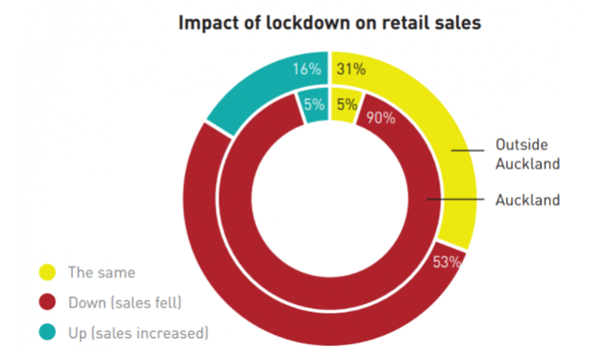
Source: Retail Radar Report, dated: September 2020
As per Retail NZ, Chief Executive, Greg Harford, the overall sales were down by 6.4% compared to last year since March.
ALSO READ: New Zealand Retail Sales Tank in June Quarter- Are we Out of the woods?
Let’s have a look at few highlights from the survey, which are as follows:
- About 64% of retailers reported that they were confident or very confident that the business will survive in the next 12 months, down from 75% last month
- While 13% are not confident of their survival, 23% believe it could go either way
- About 43% of the businesses exposed to the Auckland market were not confident or unsure of their survival in the next 12 months
- 50% of the retailers witnessed delays in the movement of freight due to level 3 restrictions while only 40% with stores in Auckland were affected
- 73% of the retailers recorded issues with international supply chains due to major problems in shipping products from abroad and freight arriving in NZ
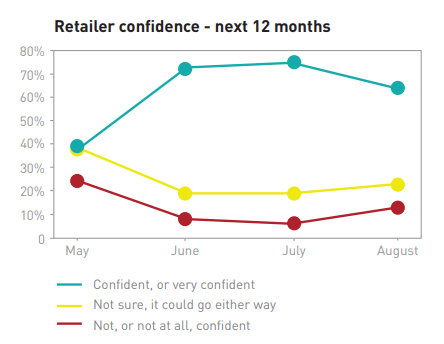
Source: Retail Radar Report, dated: September 2020
About 10,000 retail businesses are projected to be at major threat across the next 12 months period, displaying the vulnerability of the market. Various checkpoints due to lockdown measures resulted in prolonged waits for freight movement into and out of the country while retailers also had to deal with issues in sourcing products.
Resurgence wage subsidy and new contract tracing rules for retailers
After Auckland went into Level 3 restrictions, the government announced Resurgence Wage subsidy on 17 August, which supports more than 30,000 jobs. The eligibility criteria for the same include a 40% drop in the revenue of businesses over a 2-week period between 12 August and 10 September, compared to last year. The 2-week payment will be of $1171.6 for a full-time employee and $700 for a part-time employee.
The government provided original wage subsidy scheme for 12 weeks from 17 March, which ended in June provided support to businesses, which experienced a 30% decline in revenue over a 30-day period. An extension to the subsidy was given on 10 June that provides 8 weeks of support to businesses that suffered a 40% reduction in revenue, due to end by 10 September. The government anticipates the wage subsidy extension and the new wage subsidy scheme to support 930,000 jobs.
ALSO READ: NZ Government announces Wage Subsidy Extension following Extended Lockdown
As per the NZ Retail Radar survey report, the resurgence wage subsidy will support 32% of retailers across the nation, but the response was more positive for businesses with Auckland stores with 55% anticipating the subsidy to assist.
On 19 August, NZ announced that it would be compulsory for all businesses to display government’s official COVID Tracer QR code poster as part of the new range of restrictions due to resurgence of virus cases. About 37% of the retailers have reported that more than half of all shoppers are using QR codes now.
ANZ Business Confidence slid in August
The activity indicators slid from their preliminary figures in the August ANZ Business Outlook survey but stayed relatively resilient to the community’s resurgence of coronavirus on 12 August.
ANZ headline business confidence fell to -41.8% in August from -31.8% in July, reflecting a marginal difference from the preliminary reading of -42.4% in August. Similarly, own activity outlook dropped to -17.5% in August from -8.9% in July. However, businesses in Auckland were much gloomier than anywhere else.
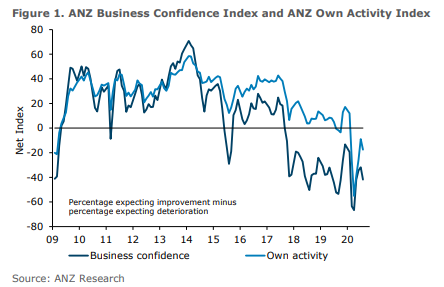
The ANZ Business Outlook Survey showed that the retail sector had been less optimistic about profitability compared to the remaining economy over the past few years.
However, the sector had experienced rebound in June and July months this year and appeared optimistic but fell back below other sectors in August. This was constant with ANZ consumer confidence survey that showed that households have become careful of expenditure in this challenging atmosphere.
Let’s have a look at business confidence at different levels in August 2020.
- Confidence has been particularly weak in agriculture at -80.6% as it is the sector most exposed to the global outlook, which rarely stimulates confidence
- Business confidence in services also appeared to be depressed at -43.3%, showing their huge exposure to tourism and lockdown, while manufacturing confidence dropped to -37.3% in August
- The construction sector has taken a bright position with confidence in the sector at -16.1% and has been lifting up
GOOD READ: Farmer confidence hits lowest levels since 2009 | NZ Market Update
ANZ Chief Economist, Sharon Zollner stated that the August result was better than expected, considering the latest resurgence of the virus. The intentions and expectations witnessed relatively modest drops compared to the first half of August.
