
 AUS
AUS
 NZ
NZ
 UK
UK
 CA
CA
 USA
USA
 IND
IND








Summary
- COVID-19 restrictions in Auckland would continue at the current Alert Level 3 until 30 August and was imposed on August 11 after the officials detected NZ’s first locally acquired cases of COVID-19.
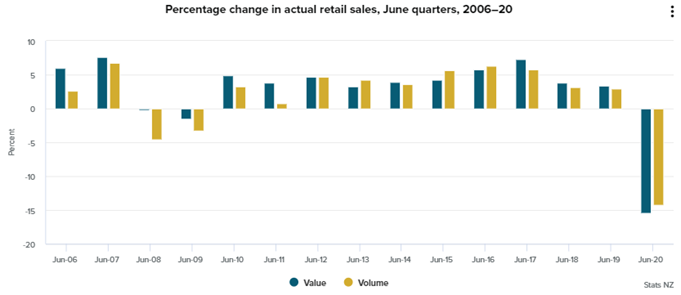
- June 2020 quarter witnessed NZ retail sales plunging down by a record 15% due to the initial COVID-19 lockdown, the biggest drop on record since the series began in 1995.
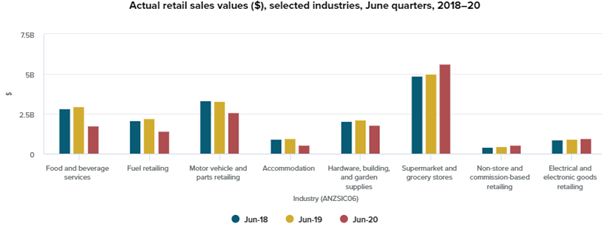
- Expenditure on dining out, home away from home, vehicles and fuel declined dramatically compared to June 2019 quarter, but was partly counterbalanced by the high supermarket and grocery sales.
- Westpac anticipated a contraction of 12% in the June quarter, but stated that the fall in retail sales was not large, and was firmer than the domestic forecasts, which predicted a fall of close to 20%.
With the sudden resurgence of coronavirus cases around 2 weeks before in Auckland, Prime Minister Jacinda Ardern was quick to put 1.7 million residents of the city in lockdown, making companies to shut down and schools to close.
On 24 August, Ardern declared an extension of current Alert Level 3 coronavirus restrictions (imposed on 11 August) until the end of the week post officials traced the nation’s first locally acquired cases of COVID-19 in more than 3 months. She also announced compulsory mask-wearing while using public transport throughout the country.
ALSO READ: NZ Economic Charter: Three Silver Linings in the COVID-19 Cloud
At the time of writing, on 25 August, New Zealand recorded 1,690 coronavirus cases with a total of 22 deaths. Also, as per Ministry of Health NZ, on 25 August, there were 129 active coronavirus cases in the country.
Retail sales plunged down by 15% in June
As per the official figures of the Stats NZ Retail Trade survey, retail sales values dropped by a historic 15% to $3.6 billion in the June 2020 quarter.
Source: Stats NZ
Westpac Senior Economist, Satish Ranchhod stated that they had predicted a reduction of 12% in retail sales value for June quarter, but the drop was much sharper. However, the result was firmer than many other forecasts as most NZ forecasters were anticipating a drop of close to 20%.
He added that the decline in total values of retail sales was not a big surprise, considering the shock that the economy has been grappling with and it just implies minimal risk to their wider projections. Westpac is now expecting a decrease of 13% in Q2 GDP.
GOOD READ: NZ economy shrinks to most significant quarterly contraction in 29 years
He noted that although spending rates picked up as the Alert Level was rolled back, the recent rise in COVID-19 cases given yet another hit to spending levels. This struck especially hard on the struggling hospitality industry. Furthermore, expenditure will continue to be questioned by the continuing lack of international tourists in the country.
Sales values tumbled down to historic lows
About 12 of the 15 industries experienced lower sales in the June 2020 quarter compared to the quarter of June 2019. Spending on dining out, housing away from home, cars and diesel all dropped significantly in June 2020 relative to the quarter of June 2019. The substantial drop demonstrated in the below-mentioned industries were the largest for every industry since the series started in 1995.
The main industry movements including price effects were as following:
- Food and beverage services were down 40% to $1.2 billion, while fuel retailing decreased by 35% to $770 million
- Motor vehicles and parts retail fell 22% to $729 million, and accommodation dropped 44% to $418 million
- Supermarkets and grocery stores witnessed the biggest rise in sales value, up 12% to $615 million, followed by non-store and commission-based retail which was up 20% to $94 million
Source: Stats NZ
ALSO READ: Retail Card Spending Picks-Up After Lockdown | NZ Market Update
Volume, stock, and regional sales slumped in June
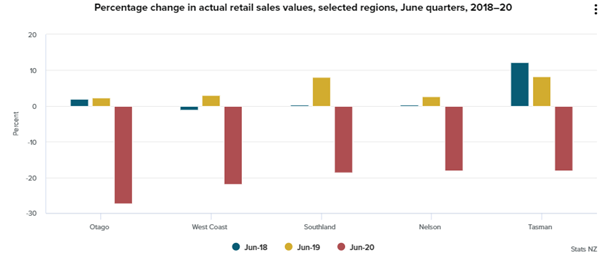
The 16 regions in NZ witnessed lower retail sales value in June 2020 quarter compared to the quarter of June 2019. Auckland region had the greatest fall (down by 13%) followed by Canterbury (down 17%), Waikato (down by 16%) and Otago (down 27%). The combined sales value for the total North Island regions declined 14% and for the total South Island dropped 20% compared with the June 2019 quarter.
Source: Stats NZ
The total value of stock held on 30 June 2020 was down by 4.2% from the stock held on 30 June 2019, to $7.8 billion. About 11 of the 15 retail industries posted falls in stock in June 2020, and the biggest fall came from motor vehicles and parts retailing (down 6.6% to $126 million), followed by departmental stores (down 8.8% to $83 million). However, the biggest rise was observed in supermarkets and groceries, up 4.3% to $32 million.
Retail statistics manager, Kathy Hicks stated that the extraordinary drop in the June quarter was not surprising, with regulations dramatically restricting market operations. She noted that during alert levels 4 and 3, non-essential companies briefly closed for about half of the quarter. For a 5 million squad, it is equivalent to each person spending around $18 a week less on eating out over the June quarter.
Ms Hicks added that there was a demand for online businesses during the lockdown, and these businesses were able to operate online under lockdown as an essential service.
She also noted that the extensive regional decline correlated with Covid-19 lockdown measures and the closure of NZ boundaries to all, but NZ people and inhabitants, with a few exceptions. The huge drop in sales for the Otago region partly represents the substantial decline in foreign visitors visiting the Queenstown Lakes zone.
