
 AUS
AUS
 NZ
NZ
 UK
UK
 CA
CA
 USA
USA
 IND
IND







Summary
- The UK’s energy mix has changed drastically over the years and 42% of electricity is now from renewable sources.
- In the UK, the biggest source of renewable energy is offshore and onshore
- The renewable energy prices have been rapidly falling since 2009. The solar cost has fallen globally by 90%.
For the first time, renewable energy produced accounted for almost half of the electricity generation in the United Kingdom between January and March 2020. As the UK government pledged to hit a target of net zero carbon emissions by 2050, the renewable energy market has grown from what it was a decade ago. The UK has been actively investing in renewable energy since 2004. The UK is in a robust position in electricity generation from several sources, particularly wind power.
The UK’s energy mix has changed drastically over the years and 42% of electricity is now from renewable sources, which is around 6% of the total energy usage, according to a research by Drax Electric Insights. Scotland produces 90% of electricity from renewable sources.
As per latest UK government data, the share of renewables in the electricity generation has risen from below 2% in 1990 to 14.9% in 2013 to 42% in 2020, helped by subsidy and falling costs, according to the UK Climate Change Committee (CCC). In 2015, by signing the Paris Agreement, the UK agreed to prevent global warming. And by its own law, the UK is now bound to achieve net zero emissions by 2050 compared to 1990 levels.
5 Promising AIM-Listed Renewable Energy Stocks
Factors affecting renewable energy production include market conditions, such as cost, diversity, demand, distribution, and resources availability; government policies, such tax credits, tariffs, and renewable standards, and other regulations.
According to government regulator for gas and electricity Ofgem, the UK government first introduced the Renewables Obligation in April 2002, which required all electricity suppliers to supply a set portion of their electricity from eligible renewables sources to its end consumers. In its 2006 Energy Review, the UK government said an additional target of share of renewables of 20% by 2020–21.
Net Zero Emissions: How UK Companies Are Trying to Achieve the SDGs
In 2012, the Green Deal was launched by the Department of Energy and Climate Change, which gave away loans for energy saving measures for properties in Great Britain to enable consumers to benefit from energy efficient improvements to their home, the Ofgem data highlighted.
The renewable energy prices have been rapidly falling since 2009. The solar cost has fallen globally by 90%, according to Department for Business, Energy & Industrial Strategy.
Biggest Source of Renewable Energy
In the UK, the biggest source of renewable energy is offshore and onshore wind. The most cost-effective way of power generation was offshore wind power, which was even cheaper than new nuclear power. Following which in 2019, the UK become one of the leading nations in the offshore wind market. The wind energy installed capacity in the country reached 24.1 GW in 2019, according to Department for Business, Energy & Industrial Strategy.
How UK Grasslands Can Help It Achieve Its Net Zero Carbon Goals
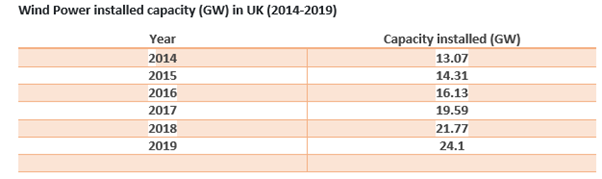
(Data Source: Statista, Government release)
Green industrial revolution
The Boris Johnson government in an attempt to become the global leader in green technologies adopted a ten-point plan to mobilise government investment worth £12 billion. It also aims to attract three times of this investment from the private sector and create, support up to 250,000 green jobs in the near future. The focus areas:
- Enhancing offshore wind power production
- Paving the way for low carbon hydrogen
- Development in nuclear power segment
- Swift shift to zero-emission vehicles
- Green ships and other means of transport
- Greener buildings
- Carbon capture and investment, usage and storage
- Ways to get green finance and innovations within the segment
The Renewable Energy industry is expected to continue to grow in the next few years with further government policy support driving the consumption and generation. The UK government is now planning to meet most of the power requirements from renewable sources. From heating homes to powering the cars, most of the power will now come from wind and solar energy, with a smaller share from tidal, hydro, and geothermal sources, stated the UK Renewable Energy Roadmap.
