
 AUS
AUS
 NZ
NZ
 UK
UK
 CA
CA
 USA
USA
 IND
IND







Summary
- FCA Chairman Charles Randell has raised concerns that there could be unexpected market disruptions in the country post the expiry of Brexit transition period on 31 December.
- One of the major issues under his radar is the cross-border derivative trading, where investors would be facing difficulties due to a divergent set of rules on either side of the border.
- The Brexit-deal negotiations are now at a risk of failure as negotiators on both sides are at loggerheads over several issues.
British watchdog Financial Conduct Authority has said that there could be unexpected disruptions in the country’s financial markets if Brexit negotiations fail after 31 December. Both sides, the EU and the UK, observe a significant amount of cross border capital market and financial transactions. They now face major bottlenecks as they would be confronting different sets of regulations if there is no trade deal after 31 December.
The scenario may not be favourable for investors as a lot of transactions would translate into increased costs and less returns. This might not just lead to a flight of capital from major European capital markets but could also lower their standing among other global capital markets.
It is not only the financial markets but there are several other sectors which would be deeply impacted by the failure of Brexit talks. The outbreak of the pandemic during this transition year has added a significant amount of complication, with many lawmakers from the EU side asking for an extension of the deadline.
FCA’s viewpoint
Before the parliamentary select committee, the FCA has stated that several issues may crop up post the 31 December and many things are still difficult to predict.
The FCA predicted an adverse impact on cross-border debts extended by British banks to businesses in the EU. A change in regulations in banking would essentially translate into difficulty in recovery of loans, which means banks would have to increase their provisions and their ability to lend would be proportionately reduced.
The chairman of the FCA said that it is necessary that both sides recognise and come to agreement that they need to have equivalent regimens.
What other sectors could be impacted?
The high technology, education, automobiles, food and beverages, and the apparels manufacturing sectors are amongst the industries that would be badly affected with the failure of these talks. The British side has got the benefit of cheap labour, materials and manufacturing facilities available in other EU countries.
On the other hand, the EU is the largest destination for goods produced in the United Kingdom. So, the imposition of new tariffs would also significantly bring down the exports of the UK, which would be very difficult to replace in the short run.
Besides, people’s movement from one country to another for jobs, education, or business would also change after 31 December. This will result in significant loss of business activities on both sides and might force the companies to scale back.
Pandemic hurdles
The outbreak of the coronavirus pandemic has become a major hurdle in the Brexit deal negotiation process.
the first few cases of coronavirus infections were detected in the UK just after few days of the country’s official pullout from the Brexit, which took place on 13 January 2020.
Soon thereafter, lockdowns were imposed in most of the countries, leading to the suspension of most official engagements across the world. Though Brexit deal meetings were held from time to time, rapidly deteriorating economic conditions in Europe delayed the talks further.
However, the complications that would crop up if a trade deal is not agreed upon the consequences would be far greater. With the second lockdown in place for a month beginning 5 November, the situation will become more complicated for the British economy after 31 December.
Stock market reaction
Let us now check out how the stock markets are reacting as the country moves closer to the due date.
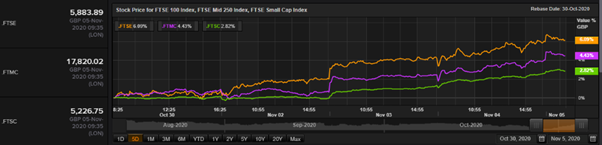
Source – Thomson Reuters (five-day comparative chart)
After the statement of the FCA chairperson on the failure of the Brexit talks on capital markets, the LSE has witnessed only a lukewarm response. On 5 November, the FTSE 100 index was trading at 5,900.70 points (9.54 AM GMT+1) gaining 0.35 per cent over the previous day’s close.
The FTSE 250 index was trading at 17,853.58 points (9.56 AM GMT+1) gaining 0.32 per cent over previous days close and the FTSE small cap index was trading at 5,230.53 points (9.58 AM GMT+ 1) gaining 0.31 per cent over the previous day’s close.
