
 AUS
AUS
 NZ
NZ
 UK
UK
 CA
CA
 USA
USA
 IND
IND







Highlights
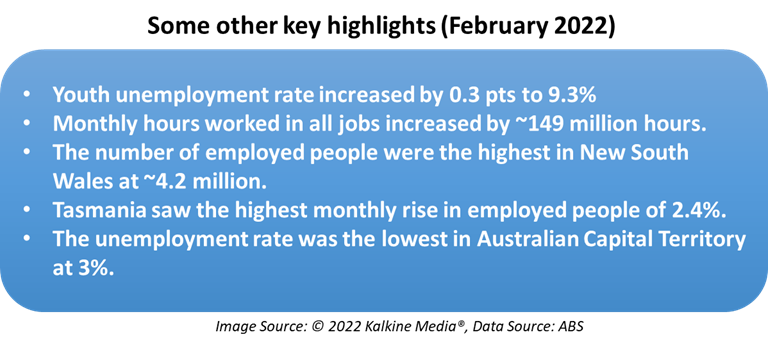
- As per ABS, the unemployment rate plunged to 4% in February 2022.
- During February, the participation rate rose to 66.4%, with the increase in participation being more pronounced for women.
- A higher than a usual number of people were on sick or casual leave during February.
After receding to trend defying levels, Australia’s unemployment rate has further plunged to a remarkable 4% in February 2022, reveals the Australian Bureau of Statistics (ABS). Australia’s jobless rate has been falling since October 2021, reaching the historic level of 4.2% in December 2021. The latest February decline has pulled the unemployment rate closer to its lowest level of under 4% seen during the 1970s.
Australia’s labour market has come a long way since the onset of the pandemic. It has been one of the first economic segments to show any semblance to its pre-pandemic state. In fact, the jobless rate has now collapsed to near 14-year low level.
Millions of Aussies to receive cash boost amid rising inflation
In February, the number of employed people increased by 77,400. This accounted for a 0.6% monthly rise and a 3% yearly rise in the number of employed people last month.
ALSO READ: Australia’s Dec Qtr property prices data out: Three points to note
Here are three crucial takeaways from the latest employment data released by the ABS.
1. Higher than usual number of people working reduced hours
ABS data showed that employment increased for the fourth consecutive month in February, reaching a total of 13.3 million employed people. The employment to population ratio also increased to 63.8% in February.
It is worth noting that an unusually high number of individuals were on sick or casual leave in the first week of January 2022, most notably due to the rising Omicron cases. This led to a large drop in hours worked in January. However, hours worked rebounded in February, rising by 8.9% on a seasonally adjusted basis after a significant fall of 8.6% in January.
Despite a recovery, hours worked were 0.5% lower than the value seen in December 2021. Additionally, hours worked in February were slightly below (0.2%) the pre-Delta period high seen in May 2021. Thus, while Omicron cases have slowly declined in number, some fear and aftereffects of the variant are still visible in February data.
IN CASE YOU MISSED: Australia’s consumer sentiment weakens in March, reveals Westpac survey
2. Women increasingly participating in labour force
The participation rate increased by 0.2 percentage points to 66.4% in February. For the male workforce, the participation rate rose by 0.2 percentage points to 70.7%. The participation rate for the female workforce also increased by 0.2 percentage points, reaching 62.4% in February. The overall participation rate was higher by 0.6 percentage points than in March 2020.

The underemployment rate fell by 0.1 percentage points to 6.6%, reaching 2.2 percentage points lower than March 2020. Additionally, the February 2022 underemployment rate was at the lowest since November 2008. For females, the underemployment rate was at its lowest of 7.9% for the second month in a row.
3. Fall in the share of underutilised labour force
The underutilisation rate, which is a combination of unemployment and underemployment rates, also dropped by 0.3 percentage points to 10.6%. This represents a fall of 3.4 percentage points compared to the March 2020 level of 14.1%. Interestingly, the underutilisation rate was at its lowest since October 2008.
During the month, full-time employment increased by 121,900 to around 9.2 million people. Alongside, part-time employment fell by 44,500 to 4.1 million people. This means that the part-time share of employment was 0.8 percentage points lower than in March 2020.
Amidst these labour market developments lies a rather concerning spillover effect of the Russia-Ukraine war. Rising inflation stemming from supply disruptions caused by the war have led many experts to believe that an interest rate hike may be on the cards soon. However, with wages growth still being lower than the inflation rate, the RBA might again defy market expectations and hold onto record-low interest rates.
ALSO READ: Federal Budget 2022-23: Key talking points that should be on agenda
