
 AUS
AUS
 NZ
NZ
 UK
UK
 CA
CA
 USA
USA
 IND
IND






Highlights
- A planetary boundary is a framework formed by environmental scientists in 2009
- Modern methods such as the use of fertilizers bring various harmful gases to the atmosphere
- About a quarter of the CO2 emissions in the atmosphere are found in the ocean in the form of carbonic acid which affects marine environments
The environment is deteriorating due to excessive consumption of natural resources and making the earth unstable. So, to ensure the livelihood of the earth for the coming years, environmental scientists have recommended nine planetary boundaries. But what is it and how is it important? Today, in this article, we will learn about aspects of planetary boundaries.
The planetary boundaries are a framework formed by environmental scientists in 2009. It consisted of nine planetary boundaries in which humanity can survive and safely operate and thrive for the coming generations.
The nine important planetary boundaries discovered by environmental scientists are the following:
- Climate change
- Biodiversity integrity loss
- Biochemical flows – nitrogen and phosphorus
- Land system change
- Freshwater use
- Ocean acidification
- Chemical pollution and novel entities
- Ozone layer
- Atmospheric aerosol loading
Also read: What plans & actions is Canada taking to tackle climate change?
Climate change
In the pre-industrial era, the concentration of carbon dioxide in the air was 280 ppm (parts per million). Now, evidence shows it is passing 390 ppm.
Due to the excessive presence of CO2, the planetary boundary limits are being crossed. The deterioration of the world’s rainforest is pointing towards the weakening of carbon sinks.
Biodiversity integrity loss
Human activities such as demand for water, food, and natural resources are affecting the ecosystem and biodiversity. Due to this, species are not only becoming endangered, but they are also becoming extinct.
Biodiversity is being lost because of rising global temperatures and human activities. So, to ensure the survival of the earth for the generations to come, humans should be involved in improving the connectivity between ecosystems, maintaining agricultural productivity, and enhancing habitat.
Biochemical flows – nitrogen and phosphorus
To increase the yield of crops, humankind has implemented modern agriculture methods. But these modern methods such as the use of fertilizers bring various harmful gases to the atmosphere. The industries that use the fertilizers and are involved in their production are liable for the emissions of greenhouse gases in the atmosphere.
Land system change
Human beings are using land for cultivation and other purposes. Forests, grasslands, and other vegetation has been converted for human use. This change of the land system is another reason for losing biodiversity, water flows, and increasing CO2 concentrations.
Also read: How is Canada affected by climate change?
Freshwater use
A United Nations (UN) agency reported that over five billion people will experience water scarcity by 2050. Human activities such as changes in river flow, vapor flows, and industrial excessive use are affecting freshwaters resources.
Ocean acidification
Over a quarter of the CO2 emissions in the atmosphere are found in the ocean in the form of carbonic acid which affects marine environments and decreases the pH of surface water. The increasing acidity in the oceans is reducing carbonate ions which are essential for various marine species such as corals, shellfish. The rising acidity in the ocean would not only affect the survival of these species but would also bring a catastrophic change in ocean ecosystems.
Chemical pollution and novel entities
Novel entities are new forms of chemicals or naturally occurring substances that can have bad geophysical and biological consequences. These entities affect the environment in the long term.
Ozone layer
The ozone layer protects the earth from harmful ultraviolet rays and if it reduces then it would cause skin cancer in humans and bring damage to terrestrial and marine biological systems.
Atmospheric aerosol loading
Aerosol particles can have a damaging effect on human health as it affects global atmospheric circulation systems. The presence of aerosol will also affect the climate by reflecting and absorbing solar rays.
Also read: The impact of climate change- warming Winter Olympics?
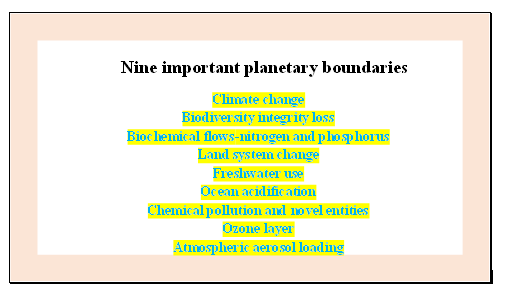
Image credit: © 2022 Kalkine Media®
Importance of planetary boundaries
The concept of the nine planetary boundaries is for ensuring the survival of humanity for the coming years. It presents a visual guide for us on what we need to do to protect the earth system.
The boundaries present a limit and warn that if we cross that limit then it will affect the livelihood of human beings and the functioning of the earth system. Countries can develop and progress well without crossing the boundaries limits.
These boundaries can help scientists in measuring and determining CO2 in the air, biodiversity loss, phosphorus and nitrogen production, and climate change limits that should not be transgressed.
Bottom line
Planetary boundaries represent specific global scales that should not be crossed. So, these planetary boundaries determine limits in which human beings can survive for future generations and crossing these limits can bring damage to the environment and humankind.
