
 AUS
AUS
 NZ
NZ
 UK
UK
 CA
CA
 USA
USA
 IND
IND








Highlights
- Stock markets are full of ups and downs, each of which affects an investor’s investment and passive income.
- A bear market refers to the market downturn, i.e., when stock prices sharply decline for a sustained period.
- A bull market, on the other hand, refers to a favourable market situation where stock prices tend to rise for a sustained period, often months or years.
Stock markets are full of ups and downs, each of which affects an investor’s investment and passive income.
In case you are a fresh investor new to the world of stock trading or are still learning the ropes, two terms you need to be familiar with are the bear and the bull market.
What is a bear market?
A bear market refers to the market downturn, i.e., when stock prices sharply decline for a sustained period. Falling stock prices can adversely affect the overall portfolio value when the market is bearish, which, in turn, hurt investors’ sentiments.
Triggered by this downward trend, Investors often trade in their stockpiles despite losses. This further crushes the overall market sentiments, which might further push down the prices and slow down the rebound in the stock market.
What is a bull market?
A bull market, on the other hand, refers to the favourable market situation where stock prices tend to rise for a sustained period, often months or years. It reflects an upward climb of the whole market.
Investors generally feel optimistic during a bull run due to favourable market conditions and add on to their portfolio value.
Also read: 5 successful stock market strategies for newbie investors
Here are key points that can help you understand the concepts of bull and bear markets.
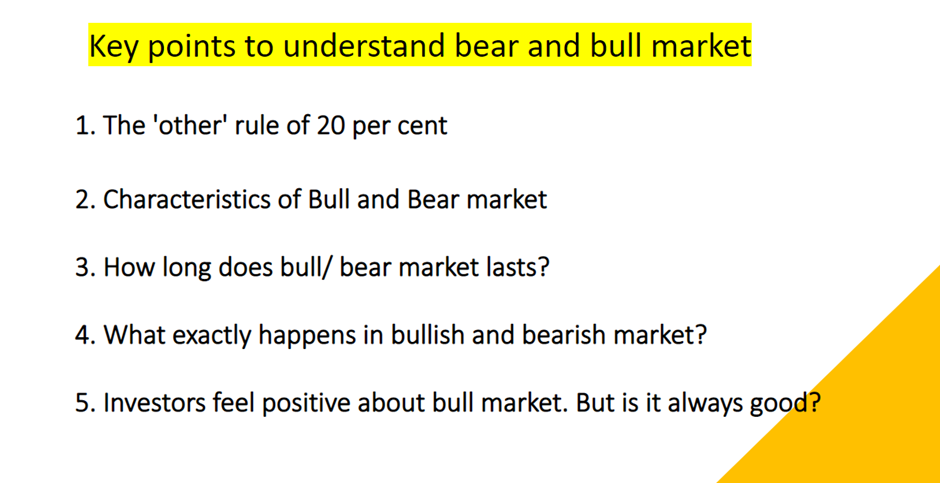
Image source: © 2021 Kalkine Media®
- The ‘other’ rule of 20 per cent
Typically, when a market notes a price drop of 20 per cent or more from its recent peak, it is deemed a bear market. In contrast, when a market sees a surge of 20 per cent or more from its lowest point, it is considered a bullish trend.
One should note, however, that bullish market trends do not mean that stock prices cannot fall. Stock prices fluctuate on a bull run too. However, positive market sentiments and investors’ confidence underpinned by strong economic growth generally help stock price recovery.
- Characteristics of bull and bear market
The bull market commonly coincides with robust economic growth, low unemployment levels and a healthy gross domestic product (GDP). Consumers can afford to pay for goods and services and are even open to new product solutions. These optimistic consumer behaviors, in turn, often help businesses generate more revenues, which can boost their stock performance.
The bear market, on the other side, is exactly opposite to the bull market.
- How long does the bull and bear markets last?
A bull market generally lasts longer than a bear market, but this does not mean that they last forever. Investors should keep in mind that bullish and bearish market trends are parts of the economic cycle.
A bearish market situation is challenging for investors as their portfolio falls in value due to falling stock prices. In contrast, a bullish market boosts their portfolio.
However, this strategy can backfire and result in losses as multiple factors can impact the stock markets.
Investors should mind that all stock prices are not guaranteed success in a bullish market.
Also read: What is Social Currency, and How Does it Affect Your Brand?
- What exactly happens in a bullish and bearish market?
Demand and supply are the two basic economic factors that influence stock price movements.
Due to strong demand and tight supply, prices tend to rise in a bull market.
On the other side, stock prices dip notably in a bull market as worried investors trade in their stocks to lessen losses.
- Investors feel optimistic about a bull market. But is it always good?
Soaring market prices are usually a green sign for investors. However, it can also cause investors to push stock prices beyond their actual worth, leading to an asset bubble.
In contrast, a bearish market can be an opportunity for some investors to invest in quality discounted stocks.
Also read: How Do I Write a Good Finance CV?
How long does a bull and a bear market lasts? Characteristics of Bear/Bull markets
Bottom line
Both bear and bull markets are parts of an economic cycle. People can fetch notable returns in a bullish market. They can also see some gains from investments made during a bearish trend in the long run based on their investment strategy.
