
 AUS
AUS
 NZ
NZ
 UK
UK
 CA
CA
 USA
USA
 IND
IND








Highlights
- Air New Zealand expects to increase travel demand following the reopening of the country's border.
- The airline intends to report a loss before other important items and taxation of less than NZ$750 million.
- Following the opening of the New Zealand border, the airline continues to observe high passenger booking activity on short-haul and international trips.
Air New Zealand Limited (ASX:AIZ) has trimmed its full-year loss prediction for the second time, citing an increase in travel demand following the reopening of the country's border.
The airline intends to report a loss before other important items and taxation of less than NZ$750 million for the fiscal year ending 30 June 2022.
This is in contrast to the airline's original loss prediction of less than NZ$800 million, which was released at the end of March.
Meanwhile, shares of Air New Zealand were trading 5.38% lower at AU$0.53 each on ASX at 12.42 PM AEST. This underperforms ASX 200 Index, which was 0.78% lower at 6,64.90 points at 12.43 PM AEST.
Following the opening of the New Zealand border, the airline continues to observe high passenger booking activity on short-haul and international trips. Domestic demand has also rebounded recently, with business-related demand reverting to levels similar to those before Covid.
New Zealand recently announced that its international borders would be fully reopened by the end of July. In April, the country welcomed travellers from its trans-Tasman neighbour Australia for the first time since mid-2021.

Source: © Foture | Megapixl.com
Recent development
On 7 June 2022, Air New Zealand announced that it had hired Kiri Hannifin as chief sustainability officer.
On 5 December 2022, she will join Air New Zealand. Kiri graduated from Canterbury University with an LLB and a BA in Political Science.
As an executive, she will see the importance of sustainability in all parts of the Air New Zealand operations and the airline's growing focus on addressing its environmental impact.
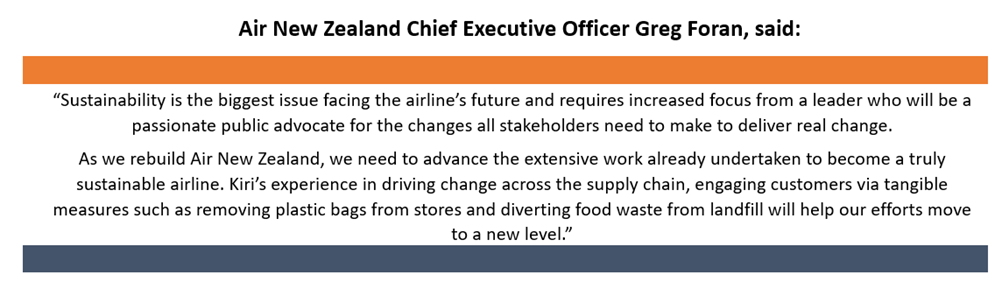
Image Source: © 2022 Kalkine Media ®
Data Source- Company announcement dated 10 June 2022
Bottomline
Meanwhile, the airline says that it is aware that the financial climate remains unstable, with disruptions from covid variants, prolonged travel restrictions in some regions, and the current conflict in Ukraine all adding to high jet fuel prices. This might impact the overall business.
Also Read: Why is Qantas (ASX:QAN) making headlines today?
