
 AUS
AUS
 NZ
NZ
 UK
UK
 CA
CA
 USA
USA
 IND
IND








Summary
- SUDA’s share price soared by ~12% on securing approval for anagrelide cancer patent in Australia.
- With the Australian Patent Office accepting the patent application, the anagrelide patent will now proceed to grant.
- The approval of the recent patent application has paved the way for the use of anagrelide in Australia.
- The grant of the Australian patent bolsters SUDA’s potential to draw considerable value from its anagrelide program.
- SUDA is in the process of developing oro-mucosal spray of the anagrelide drug to limit the unwanted side effects associated with the pill.
SUDA Pharmaceuticals’ (ASX:SUD) share price soared by ~12 per cent on 8 September 2020, following the release of an important update in relation to the anagrelide cancer patent for Australia. The Australian Patent Office has accepted the patent application for SUDA’s anagrelide, and the patent will now proceed to grant.
The Australian Patent Office will grant the patent titled “Prevention and Treatment of Metastatic Disease in Thrombocytotic Cancer Patients” to the Company. The patent has an expiry date of December 2035.
Interesting Read: Scan Through SUDA’s Key Operational Achievements in FY 2019-2020
In May this year, the Japanese Patent Office also accepted SUDA’s patent application for anagrelide cancer patent, paving the way for the use of anagrelide in Japan. In addition to the granted European patent and Japanese patent, the grant of the Australian patent bolsters SUDA’s potential to draw considerable value from its anagrelide program.
Know About SUDA’s Anagrelide
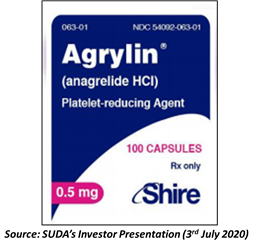
Anagrelide is a drug that is used to treat blood disorders in patients with high platelet count. The drug is approved by the Food and Drug Administration (FDA) and the European Medicines Agency (EMA).
There are multiple solid tumour types for which increased platelet levels have been found to occur in a sizeable proportion of the patient population. These tumours include mesothelioma, ovarian, vulvar, melanoma, pancreatic, endometrial, renal cell, lung, glioblastoma and colorectal cancer.
SUDA is in the process of developing an oral spray version of anagrelide for treating metastatic disease in patients suffering from certain solid tumour cancers, with the intention of improving progression-free survival or lifespan. As anagrelide has been shown to have cardiac side effects as acapsule, SUDA is creating oro-mucosal spray of the drug to limit unwanted side effects.
Recent research has revealed that platelets play a proactive role in promoting the growth and spread of cancer, besides suppressing immune responses to cancer. Moreover, it has also been demonstrated that cancer cells can trigger a negative feedback loop, releasing chemicals that signal for the body to generate more platelets and thus aid in the further development of cancer.
Potential Benefits of Anagrelide
Literature suggests that lowering the platelet count will play an important role in improving patient survival rates in case of solid tumours with higher platelet levels.
SUDA’s anagrelide not only reduces blood platelets advantageously but has also been shown to prevent cancer cell movement towards platelet-producing cells, megakaryocytes, which are primarily found in the lung and bone marrow, the two likely sites of metastases.
The preliminary data from a recently completed pharmacokinetic study at UK-based Covance Inc. also supported SUDA’s hypothesis of greater safety with the use of anagrelide as an oral spray. The data supported the assumption that an oral spray of the drug can be a safer way to deliver anagrelide for treating metastatic disease in patients with solid tumour cancers. The spray is believed to have the potential to lower the unwanted cardiovascular side effects connected with the existing commercial capsule form of the drug.
Management Commentary
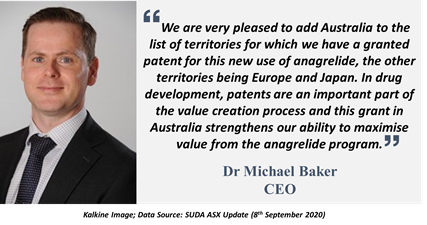
Notably, SUDA is actively progressing with the development of anagrelide formulation, backed by a highly experienced team, led by Dr Richard Franklin. The Company is also undertaking discussions with several internationally based providers for preclinical research under the anagrelide program.
