
 AUS
AUS
 NZ
NZ
 UK
UK
 CA
CA
 USA
USA
 IND
IND






Summary
- The latest study by ASX has provided a unique insight into trends shaping the markets and the COVID-19 impacts on the investor demographics.
- The study shows that more than half of the investors have invested in direct shares.
- The number of investors has increased in the last few years.
- 45% of those who started trading in the last 12 months were women.
- Next Generation investors make up to 10% of investors in Australia.
- There has seen a shift towards digital channels across investor groups.
The world is starting to reopen slowly. It's August end and nearly six months since the lockdown. Novel coronavirus (COVID-19) pandemic struck and disrupted all business and economic activities. Australian share market saw its ups and downs like any other stock exchange in the world.
Economists believe that many countries will not see a V-shape recovery and face recession. It will still be more time to see the new normal.
While, S&P ASX 200 is slowly recovering, with investors looking forward to a better future. The index has recovered ~34% since the March dip.
Economic recovery hopes are strengthened. Vaccine developments are being closely eyed at a global level. Reporting season has seen several companies beating market expectations, although overall results were not that encouraging.
The market is moving on from the pandemic effects. The Joint Ventures, Mergers & acquisitions and investments which were on pause have started to resume. Overall, it looks like investors have quickly adapted to the crisis situation.
ASX Australian Investor Study 2020
The latest study by ASX has provided a unique insight into trends shaping the investment markets and the impacts of the COVID-19 pandemic on the investors profile. Below are some key results:
- Out of 9 million current investors, 42% are women.
- Because of the COVID-19 pandemic, 28% investors changed their retirement plan. 54% made changes in their portfolios, 17% invested all spare cash.
- Over the next 12 months, 28% investors plan to buy ETFs, 57% investors plan to buy Australian shares, 17% plan to buy international shares.
- The risk appetite of investors increased between January to May 2020.
- 64% investors stated that they would accept moderate or high variability with the potential of high returns.
- 36% stated they are prioritising sustainability of dividends.
- 31% said they are placing a greater emphasis on the impact of diversification on volatility and returns.
Also read: Would You Be Interested in Investing $10000 in These Stocks: COF, ELO, NXT, SVW
Women investors on the rise
According to the Australian Securities Exchange's (ASX) Australian Investor Study 2020, women investor numbers are on the rise. Women and Gen Z numbers are almost half of the people who started investing in the last 12 months.
Since the year 1989, the ASX Australian Investor Study provides steady guidance on changing investors' behaviour. Its 2020 study gives an insight into an in-depth analysis of the investors' attitude, behaviour and the decision-making ability, especially before and after the COVID-19 crisis.
Currently, about nine million adult Australians hold investment outside their super and primary dwelling. The study shows that more than half of the investors have invested in direct shares. The number of investors has increased in the last few years.
45% of those who started trading in the last 12 months were women. This number has surged from 31% from the investors who began trading five to ten years ago.
According to the report, among the people who intend on taking trading, women numbers have increased to 51%.
The study shows these women hold fewer assets and are with less diversification because of which they may stand at more risk than men. The thought process is reflected in their preference for stable cash flow over higher return potential.
As per the study, women showed more inclination towards setting a strategy and holding on to it. They also preferred reviewing their portfolios less often and making fewer changes in response to market movements. This approach may help women in times of crisis to avoid losses, but this may also prevent them from taking due advantage of emerging opportunities.
During the coronavirus crisis, only 41% of women made changes to their portfolios, versus 63% of men.
The lack of confidence among women is also because of the lack of exposure compared to their male counterparts, stated in the study.
Also read: Coronavirus Pandemic could hit Women the hardest
Generation Next is keen on equity investment
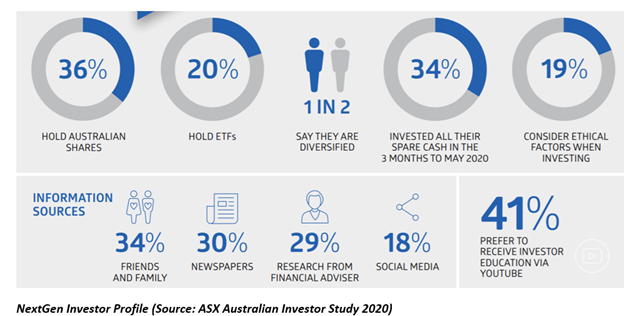
Since the last two years, younger investors have increased in the market, which has given a shift in investors’ demographics. With the increased number of women and younger Australian investors, the trend looks to accelerate in coming years.
Notably, the country's highest value individual investors are still the older Australians; they have large portfolios and increased trade volumes. Many of these highest-value individual investors execute through an SMSF, as per the study.
The Next Generation i.e. 18-24-year-old investors make up to 10% of investors in Australia. The last two years saw an increase in young investors.
Among those who started trading on a securities exchange within the last two years, a quarter is the GenNext investors. While 27% of investors planning to begin investing within 12 months are under age 25.
GenNext is distinguished from their older peers because of their investment preference and behaviour. They are risk-averse and intend to focus on generating a reliable income stream. The COVID-19 induced market led the emphasis on capital growth for GenNext.
The report suggests homeownership is undesirable or unachievable for the GenNext, making them focus on income through equity investment.
Also see: Billionaires Of Two Different Generation: Warren Buffett & Mark Zuckerberg
Bottomline
When COVID-19 struck the world, the governments and central banks immediately released various stimulus and relief packages. It may have helped the countries from falling in global depression and given a much-needed push to the industries, but overall, because of this shift, the investment scenario has transformed.
People are stuck at home since the beginning of March and have ample time in hand to find ways to keep themselves engaged. Facing a crisis is not a new feat for experienced investors, but the current health crisis is uncharted territory even for them.
The situation has disrupted the core process, and the companies are now slowly making adjustments. Now that the number of investors, mostly young and female, is rapidly increasing, perception of the amount of capital one needs to start investing has also fallen. A wide variety of Australians seeking to build wealth for the future is a fresh outlook COVID-19 has presented.
The rise of a new generation of younger investors, combined with a proliferation of online investment information and tools, has seen a shift towards digital channels across investor groups.
