
 AUS
AUS
 NZ
NZ
 UK
UK
 CA
CA
 USA
USA
 IND
IND








Highlights
- India’s RBI had previously banned banks from providing crypto services, later lifted by the Supreme Court
- The matter of the RBI banning cryptos is a part of the statement made by India’s finance minister in the country’s Lower House
- In India, cryptos presently attract income tax, similar to what their tax treatment is in countries like the US and Australia
Any news concerning the cryptoverse can have multiple layers. For example, if crypto participants like Celsius and Voyager are going for bankruptcy filings, it does not necessarily mean the investors are about to lose their funds.
The latest big news in the crypto world is India’s central bank, the RBI, favouring a ban on cryptocurrencies. Is the RBI prohibiting cryptos in one of the fastest growing major economies, which has multiple crypto exchanges operating? Are crypto enthusiasts in India about to lose their holdings? Let us explore this in detail.
Is RBI banning cryptos?
The answer is: No, it is not, at least for now. What has happened is India’s finance minister Nirmala Sitharaman has reportedly made a remark during the ongoing session of the Indian parliament. She has stated that the country’s central bank wanted cryptos banned. This owes to fears that the RBI thinks cryptos pose to the monetary and fiscal stability of the country.
In the same statement, Sitharaman recommended international collaboration that can make any regulation on “borderless” cryptoassets effective. It is notable that the RBI had on a previous occasion prohibited Indian banks from providing crypto-related services. However, this prohibition was lifted in 2020 by the country’s Supreme Court.
Cryptos and India
Cryptos have more or less the same status in India as they have in countries like the US, Australia and Canada. They are treated as tradable assets by regulating authorities and for taxation purposes.
Cryptoassets, ever since the announcement and implementation of India’s latest union budget, attract 30% income tax. It is also said that losses on cryptoassets cannot be offset. In Australia, for instance, losses incurred in any financial year can be offset against profits in subsequent years. TDS (Tax Deducted at Source) of 1% is also applicable on transfers of cryptos in India.
Crypto prices
All the noise around regulating and banning cryptos owes to a sharp dip in prices this year. Separately, major participants like Celsius Network, which claimed a high yield for crypto depositors, have suspended operations. In India, a crypto exchange Vauld was also reported to have suspended withdrawals earlier this month.
For now, cryptos have rebounded a little, with Bitcoin and Ethereum both having gained over 10% in the past one week alone. Other popular assets like Dogecoin and Shiba Inu have also appreciated in value. This might bring some hopes amid news that India’s central bank wants to ban cryptos.
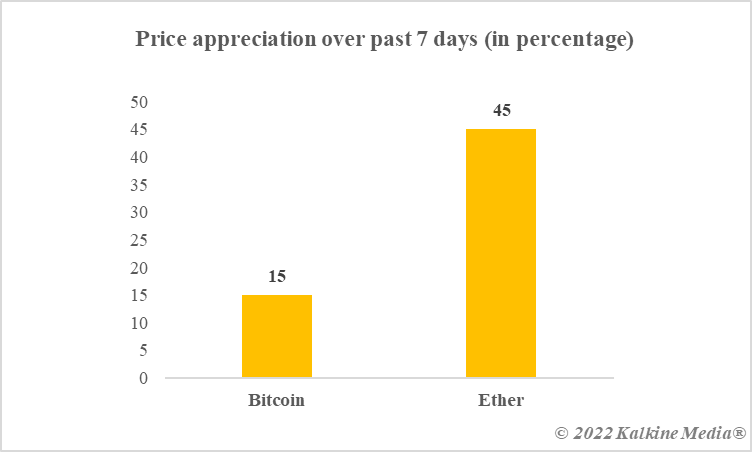
Data provided by CoinMarketCap.com
Bottom line
India’s finance minister has recently remarked in the parliament that the country’s central bank wanted cryptos prohibited. This, however, does not automatically ban cryptocurrencies, which attract a 30% income tax levy in the country. Sitharaman has called for a global effort to effectively regulate digital currencies.
Also read: What is AEX exchange and why has it suspended operations?
Risk Disclosure: Trading in cryptocurrencies involves high risks including the risk of losing some, or all, of your investment amount, and may not be suitable for all investors. Prices of cryptocurrencies are extremely volatile and may be affected by external factors such as financial, regulatory, or political events. The laws that apply to crypto products (and how a particular crypto product is regulated) may change. Before deciding to trade in financial instrument or cryptocurrencies you should be fully informed of the risks and costs associated with trading in the financial markets, carefully consider your investment objectives, level of experience, and risk appetite, and seek professional advice where needed. Kalkine Media cannot and does not represent or guarantee that any of the information/data available here is accurate, reliable, current, complete or appropriate for your needs. Kalkine Media will not accept liability for any loss or damage as a result of your trading or your reliance on the information shared on this website.
