
 AUS
AUS
 NZ
NZ
 UK
UK
 CA
CA
 USA
USA
 IND
IND







Highlights
- Bitcoin works in Australia if one looks at it as a tradable investment asset, but it is not legal tender
- Australia replaced its pound with the AUD in 1966, and since then, the Australian pound has stopped working
- Recent failures of big crypto-linked companies like FTX have ignited calls for tougher regulation for all cryptocurrencies
Did you know that the Australian pound was once the currency of the country? Even though the year 1966, when the Australian dollar (AUD) replaced the pound, was over five decades back, you can find many Australians who had witnessed the historic moment. However, many youngsters may argue that the Australian dollar has been the currency for ages and the pound never existed.
Whatever an average Australian thinks, the AUD is the currency of the country. But is it the sole currency, or has its status been challenged with the advent of cryptocurrency?
It is true that blockchain-based Bitcoin has gained popularity. It has also been declared a legal tender in a couple of countries. But does Bitcoin work in the same manner as the AUD in Australia? The answer is not as simple. The reason is while the intended utility of the AUD is its use as money, Bitcoin’s utility is a subject of debate. This is why Bitcoin and other cryptos trade as speculative assets in Australia, with very limited use in payments. It makes answering how Bitcoin works in Australia a little difficult.
Let us discuss this.
Does Bitcoin work as a currency in Australia?
The answer is no. It means that even though Bitcoin is not legal tender as the AUD is, some merchants and businesses do accept it as a mode of payment. OTR, a popular business in Australia, has declared that it would accept cryptocurrency payments at its 175 convenience stores. But this move is an exception, with most merchants across the country hesitant to accept any cryptocurrency as money.
The reason is the heavy volatility in cryptocurrency prices. Bitcoin was nearly US$47,000 when the year began, but the value has dropped by more than half. The other problem is unpredictability. In the wake of a string of failures of crypto-related companies like FTX and Terra, many regulators across the world are contemplating new stringent rules. In fact, China has banned all activities in Bitcoin or any other cryptocurrency. A few merchants might today be accepting Bitcoin in Australia, but would they accept it tomorrow lacks certainty.
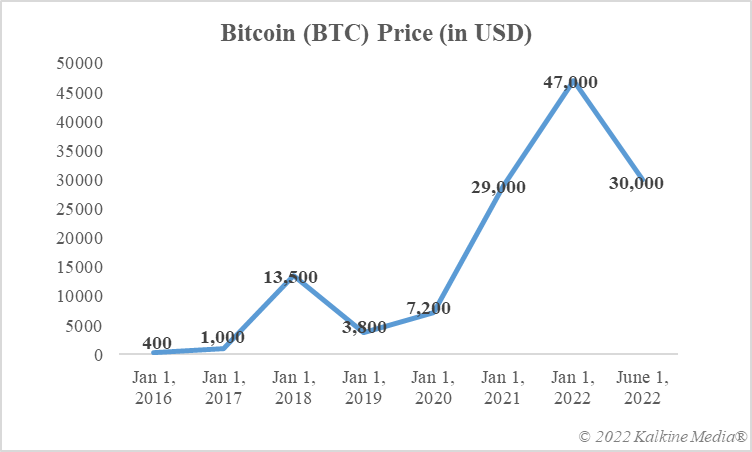
Data provided by CoinMarketCap.com
Does Bitcoin work as an asset?
The answer is yes. The Australian Taxation Office (ATO) has clear guidelines on how crypto assets, including Bitcoin, altcoins (alternative cryptos like Ether), and non-fungible tokens (NFTs), are treated for tax purposes. These assets attract CGT (capital gains tax). It clearly implies that although Australia has not allowed Bitcoin as legal tender on par with the AUD, interested people can trade it using exchange services.
Bottom line
There are two ways to answer the question -- Does Bitcoin work in Australia? No, it does not if one asks in the context of legal tender like the AUD. But the answer is yes if one asks in the context of speculative tradable asset. That said, such investments are risky, and this year, virtually all cryptocurrencies have traded in heavy losses.
Risk Disclosure: Trading in cryptocurrencies involves high risks including the risk of losing some, or all, of your investment amount, and may not be suitable for all investors. Prices of cryptocurrencies are extremely volatile and may be affected by external factors such as financial, regulatory, or political events. The laws that apply to crypto products (and how a particular crypto product is regulated) may change. Before deciding to trade in financial instrument or cryptocurrencies you should be fully informed of the risks and costs associated with trading in the financial markets, carefully consider your investment objectives, level of experience, and risk appetite, and seek professional advice where needed. Kalkine Media cannot and does not represent or guarantee that any of the information/data available here is accurate, reliable, current, complete or appropriate for your needs. Kalkine Media will not accept liability for any loss or damage as a result of your trading or your reliance on the information shared on this website.
