
 AUS
AUS
 NZ
NZ
 UK
UK
 CA
CA
 USA
USA
 IND
IND






Summary
- In May of the year 2020, the company had blown up two ancient ab-original caves in Pilbara, Western Australia leading to widespread condemnation and protests by the public and the company shareholders.
- The event led to the Australian government initiating an investigation into the conduct of the company, while the board of the company removed chief executives Jean-Sébastien Jacques while also cutting down executive bonus.
- This event has renewed the debate on corporate accountability of such companies, and their sensitivity towards cultural, social, and local issues of places they operate in.
In one of the most high-profile incidents of its kind, the CEO of Rio Tinto Jean-Sébastien Jacques had to resign from his position due to an unfortunate incident. The company had destroyed sacred aboriginal caves in Pilbara, Western Australia. They were also of great historical and archaeological importance to the country.
The caves were sitting on top of £75 million worth of iron ore. While this was not a very valuable asset for the company given the massive scale of its operations, however, Rio Tinto still went ahead with its demolition drive.
Evidence which is available suggests that the company was very much aware of the archaeological importance of this site as they had sought legal counsel just ahead of the said demolition.
Available evident pointed out that the company was aware of the site’s archeological importance and had sought legal advice before the demolition.
This disregard of local and culturally important artefacts by a corporate entity has brought forward the debate of how to fix accountability so that such an incident might be prevented in future.
A significant amount of condemnation has come from the shareholders of the company as well as the general public. It remains to be seen how the government of Australia takes any punitive action against the company.
Also Read: Rio Tinto’s Chief Executive Under Pressure to Resign in Juukan Gorge Rock Shelters Case
Corporate accountability for the environment
A company’s performance with respect to non-financial aspects such as social reforms and environmental sustainability form a part it’s corporate accountability.
For instance, all the companies that operate in a country or region are responsible for creating the least possible damage to its ecosystem and also contribute towards its development. Some of these measures include less pollution, sustainable use of resources, and respect for local laws and traditions in addition to treating people with respect.
Many countries have requisite laws in this regard and enforce them strictly. Despite this, such incidents do happen, which brings forth the need to have an international treaty so that there is greater sensitivity among corporations and people regarding such cultural and ecological sites.
A well-defined corporate accountability in such matters fixes the onus of responsibility. It also quantifies the responsibility of the top management while dealing with such sensitive issues.
More accountability needed for mining cos
There might be a case for enhance accountability measures in case of mining companies across the globe. The reason is that the mining industry, more than any other type of industry, causes the maximum amount of damage to that region’s ecology.
Sometimes, the mining activity also robs the local people of their traditional livelihood methods, rendering them poorer, in case alternate jobs are not created for them.
Mining companies more often than not end up destroying the local vegetation and use up natural resources which would otherwise be useful for the sustenance for the local people. Hence a company which seeks to operate in such an area must also provide alternative sustainable livelihood means to the local people before they can start operations. The same also goes for the local traditions, religious and archaeologically important artefacts, which need to be dealt with deep respect, as per local traditions and practices.
Therefore, keeping all these factors in mind, most countries try to put enhanced regulations on mining activities and also require them to contribute more with regard to their corporate social responsibility spending.
CSR at Rio Tinto
Despite the present controversy, Rio Tinto has a solid track record in delivering on corporate social responsibility. In the year 2019: out of the total electricity used by the company, 76 per cent came from renewable resources. Further, it became the first company in the world to be given an ASI certificate for the aluminium it produces. The company's spending on communities stood at $36 million, while it was ranked 2nd in the global Corporate Human Rights Benchmark.
On the environmental front, the company has a target of reducing its emission intensity by 30 per cent by the year 2030, with an absolute emission reduction of 15 per cent by that time. The company also earmarked an investment of $1 billion to be undertaken over a period of five years with an ultimate target of reaching next zero emissions by 2050.
The company publishes its sustainability report annually, which not only talks about what has been achieved in the past year but also outlines the company’s near and mid-term future plans. The company is one of the most respected in its field and has got several firsts to its credit in the environmental sustainability and CSR category.
The share price performance of Rio Tinto at the LSE
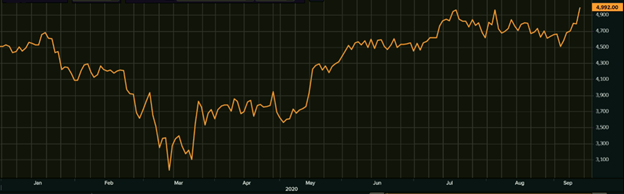
Source – Thomson Reuters
The shares of Rio Tinto Plc (LON:RIO) have been performing well at the London Stock Exchange since the beginning of the year. On 2 January 2020, the shares of the company traded on the exchange at GBX 4526.50 per share, and towards the third week of March 2020, they took a sharp turn downwards to reach a low level of GBX 2,968.00 on 12 March 2020.
The stocks turned volatile and recovered to GBX 4959.50 on 20 July 2020. However, there was another downward movement in the prices of the stock, which reached a low of GBX 4503.00 on 3 September 2020. Since then, the share price has been rising sharply again, and as of 11 September 2020, the shares of the company were quoted at GBX 4992.00 (GMT+1 16:28 PM), up by 4.35 per cent from the previous close.
Also Read: Performance Review of Two Mining Stocks – Rio Tinto & Resolute Mining
