
 AUS
AUS
 NZ
NZ
 UK
UK
 CA
CA
 USA
USA
 IND
IND







Summary
- The total public borrowings in Britain at an all-time high, having crossed the level of £2 trillion by the end of August 2020
- Monthly borrowings for August 2020 were third highest since the government records began
- Government CLBILS scheme supported 566 businesses until 20 September 2020
- EasyJet also secured loans under the government coronavirus aid, and seeks further targeted assistance
The public borrowings for the country surged to a high level of £36 billion during the month of August 2020, according to the latest government statistics. The British government has been forced to spend a large sum of money towards economic recovery as a result of the coronavirus pandemic.
This is the third highest amount of borrowings (for August 2020) since the UK monthly records were started, way back in the year 1993. Not surprisingly, the other two months when this public debt figure peaked were April 2020 (£49 billion) and May 2020 (£44 billion), after the pandemic broke across the nation.
This has put the total government debt for the UK at a bewildering amount of more than £2 trillion.
The primary reason for this trend has been an increasing gap between income and expenditure of the government. On the one hand, revenue has been falling sharply due to dropping production and sales for a large number of businesses and poor income tax collections with many people without jobs. Moreover, the temporary cuts in business rate, VAT, and stamp duty have lowered the government earnings. For instance, the central government tax collections were down by £7.5 billion during August 2020 compared to the corresponding month in 2019.
On the other hand, to support the ailing businesses and falling employment rate across various sectors, the government expenses have been rising. To this end, various business loan schemes and employment support plans have been laid out until now.
To bridge the rising gap between its spending and income, the UK government had to up its debt levels substantially. Therefore, total amount of public debt during April to August 2020 (£173.7 billion) was almost thrice the amount required during the corresponding period in the year 2019.
It remains to be seen that till how long can the British government keep on absorbing the cost of the coronavirus crisis.
An immense pressure on government finances was the main reason why Rishi Sunak did not extend his popular furlough scheme to sustain employment in his winter economy plan announced recently, which is due to expire on 31 October 2020. Instead he introduced a new jobs support scheme that would cost the exchequer a fraction of the money rolled out for the furlough scheme.
So, on the flip side, the economic recovery could get delayed with fading government support and a resurgence in the coronavirus infections across the nation. Additionally, till the time economic output levels are down, the tax collections would also be compromised.
Let now take our lens over one the popular government loan schemes offered to bail out the medium and large-sized businesses in the UK – the Coronavirus Large Business Interruption Loan Scheme (CLBILS).
CLBILS
Many businesses have got funding support under this scheme which provides a partial government guarantee to the lenders, thereby encouraging private sector borrowings. Businesses with a turnover of more than £45 million were eligible to apply under the scheme.
The CLBILS scheme expires on 30 November 2020. It is offering finance in the forms of asset and invoice finance, term loan, and overdraft facility.
By 20 September 2020, 566 organisations had availed financial assistance under the scheme worth a total value of £3.84 billion. Some prominent names in this list have included BASF SE, Bayer AG, Chanel Ltd, CNH Industrial NV, Compass Group plc, EasyJet plc, Intercontinental Hotels Group, JCB Service, Nissan Motor Co Ltd, Ryanair DAC, British Airways, and ABB Finance BV, among others.
Today, we shall take a closer look at EasyJet who availed loans under the government’s coronavirus aid scheme.
EasyJet plc
The low-cost airline flyer company had secured loanS worth £600 million from the UK Treasury and Bank of England’s coronavirus fund. It also borrowed another sum of more than £400 million from the commercial creditors to ensure enough liquidity. It is pertinent to note that the British aviation has been one of the worst affected sectors due to the pandemic.
EasyJet had to place close to 80 per cent of its pilots on the government’s furlough scheme in March 2020. Later in the month of May 2020, it laid off 4500 employees across Europe.
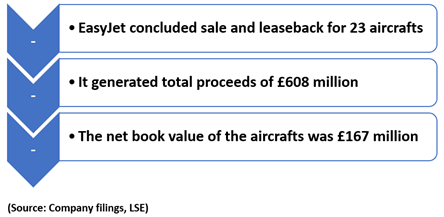
Hard-pressed for funds, the company had to sell up to 30 per cent of its aircrafts and might sell more. The airline had also closed its flying bases at Newcastle, Southend, and Stansted.
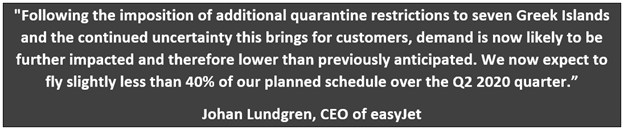
These prudent measures towards capacity reduction and cash preservation are expected to help the company survive the pandemic. Johan Lundgren, CEO, EasyJet recently said that with additional quarantine restrictions to the Greek Islands, demand for air travel would get negatively impacted.
He added that the sector required targeted support to sail through the coronavirus led crisis. Lundgren asked for a waiver of air passenger duty and air traffic control fees.
Stock performance: The company shares have lost more than 65 per cent of their value since the beginning of the year 2020. On 2 January 2020, the company stock (LON:EZJ) was trading at a value of GBX 1430.
More recently, on 26 September 2020 at 1.48 PM, the stock was trading at a value of GBX 486.20 down by 0.47 per cent from the previous close of GBX 486.20. At that time, the stock’s market capitalization was worth 2,231.22 million. It displayed a negative year to date return of 66 per cent and was providing an earnings per share of 0.89 per cent. The stock’s 52-week low/high range showed a wide gap and was recorded to be 475.00 / 1,552.00. The volume of shares traded at the time of reporting were 4,882,509.
The government of UK has tried its level best to handhold the businesses and people through the coronavirus led pandemic. Initially during March 2020, the support measures offered were large-sized, however, they are now shrinking as there is a limit to which the government can disturb its fiscal discipline. The furlough support would not be extended beyond October 2020 and the support to businesses also might reduce with time. Many large sized businesses have availed and benefitted from the government loan schemes including EasyJet, which belongs to the battered aviation sector. With tighter controls on flying to contain virus cases, the airline company seeks further government support to effectively sail through the pandemic.
