
 AUS
AUS
 NZ
NZ
 UK
UK
 CA
CA
 USA
USA
 IND
IND






Summary
- EasyJet has announced the sale and leaseback of nine of its aircrafts
- The step has been undertaken to strengthen its financial and liquidity position
- Cash proceed of $398.6 million is expected to be generated by the move
The Covid-19 pandemic has resulted in a dramatic drop in the demand for air transport and the renewed restrictions are threatening the viability of the aviation industry with thousands of jobs under threat. Though the UK government has injected a new array of loans, loan guarantees, wage subsidies, and equity injections in the aviation industry, the sector continues to suffer.
The sharp fall in demand has put the liquidity buffers of airline companies under pressure. As a slight relief, the recent drop in oil prices has lowered their operating costs. Like most of its rival companies in the sector, the travel restrictions imposed to curb the spread of Covid-19 has hit EasyJet hard. The company is planning to fly at only 25 per cent of its planned capacity ahead of the winter.
Must Read: EasyJet and IAG Stocks Soften with Slump in Demand on New Quarantine Measures
In order to raise further liquidity and strengthen its financial position, EasyJet announced on 27 October that it has engaged with a number of operating lessors, following high levels of demand from the operating lease marketplace. The FTSE 250 company has confirmed the sale and leaseback of nine aircraft with two counterparties that will help in generating a total cash proceeds of $398.6 million (£305.7 million).
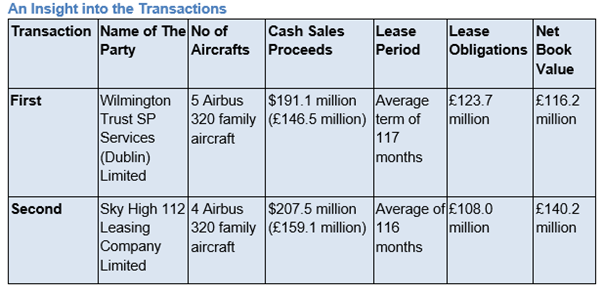
The average incremental net annual headline cost that will be reflected in EasyJet's income statement over the terms of the above mentioned nine leases will be approximately £15 million, fueled by rising interest payments and depreciation.
EasyJet will retain 152 fully owned and unencumbered aircraft, which represents approximately 44 per cent of the fleet after the completion of these two transactions.
Earlie, in June, EasyJet had executed the sale and leaseback of six A320neo aircraft with leasing firm SMBC Aviation Capital, raising $255 million (£205 million). To survive the travel slump caused by the crisis and to help boost its liquidity to 3 billion pounds, the airline company had raised 419 million pounds through an equity raise.
Though EasyJet entered 2020 with one of the industry’s strongest balance sheets, rising infections, lockdowns and travel restrictions across Europe punctured their dreams to stay profitable. The impact was so bad that the airline reported its first-ever annual loss, scrapped dividend payments and reduced its winter schedule.
Fiscal balance
On 8 October, easyJet released its trading update for the September quarter recording the total revenue of £620 million. It was £2.28 billion in Q3 2019. The cash position of the company stood at £2.3 billion and net debt recorded £1.1 billion as on 30 September.
The group headline loss before tax for Q4 2020 is expected to be lower than Q3 2020. The headline loss before tax of the company for FY 2020 is expected to be in the range between £815 million and £845 million.
Operational Highlights
During this quarter, the company flew 38 per cent of planned capacity, recording a decline of 61.5 per cent to 66,533 flights (30 September 2019: 172,739 flights). The passengers flown by the company during the quarter stood at 9.36 million (30 September 2019: 28.02 million passengers), registering a fall of 67 per cent.
Also Read: Easyjet Request Government for Urgent Help, Annual Loss Could Mount Over £800 Million
Stock Performance
EasyJet plc (LON: EZJ) stocks traded at GBX 490.80 on 28 October 2020 at 10:07 AM, which was down by 2.62 per cent from its previous close of GBX 504.00. The 52-week low/high price was reported to be GBX 475.00/1,552.00. It had a market capitalisation (Mcap) of £2,302.02 million. The company recorded a negative return on price which was 64.76 per cent on a year-to-date basis.
On the other hand, British Airways is focusing on customer satisfaction by bringing back hot food on their long-haul flights. British Airways had stopped providing hot meals in all classes except for the first class. However, EazyJet’s Marks and Spencer buy onboard menu will not be returning to the economy cabin on short-haul flights because Greggs and Waitrose are being considered by the airline as a replacement.
Stock Performance
International Consolidated Airlines Group PLC (LON: IAG) stocks traded at GBX 94.22 on 28 October 2020 at 11:35 AM, which was down by 2.20 per cent from its previous close of GBX 96.36. The 52-week low/high price was reported to be GBX 91.00/671.00. It had a market capitalisation (Mcap) of £4,784.99 million. The company recorded a negative return on price which was 84.85 per cent on a year-to-date basis.
Marks and Spencer Group PLC (LON: MKS) stocks traded at GBX 92.66 on 28 October 2020 at 11:38 AM, which was down by 0.86 per cent from its previous close of GBX 93.46. The 52-week range was reported as GBX 85.04 and GBX 228.90 respectively. It had a market capitalisation (Mcap) of £1,825.64 million. The company recorded a negative return on price which was 56.71 per cent on a year-to-date basis basis.
The hospitality, travel and leisure industries have been the worst affected sectors due to the pandemic. The situation has worsened with the onset of the second wave of infection, new restriction measures implemented in October. Most airline companies have been affected negatively. Let’s hope the vaccine will hit the market soon so that the companies can bounce back faster.
