
 AUS
AUS
 NZ
NZ
 UK
UK
 CA
CA
 USA
USA
 IND
IND





Summary
- Pubs & Eateries might be asked to make check-ins mandatory
- The hospitality sector is awaiting specific guidelines from the Government for reopening
- The stringent measures announced by the Government might come at incremental costs for the consumers
Customers visiting pubs & eateries could be asked to check in upon arrival. This could be done as a measure to improve tracking and tracing of infected people. The rate of infection, which is close to one is constantly being monitored by the government as it prepares for lockdown easing in the hospitality sector (Food & Drinks).
The Leisure and hospitality industry has been among the worst hit sectors during the lockdown induced by the pandemic. According to the British Beer and Pub Association (BBPA), nearly 47 thousand pubs in UK were closed in March due to shutdown caused by coronavirus induced lockdown. Brewery businesses are incurring £100 million in costs every month in cash during lockdowns, according to BBPA. The beer sales plunged by 7.2 per cent in the first quarter of 2020 as compared to the same period previous year. To make things worse, the new two-week quarantine regime introduced by the British government has been deterring foreign travellers from visiting the bars and pubs.
However, the idea of mandatory check-ins was not appreciated by the trade bodies. As the industry is not equipped to handle customer’s personal data. Moreover, the data could make customers vulnerable to identity theft, potential unlawful and criminal activities. In addition, the implementation of this feature would come at an additional cost for the business.
The sector is already burdened with weakened consumer confidence, additional costs due to increased sanitisation, and protective gear. The idea is being worked upon as the sector prepares for lockdown easing from first week of July. Many customers might not like sharing their personal details with the eateries & pubs, which could be detrimental for the business. However, there are some businesses which are already handling customer’s data as they have advance booking mechanism in place.
Moreover, the social distancing rule is likely to be relaxed in the hospitality sector reopening plans. With the present social distancing norms in place, the trading would not be profitable for businesses. The decision is under review and is eagerly awaited by the businesses.
In many countries, technology is used to track people movements. People are required to scan codes to enter a public place. These public places are supposed to maintain a digital log of customers. This system make contact tracing easy in case somebody gets infected.
In the prevalent conditions, the businesses are taking precautions to reduce costs. They could opt for a simple approach of collecting their customers contact details at the public places. The guidelines which are expected to be rolled out on 4th July are likely to include seating arrangement as a focal point. The businesses would have to ensure social distancing guidelines are met. Parking spaces could be used to make people seated if required. The pubs & restaurants could ask their customers to place orders through mobile applications as well.
UK cannot afford to be complacent in terms of the reproductive rate of virus. According to some media reports, some nations are witnessing a second wave of novel coronavirus. History suggests that the maximum amount of carnage is caused during the second wave of the pandemic.
Let us discuss a few businesses operating in this sector.
- J D Wetherspoon Plc (LON:JDW)
J D Wetherspoon Plc is the United Kingdom-based company which owns pubs, restaurants, and bars. The company’s revenue was up by 5 per cent on like-for-like basis to £933 million in the first half of the fiscal year 2020. The company’s profit before taxation was up by 15.2 per cent to £57.9 million in the first six months of the fiscal year 2020. The company has cancelled its dividend pay-out to preserve cash.
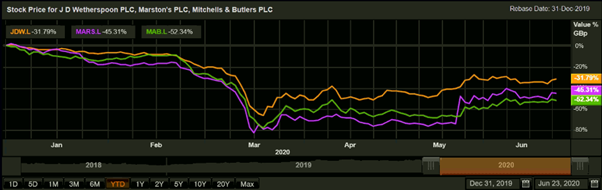
On 23rd June 2020, at the time of writing (before market close, GMT 01:45 PM +1), J D Wetherspoon Plc shares were 3.32 per cent up against its previous day closing price and were trading at GBX 1,151.00. Stock's 52 weeks High and Low is GBX 1,734.00 /GBX 559.50. The beta of the company stood at 1.43, reflecting higher volatility as compared to the benchmark index. J D Wetherspoon Plc’s total M-Cap (market capitalisation) while writing stood at £1,341.03 million. The stock has plummeted by more than 30 per cent on the YTD basis.
- Marston’s Plc (LON:MARS)
Marston’s Plc is a United Kingdom-based company which is into the business of brewing and managing pubs. Marston’s had secured an additional GBP 70 million to wither through the crisis induced by the pandemic and has stopped dividend pay-outs.
On 23rd June 2020, at the time of writing (before market close, GMT 01:53 PM +1), Marston’s Plc shares were 0.14 per cent up against its previous day closing price and were trading at GBX 70.35. Stock's 52 weeks High and Low is GBX 131.40 /GBX 22.20. The beta of the company stood at 1.57, reflecting higher volatility as compared to the benchmark index. Marston’s Plc’s total M-Cap (market capitalisation) while writing stood at £445.42 million. The stock has plummeted by more than 45 per cent on the YTD basis.
- Mitchells & Butlers Plc (LON:MAB)
United Kingdom-based Mitchells & Butlers Plc is into the business of pubs and restaurants. The company’s like-for-like sales increased by 3.5 per cent in the first quarter of 2020. The group’s performance was negatively impacted by the outbreak of COVID-19. Currently, the group has a strong balance sheet with enough liquidity.
On 23rd June 2020, at the time of writing (before market close, GMT 01:57 PM +1), Mitchells & Butlers Plc shares were 1.34 per cent down against its previous day closing price and were trading at GBX 221.50. Stock's 52 weeks High and Low is GBX 470.50/GBX 100.80. The beta of the company stood at 1.53, reflecting higher volatility as compared to the benchmark index. Mitchells & Butlers Plc’s total M-Cap (market capitalisation) while writing stood at £963.56 million. The stock has plummeted by more than 50 per cent on the YTD basis.
Stock price comparative chart: JDW, MARS, and MAB
(Source: Thomson Reuters)
