
 AUS
AUS
 NZ
NZ
 UK
UK
 CA
CA
 USA
USA
 IND
IND








Summary
- CMV is struggling to raise finances amid the coronavirus crisis
- Travel companies are reducing costs and axing jobs to preserve cash
- The sector is under immense pressure from refund seeking customers
The British cruise line company CMV (Cruise and Maritime Voyages) failed to secure a £25 million loan under the coronavirus business interruption loan scheme (CBILS). The management of the company is now chalking out a plan to secure funding, which could help the company in seeing through an unprecedented crisis. This scheme and other similar schemes backed by the British government were launched to support UK businesses remain afloat through the unseen crisis.
The travel sector has been among the worst-hit sectors during this unprecedented crisis induced by the novel coronavirus. As the nations across the globe underwent lockdown, travel restrictions were imposed to contain the spread of the deadly virus. The travel industry had never ever imagined such a scenario. The sector witnessed major job redundancies across segments of airlines, cruises, and other dependent sectors such as hospitality. The sector is under immense pressure from refund seeking customers.
The sudden drop in confidence of the travellers has brought many related businesses on the verge of collapse, and many are likely to go into administration. Major cruise ships such as Carnival plc were making the headlines as travellers got infected with the deadly virus while travelling. Industry experts strongly believe that the holiday business would take a lot longer time to recover from the devastation caused by the novel coronavirus.
Since the start of the year, Carnival Plc has lost a lot of market capitalisation which could result in its exclusion from the London’s broader equity benchmark index, FTSE 100. Cruise line, P&O Cruises owned by Carnival Plc would not commence operations until October due to the pandemic. The cruise line is currently implementing necessary health & safety measures which would help in restoring confidence among the travellers.
Since March, none of Carnival’s cruise lines has sailed due to the novel coronavirus. The Cruise company axed nearly 450 jobs in the United Kingdom last month. In addition, the remaining workforce would undergo a 20 per cent pay cut until November in the UK. The company has raised £5 billion by issuing fresh debt and equity in April. The company also accessed a £25 million loan under Covid-19 Corporate Financing Facility (CCFF) launched by the British government.
Due to lessened demand, Easyjet Plc had earlier announced to axe more than 4,000 jobs. The company was expected to reduce its fleet size by nearly 50 planes. These measures are taken by the company to ensure liquidity and sustainability. The airline company has resumed its operations on 15th June with enhanced safety protocols. Since the start of the year, Easyjet Plc has lost a lot of market capitalisation, which could result in its exclusion from the London’s broader equity benchmark index, FTSE 100. The company’s finances were further dented with high parking charges due to most of its fleet being grounded during the novel coronavirus.
Axing jobs and other cost reduction measures have become a common phenomenon across the industry. Moreover, the introduction of a new quarantine regime is expected to cause further carnage to the battered travel industry. Incoming travellers in the UK have to undergo a mandatory quarantine period of two weeks. Industry experts believe that this move by the government would be detrimental for the sector as it will discourage people from travelling. Some of the prominent airlines in the UK are seeking legal action against this new quarantine regime.
Here we would discuss some businesses from the travel industry and their share price performance-
- Carnival Plc (LON:CCL)
Carnival Plc has taken several actions to reinforce liquidity, such as a reduction in planned capital expenditure and non-priority operating expenses, while they are pursuing additional financing options. The Group reported a strong start of wave season with booking volumes for the three weeks ending January 26, 2020, remaining higher than the previous year. Moreover, Carnival has a resilient business model, which could help the company in staying afloat during this unprecedented crisis.
The cruise line operator has achieved a growth of 7.29 per cent on CAGR (Compounded Annual Growth Rate) basis, as its revenue grew from US$ 15,714.00 million in FY15 to US$ 20,825.00 million in FY19.
Carnival Plc’s shares were lower by 1.15 per cent versus its previous day closing price; at GBX 1,246.50 on 19th June 2020, at the market close. The stock’s liquidity looks strong in terms of buyers and sellers as the volume was floating around 1,472,316 at the time of writing. The stock's 52 weeks High and Low was GBX 4,037.00 /GBX 581.00. The market capitalisation of the company at the time of reporting stood at £11.07 billion.
- International Consolidated Airlines Group SA (LON:IAG)
British Airways owner, IAG has a robust balance sheet along with adequate liquidity to see through the unprecedented crisis and has access to £300 million CCFF facilities from the UK Government and extended RCF (Revolving Credit Facility) to boost liquidity. The Company is chalking out plans to improve its cash flows and reduce its operating costs.
International Consolidated Airlines Group’s shares were higher by 0.93 per cent versus its previous day closing price; at GBX 271.50 on 19th June 2020, at the market close. The stock’s liquidity looks strong in terms of buyers and sellers as the volume was floating around 27,962,926 at the time of writing. The stock's 52 weeks High and Low was GBX 671.00 /GBX 168.20. The company’s market capitalisation at the time of reporting stood at £5,342.79 million.
- EasyJet Plc (LON:EZJ)
The low-cost airline reported an increase of 9.6 per cent in revenue per seat to GBP 55.60 in the first half of the fiscal year 2020. Recent Coronavirus outbreak had impacted the growth of the Company in the short terms and could further mount pressure on its revenue and profitability in the times to come. The company has launched attractive schemes to lure customers such as easyJet holidays.
EasyJet Plc’s shares were lower by 0.65 per cent versus its previous day closing price; trading at GBX 798.00 on 19th June 2020, at the market close. The stock’s liquidity looks strong in terms of buyers and sellers as the volume was floating around 10,533,208 at the time of writing. The stock's 52 weeks High and Low was GBX 1,552.00/GBX 475.00. The market capitalisation of the company at the time of reporting stood at £3,190.38 million.
Stock price comparison chart of CCL, IAG, and EZJ
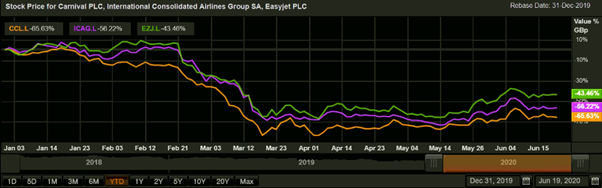
(Source: Thomson Reuters)
