
 AUS
AUS
 NZ
NZ
 UK
UK
 CA
CA
 USA
USA
 IND
IND








Summary
- On 19 March 2020, NZ closed its borders for almost all non-citizens or residents and pursued an approach of going tough and early to halt the coronavirus spread.
- NZ announced that it would allow 250 international students to continue their postgraduate studies in the country by reopening its borders, with the first batch to arrive in November and the rest of them, by next year.
- As per the Education Minister, the new exception was a balanced decision that identified the vital role of international education in the recovery and rebuilding of NZ and the fight against coronavirus.
- The new border exception decision was also appreciated by Grant McPherson, Chief Executive of Education NZ, who termed it, as a sensible step on the path to recovery.
On 16 March 2020, Prime Minister Jacinda Ardern imposed a mandatory self-isolation, on arrival to NZ, unless people were coming from mostly unaffected Pacific island countries.
Some days subsequent to it, the country closed the borders of NZ entirely for almost all non-NZ residents or citizens to halt the spread of COVID-19, imposing one of the strictest lockdowns in the world.
Coronavirus has infected more than 1, 800 people and killed 25 people in NZ, as on 14 October 2020.
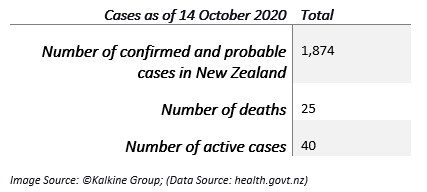
NZ’s strategy of going tough, with an early imposed lockdown helped the country to stop community transmission. The strict and an early response of NZ to the pandemic received an international appreciation all over the world.
INTERESTING READ: Is the Australia New Zealand travel bubble a viable solution?
After 102 days of being coronavirus free, the country witnessed another virus outbreak in the Auckland city by 11 August, which pushed the city into Alert Level 3.
Nonetheless, NZ revoked coronavirus restrictions on its largest city, Auckland on 7 October after the city did not report any positive case in 10 days.
ALSO READ: How Are Global COVID-19 Numbers Stacking Up Now, After more than 6 Months Into Pandemic?
The country is now at Alert Level 1 and people are still encouraged to wear face masks on public transport, and at places where maintaining physical distance is challenging.
As NZ recovers from the virus, the country has started to relax its border restrictions.
NZ permitted border exceptions for international postgraduate students
The NZ government has formed a new category that will permit 250 International students to continue with their postgraduate studies in NZ. The country has now allowed students to carry on their studies as a part of the latest coronavirus border exceptions.
Education Minister Chris Hipkins stated that the exception was a balanced decision keeping in mind the role of international students in NZ recovery. The step will enable the country to bring back a good number of PhD, as well as Masters’ students caught offshore and who needs to be in NZ to complete their work.
ALSO READ: How are NZ Educational Institutions Bracing for 2021 Calendar?
He stated that the health, safety, and wellbeing of people in NZ is the top priority of the government. He also added that the tight border restrictions are critical in safeguarding kiwis against coronavirus and in ensuring that they can return home.
Mr Hipkins also informed that the government had granted about 10,400 exceptions for essential health workers, critical workers, and family of NZ citizens.
Some of the details of the arrival of international students included of the following:
- Students who currently have or had visa for 2020, and whose long-term commitment to study in NZ was interrupted by coronavirus would now be able to come back.
- Precedence will be given to students who need to be in the country for practical modules of their research and study.
- All students will stay in managed isolation for 14 days and will be charged for the stay as well.
- The first batch of students are likely to arrive in November 2020, with the majority of students coming in the new year.
Mr Hipkins also stated that the number of international students who are being granted exceptions is a tiny proportion compared to the numbers the country is used to.
He also acknowledged that students of other international education providers like schools and Private Training Establishments would be dissatisfied, as their students are not a part of the border exception group.
ENZ embraced a commitment to international education
Grant McPherson, Chief Executive of Education NZ, appreciated the decision to allow a small portion of international students to enter the country, as a signal of continuous and robust pledge towards international education.
He stated that international education is significant to NZ and will play a vital role to reconstruct and recover from coronavirus.
Education NZ is the government agency in charge of international education to give social, cultural, and economic benefits to NZ.
Mr Hipkins had announced a long-term strategic recovery plan in July, backed by $51.6 million investment from the COVID recovery and response fund to assist in steadying the international education sector in NZ.
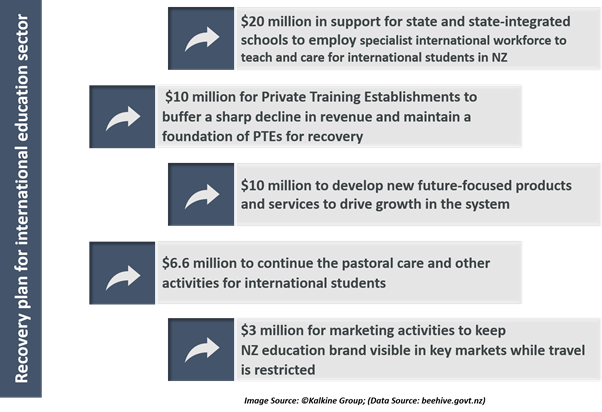
As per Mr Grant, international education was the 5th largest export earner of NZ, adding roughly NZ$5 billion a year to the economy and produced about 45,000 jobs before COVID-19.
Mr McPherson specified that the government has taken a sensible first step towards recovery. He stated that while NZ welcomes what international students contribute to the country, the nation globalises students’ thinking, provides the skill to work across different borders and cultures and enable them to be a part of revolutionary international research.
