
 AUS
AUS
 NZ
NZ
 UK
UK
 CA
CA
 USA
USA
 IND
IND







Summary
- The pandemic has left major impact on Canada’s struggling retail industry
- Consumer behavior has changed forever, and rules of retail are being rewritten by the new normal
- After historic declines in March and April, May retail figures are up 18.7 percent month-on-month. Early flash estimates for June suggest that retail sales are further up 24.5 percent.
- Expect a COVID-19 hangover as consumers continue to spend with caution, warns Deloitte Canada.
The retail sector in Canada was already struggling, but the ongoing pandemic has left it in dire straits. A wave of bankruptcies, closures and consolidations are coming forth, confirming fears that the consumer-driven retail industry won’t be the same anymore. The industry was already in the midst of a fierce battle with its online counterpart and the pandemic has simply accelerated it.
After historic declines in March and April, retail figures show there’s respite on the horizon.
Retail sales are up 18.7 percent to C$ 41.8 billion between April to May, latest data by Statistics Canada (StatsCan) reveals. Auto sales led this growth, jumping 66 percent. Numbers are up in almost every subsector in May, except food and beverage stores. Early flash estimates for June suggest that retail sales are further up 24.5 percent month-on-month.
Among provinces, Quebec recorded the highest percentage advancement, followed by Newfoundland and Labrador and Manitoba as shown below:
Retail sales in Canadian provinces, % growth from April to May 2020
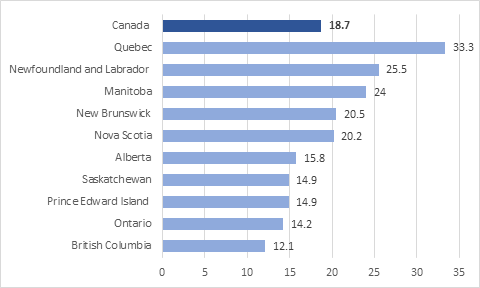
Source: StatsCan
Retail e-commerce has continued to post gains amid pandemic, recording 112.7 percent year-on-year growth in May 2020. Online sales touched C$ 3.8 billion in May, accounting for 8 percent of total retail trade, adds StatsCan.
Retail e-Commerce Sales
|
|
May 2019 |
April 2020 |
May 2020 |
May 2020 |
|
millions of dollars |
millions of dollars |
millions of dollars |
year-over-year |
|
|
Retail trade sales |
57,707 |
34,869 |
46,171 |
-20% |
|
Electronic shopping and mail-order houses sales |
1,410 |
2,061 |
2,208 |
56.6% |
|
Retail e-commerce |
1,808 |
3,629 |
3,846 |
112.7% |
|
Retail e-commerce (percentage of total retail trade) |
3.06 |
9.83 |
7.95 |
Not Applicable |
Source: StatsCan
Though receipts picked up in May, retail sales remain 20 percent below February levels, adds StatsCan.
In last two-three months, major Canadian retailers have announced store closures and restructuring. Some of these companies are Aldo Group, Starbucks, Scholar’s Choice, Reitmans Canada, DavidsTea, Mendocino Clothing Co., The Children's Place, Bestseller Canada (company that operates Jack & Jones and Vero Moda), Victoria's Secret, Bath & Body Works, Henry’s and many more.
The economic and financial fallouts of the novel coronavirus has fundamentally changed the outlook for retail spending. And industry pundits fear, more is yet to come.
Retail in post-pandemic world
The retail industry, just like the rest of the world, will never be the same after this pandemic. It will take at least a year or more to emerge from this crisis that has pushed the Canadian economy to depths not seen since the Great Depression of 1930s. Despite the continued support from federal government and central bank, the Bank of Canada says the economy is not likely to recover before 2022.
Consumer behavior has changed forever, and people are slashing discretionary spending. A recent study by Deloitte says Canadians spent an average of C$ 250 on goods because of the coronavirus impact. About 44 percent now focus on buying essentials while 72 percent plan to cut spending on apparel and footwear.
Store visits have dropped amid coronavirus flare-ups and retailers planning their survival path in this new normal face stiff competition from e-commerce and online stores.
As phase of “next normal” takes shape, management consulting firm McKinsey says consumer behavior will observe clear effects in five key areas, which are likely to “stick” in the long run. These are:
- Spending only on essentials and seeking value across purchases
- Shift from brick-and-mortar stores to digital and omnichannel
- Struggling with limited access, consumers experiment with new brands and places to shop, causing a “shock to brand loyalty”
- Renewed focus on health and companies’ action in the face of pandemic. Consumers are noticing how firms treat their employees.
- The stay-at-home economy or “homebody economy” to guide the future markets.
Building a better omnichannel experience in a post-pandemic world will be critical. World’s largest retailer Walmart has already announced an investment of C$ 3.5 billion in Canada to stay on top of these tectonic shifts in consumer behavior and upgrade its e-commerce and physical stores.
Retailers with brick-and-mortar operations can no longer afford to be in a wait-and-see mode, says Harvard Business Review.
Apart from complying with health and safety regulations and meet basic customer expectations, retailers need reimagine their baseline requirements and take their in-store experiences to the next level so that customers are compelled to visit, adds the HBR write-up.
In short, it is time for retailers to get a face-lift and present their caring attitude. Companies need to prove that they care about more than the bottom line.
Retail Stocks
The renewed momentum in May retail sales figures presents the country’s slow emergence and economic recovery. Led by gains in e-commerce, Canada’s online retail brands such as Shopify have posted remarkable returns, doubling its stock value in last three months. The consumer staples index on the Toronto Stock Exchange has also advanced by 5.5 percent in a month and posted a similar increase in year-to-date figures. Retail, as a sub-sector of consumer staples and e-commerce, is also likely to benefit under these progresses.
Here are two hot stocks from retail industry:
Metro (TSX:MRU)
One of the largest retailers in Canada, Metro shares has advanced by nearly 10 percent in 2020 and posted gains of over 280 percent in a decade. The brand has chain of food and pharmacy stores and recently acquired drugstore company Jean Coutu. Demand for Metro’s products has been mostly stable even during the pandemic-led market crash in March this year.
The company posted net earnings of $ 176.2 million, up 45 percent from corresponding quarter of 2019, and announced a quarterly dividend of $ 0.225 per share. It has a current market capitalization of C$ 14.7 billion.
Loblaw Companies Ltd (TSX: L)
Shares of Loblaw posted nearly 5 percent growth this year. The company is currently paying C$ 0.315 quarterly dividends. In the first quarter, Loblaw’s net income is up by 30 percent and revenues by 10.7 percent, compared to 2019. Retail segment sales is also up by 10.8 percent, generating C$ 1.1 billion in free cash flow.
Loblaw is among the largest grocery, general merchandise, and pharmacy retailers in Canada. It has a market cap of C$ 24.7 billion. The company will announce its second quarter 2020 results on July 23, 2020.
Expect a COVID-19 hangover, says Deloitte Canada, as consumers continue to spend with caution and focus on value-add products rather than discretionary spending.
The shift from physical to online mode was already in progress and has only been accelerated with the pandemic. With the rise of e-commerce, there is room for growth and brands need to think beyond to ensure customer loyalty.
