
 AUS
AUS
 NZ
NZ
 UK
UK
 CA
CA
 USA
USA
 IND
IND


.jpg)




Summary
- NAB published its monthly business report showing a 7-pt increase in business conditions alongside a 9-pt reduction in business confidence.
- The employment component under business conditions was the driving force behind its gains.
- State-wise results showed varying levels of improvement with South Australia, Western Australia and Queensland leading the way overall.
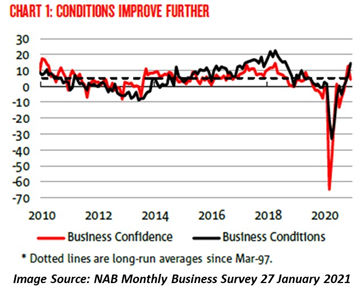
The monthly business report published by NAB shows an increase in business conditions during December 2020. Business conditions reached 14 pts, the highest level since late 2018, marking four continuous months of increase.
However, the same was not true for business confidence, which sank 9 pts from the previous month, down to 4 index points in December 2020. Subsequently, Australian share prices fell in the afternoon yesterday following the report. The recovery in business conditions had various factors leading to it. Among its components, trading and employment contributed to the growth in business conditions, increasing by 5pts and 13pts, respectively. However, profitability component showed a decline of 2 pts from previous month.
Employment-Driven Growth
In a major highlight of the NAB report, employment conditions bounced back to positive numbers for the first time since the pandemic. Employment component under business conditions was levelled at -4 pts in November 2020, moving swiftly up to 9 pts in December 2020.
A rise in the employment index reflects increased job growth, as more businesses are reporting higher employment figures in the month. The rise in employment and trading conditions was more than enough to compensate for a 2 pts decrease in profitability during the month.
Labour Market showed significant recovery with almost 90% jobs that had been lost during the pandemic being recovered to date. This could further strengthen household activity as well. However, employment might take another 2-3 years to fully return to the pre-pandemic levels.
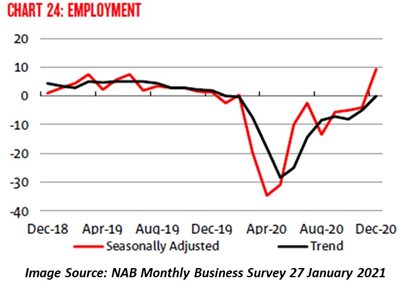
Employment touched the horizontal zero mark in December, after almost a year of negative values. It plunged significantly during April 2020, when it reached a value less than -30 pts.
Improvements in other Indexes
Capacity utilisation swinged high during December 2020, rising to 80.9%. The index is back to its pre-pandemic level after taking a steep incline in its course. Forward orders also increased, rising above the zero mark in December.
Industry-wise, mining saw huge gains in the month, followed by finance, property and business services, retail, and wholesale. These industries showed conditions of 28 basis points or higher. Gains were not so apparent in the transport and utilities industry. The worst of the lot were wholesale, recreational & personal services and retail, which saw the biggest losses. Recreational and personal services continue to stay in the negative territory.
Among the industries, confidence reduced in all, except for mining, construction and transport and utilities. Due to their poor conditions, recreational and personal services recorded the lowest business confidence during the month.
State-wise results are varying for different indexes. South Australia and Western Australia dominate in the employment sphere as the values have remained positive for past four months. Overall conditions are highest in SA, WA, and Queensland with conditions equal to 17 pts or above.
The fall in business confidence was led by Victoria, which saw a 15-point decrease, followed by a 10-point decrease in NSW and Queensland. Victoria suffered greatly due to the Sydney’s COVID-19 outbreak through December.
