
 AUS
AUS
 NZ
NZ
 UK
UK
 CA
CA
 USA
USA
 IND
IND


.jpg)





Summary
- Canada’s “resilient financial system” and focused responses by the authorities have saved the country from broad financial stress, said Bank of Canada’s Deputy Governor Toni Gravelle in a recent speech.
- He added, however, that Canada’s households, businesses and markets continue to be under COVID-related financial risks.
- Moody’s Investors Service recently upheld Canada’s AAA credit rating and said it has a “very high degree of resilience”.
The onset of the COVID‑19 pandemic earlier this year triggered major concerns among central banks all around the world. The outbreak of a pandemic at this level and subsequent governments measures to contain its spread would weigh down on countries’ financial backbone and, in turn, the economy.
The Bank of Canada (BoC), in a recent official release, reiterated concerns it had previously voiced during the onset of the pandemic, highlighting situations such as heightened household debt and “overheating housing markets”. But Canada’s “resilient financial system” and focused responses by the authorities saved the country from broad financial stress, it added.
Speaking on the matter, Bank of Canada’s Deputy Governor Toni Gravelle pointed that the central lender acted swiftly to stabilize market functioning. The Canadian government, meanwhile, put in place a series of programs to aid households and businesses suffering financially due to the pandemic.
However, Gravelle stressed that all is not won yet because the full impact of mortgage deferrals that are coming to an end will not be seen till 2020- end or early-2021.
Canada Household Debts ‘Lower’, But COVID Risk Remains
The risk of financial crisis for Canada’s households and businesses increases with the duration of the pandemic’s impact on employment and income, Gravelle reiterated BoC’s point from the May financial system review.
Combined initiatives of the central bank and the federal government helped households get through the initial phases of the pandemic, Gravelle pointed. He even added that household and consumer debt levels are starting to lower.
However, the benchmark interest rates continue to be lucratively low, and is likely to keep attracting loan-seekers. And not too long ago, BoC governor Tiff Macklem had warned about future financial vulnerabilities due to high debt levels caused by borrowers seeking more than their incomes can shoulder.
The surge in housing prices this year has also been worrisome. Macklem had said that the authorities are keeping a watch to ensure that Canadians seeking housing loans are not overburdening their income.
But the deputy governor in his recent speech hinted that the rise in housing prices was more of an impact of factors such as increased pent-up demand and a change of taste.
Renewed Lockdowns May Impact Canadian Businesses’ Recovery
Businesses, especially those related to transportation, arts and entertainment, and accommodation and food services industries, took major hits in the pandemic crisis. While wage and rent subsidies have helped many businesses stay afloat, Gravelle said that the authorities will be paying close attention to the impact a second wave of lockdowns have on their recovery.
A recent KPMG study found that about 31 per cent of the Canadian business owners that were interviewed felt that their medium- or small-scale enterprises might not survive a second COVID-led economy crash. Meanwhile, about 24 per cent of the entrepreneurs were looking to sell their businesses following the buckling impact of the pandemic.
Canada’s Market Functioning ‘Vital’
As uncertainties prevail in this pandemic climate, continued “well-functioning” of Canadian markets is “vital” to support households and businesses in the future, noted Gravelle.
The Bank of Canada had set up programs for asset purchase and liquidity facilities during the initial stages of the pandemic, which, Gravelle said, have helped Canada’s financial system “run smoothly”.
Some of these programs have ended, but will be reinitiated “if the need arises”, the deputy governor said.
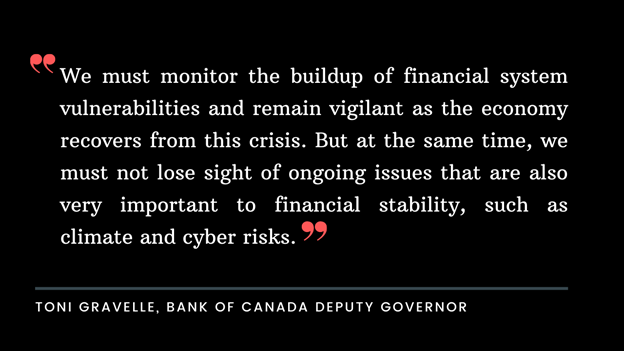
Gravelle added that the central bank remains vigilant regarding “vulnerabilities” in Canada’s financial system. He also stressed that as the recent Financial System Survey had pointed, experts of the industry are “fairly confident” that Canada’s financial system is sturdy enough to bear another shock.
However, the experts feel the risks and vulnerabilities of a second blow are greater, he added.
Moody’s Upholds Canada’s Top Credit Rating
Moody’s Investors Service recently upheld Canada’s AAA credit rating and said it has a “very high degree of resilience”.
Speaking on the same lines regarding the strength of Canada’ financial system, the credit rating agency noted that its financial sturdiness is supported by the country’s economic tenacity and effective policies.
However, Moody’s added that Canada’s historic low benchmark interest rates could result in the largest budget deficit seen since World War II.
It also predicted that the country’s gross domestic product (GDP) would dwindle about six per cent in 2020, though it would go one to climb by five per cent in 2021.
Earlier in November, a research published by the Canadian Imperial Bank of Commerce reported that households and businesses are currently hoarding at least C$ 170 billion, which is more excess cash than ever before in recorded history. There are a few more such pandemic-related factors that could impact the Canadian financial system in case of the coronavirus wishes to stick around much longer. One could only hope that its “resilience” lasts longer that that of the virus.
