
 AUS
AUS
 NZ
NZ
 UK
UK
 CA
CA
 USA
USA
 IND
IND







Summary
- Prime Minister Justin Trudeau said Canada will need to be prepared “for any outcomes” if the US presidential elections don’t result in a clear winner.
- Finance Minister Chrystia Freeland noted that disregard of who becomes the next US president, either scenarios “will be significant for Canada.”
- The S&P/TSX composite index jumped 1.5 per cent and the Canadian dollar climbed a near two-week high against the US dollar on Tuesday, November 3.
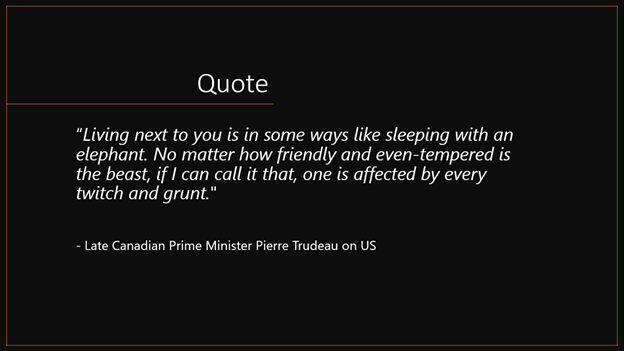
Late Canadian Prime Minister Pierre Trudeau had once famously likened having a neighbor like the United States to "sleeping with an elephant”, in the sense that its movements had a cascading impact on Canada. With the US presidential election results now unfolding, this statement seems quite understandable.
As the US geared up to count the votes on Tuesday, November 3, the S&P/TSX composite index jumped 1.5 per cent, while the Canadian dollar climbed a near two-week high against the US dollar.
Like in every election, investors are hoping for a clear winner by the end of the counting, as the alternative of a dragged-out recounting process could have a likely impact on the stock markets. In fact, the delay of a clear-cut result could affect Canada beyond just the stock markets.
Canadian Prime Minister Justin Trudeau recently commented that while he is hoping for a clear result from the US presidential elections, his government is also reflecting on an alternative scenario. In case of a “less clear” result and subsequential disruptions in the US, Canada will need to prepare “for any outcomes”, he said. Finance Minister Chrystia Freeland also spoke on the same lines recently, stressing that the Canadian government gearing up for likely outcomes following the 2020 election results.
Freeland also noted that disregard of who comes to power in the White House in 2020, either scenarios “will be significant for Canada.”
Impact Of The US On Canada’s Recovery Post COVID Lows
The coronavirus pandemic this year shook up the entire world economy. While Canada is rebounding from its COVID-inflicted lows in most sectors, it still has a long road ahead to meet its pre-pandemic performance levels in terms of economic stability. And one way to do it would be through international trade.
Here’s where the US comes into the picture.
Canada’s neighbor south of the border is its largest trading partner, with over 75 per cent of its exports heading that way. A major chunk of Canada's GDP depends on its exports to the US.
Bank of Canada governor Tiff Macklem also pointed recently that Canada’s recovery following the pandemic challenges would depend on the United States’ recovering activity. He added that while the US has “rebounded strongly”, the recovery is expected to be relatively slower ahead.
Prime Minister Trudeau has stressed in the past that no matter who wins the US presidential elections, his government will focus on building positive relations and promoting Canada’s interests in trade-related matters. Under Trump’s regime, Canada-US relations hit a bump when the president decided to reimpose the 10 per cent tariff on Canadian aluminum imports. It also did not help the case that Trump more than once took jibes at Trudeau in public forums. Democrat Joe Biden, on the other, has hinted at reconsidering some of the tariffs put in place by Trump if he becomes president.
While a majority of Canadians don’t sing praises for Trump, he remains popular among Canadian oil and gas manufacturers for his staunch support for the fossil-fuel industry. Biden, on the other hand, gives hope to Canadian clean technology companies and, more than ever, the cannabis sector.
At the end of the day, Canada will have to make the best of the president America chooses for itself. Keeping international trade and border peace in mind, it is only best that it does not to poke “the sleeping elephant”.
