
 AUS
AUS
 NZ
NZ
 UK
UK
 CA
CA
 USA
USA
 IND
IND





Summary
- Government debt would shoot up and the GDP would contract, albeit at a smaller pace than the first lockdown
- Unemployment rate could rise further, despite the extension of the furlough scheme
The industries such as retail, hospitality, and travel are in for a nightmare as the UK government imposes the second lockdown across the country beginning Thursday, 2 November.
The busiest shopping season for all these industries was coming forth during the next few weeks, but the story would be different this year, as government is worried over controlling the second Covid-19 wave. On 1 November 2020, there were more than 23000 new coronavirus cases recorded for the day across the UK.
Many of the firms across these industries had not yet fully recovered from the disastrous impact of the first lockdown that was imposed during the last spring season. For many businesses in these sectors, a good year end was all that they needed to turn profitable for the tough FY21.
Experts also pointed out that there was no guarantee that the lockdown would surely be over on 2 December. It would all depend on the speed with which the infection rate slowed down, once these stricter rules start to be followed.
The government expenses are expected to rise with another lockdown in place, as expected. The UK government has already extended the furlough scheme that would additionally burden the exchequer. Moreover, the lockdown would slow down business activity drastically across many sectors, which would put pressure on tax collections, at least for the lockdown month, if not more.
At the same time, some economists are of the view that as compared to the first lockdown, this one would give a lighter blow to the British economy as many activities are being allowed to function. The UK economy shrank by close to 20 per cent during Q2 2020, which is unlikely to happen this time around, they explained.
Let us now take a closer look at the details of the second lockdown.
The lockdown-2
Boris Johnson, the British Prime Minister recently announced that the government would be imposing a second lockdown throughout the nation beginning 5 November until 2 December 2020. Its specific details are as follows:
- People to stay at home except for going to work that cannot be done from home, going to school, childcare, or university, outdoor exercising, shopping for essentials, medical requirements, or while caring for anyone vulnerable
- Indoor meetings not allowed while meeting a member of a different household allowed at a public place
- Non-essential retail closed, except online delivery
- Bars, pubs, and restaurants to close, while all takeaways allowed except alcohol
- Beauty salons, entertainment places, swimming pools, and gyms to close
- Places of worship to close
- Civil partnership and wedding ceremonies not allowed except in special cases
- Overnight stays, holidays, and going to second home not permitted
- Only essential travel encouraged by public or private transport
- Manufacturing and construction sites to remain open
Impact on the economy
First let us talk about the good thing which is that as we hear from the experts, the blow is expected to be less severe this time as compared to the first national lockdown in the UK.
There are few reasons for this presumption by the leading economists.
First, the spring lockdown lasted roughly for two months. On the other hand, the latest one has been announced for a period of one, which would mean half the impact, simply as an arithmetic calculation.
Second, this lockdown is allowing many sectors to remain open like manufacturing, construction, and education, amongst others.
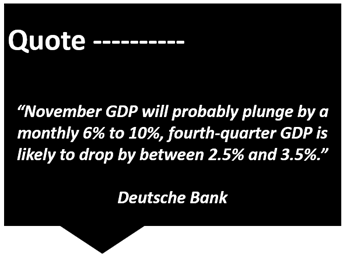
As a rough estimate, the education sector contributes 5 per cent to the national GDP (gross domestic product) in Britain. When the sector is open, it continues to contribute to the overall economic output.
Now, coming to the bad part, there are certain areas in which the impact could be worse than that of the first lockdown, lament market experts. For instance, the business investments could slow down at a faster pace than before, which is detrimental to the economy’s long-term growth potential.
Moreover, the UK treasury might have to raise additional public debt, which is already at an all-time high value of 2 trillion pounds. This would make the fiscal deficit move further way from the government’s desired target. According to JP Morgan estimates, the UK fiscal deficit could touch a figure of 20 per cent of its GDP with the extra support being extended.
The popular furlough scheme has been extended by the government for another few weeks till 2 December 2020. It will continue to pay for up to 80 per cent staff salaries for businesses impacted by the coronavirus pandemic. People working across bars, cafes, restaurants, pubs, hospitality, and non-retail sectors are expected to benefit from the move, among other industries.
During the first lockdown, the non-essential retail shops suffered a weekly loss worth £1.6 billion. According to Helen Dickinson, CEO, British Retail Consortium the loss would be more this time, being the busiest season of the year.
Rising unemployment is definitely a big worry, which was anyways on the rise even without the new set of rules were announced. Carolyn Fairbairn, Director General, CBI (Confederation of British Industries) expressed that she was worried about the next generation and impact of the pandemic on the shooting number of job losses. The government should prepare a one-year long job creation program, which is focussed and practical, she added.
Finally, the latest government estimates suggest that the British economy is close to 10 per cent smaller than its pre-pandemic size. Whatever be the overall impact of the second lockdown on the British economy, one thing is for sure, that its size would be cut-short furthermore. But by how much exactly, that only the coming times could tell.
