
 AUS
AUS
 NZ
NZ
 UK
UK
 CA
CA
 USA
USA
 IND
IND






Summary
- Covid-19 second wave to put pressure on economic recovery
- IMF suggested the UK government to raise public investment and welfare support to check the rising number of job losses
The International Monetary Fund (IMF) has downgraded its forecast for the UK economy to a contraction of more than 10 per cent for the year 2020, as the nation continues to struggle with the second wave of the coronavirus pandemic. It also projected a UK inflation rate below 1 per cent for the year.
The UK economy is undergoing tough times with the resurgence of the pandemic across the nation. The number of infections is doubling every 9 days, according to latest government estimates, which is a cause for concern.
Economists are worried that the UK economy might enter into a double dip recession in the coming months, if this trend of spiking cases continues.
During a recession, an economy’s growth gets into the negative territory for two quarter consecutively, as per the definition.
If there is a brief recovery after the recession, after which the economy once again goes into another recessionary phase, such a scenario is called a double dip recession.
Apart from the second wave of the pandemic that is making the British economy sluggish again, another problem is that of the rising unemployment numbers in the country.
There are fears that companies might lay off more staff with the ending of a popular job retention scheme in the UK called the furlough scheme that ends on 31 October. It was started by the UK Treasury after the pandemic broke out in the nation and supported employers in paying for up to 80 per cent of their total staff salaries.
Expert estimates have suggested that during the post pandemic period in Britain, people lost jobs at a faster pace than the last big crisis witnessed, in the year 2008, namely the financial crisis.
Further, by the end of December, the unemployment rate might jump to its highest levels since the 1980s, according to market experts.
Faced with such discouraging predictions, Rishi Sunak, chancellor, UK Treasury had to roll out a less generous jobs support scheme beginning 1 November that would be paying for almost two thirds of the staff salaries for businesses impacted by the tighter restrictions. This scheme had to be introduced despite huge financial pressure on the Treasury with the government debt already having crossed the 2 trillion pounds mark.
Economy
The British economy experienced contraction for the first two quarters of the year 2020 (January to March and April to June). For July and August, the growth numbers were low but positive. This growth came about was with all the support offered by the government in terms of various schemes for jobs, business loans, hospitality, and housing etc.
However, with renewed set of stricter restrictions placed throughout the nation, the economic growth seems to have its momentum, according to market experts, though we will need to wait for the official numbers to arrive.
Nonetheless, two bright spots remained – a rise in retails sales, especially the online ones during the past few weeks, and an increase in home prices across the nation.
The unemployment rate rose to 4.5 per cent in the three months to August period as compared to a value of 4.1 per cent during the three months to July 2020 period, according to government estimates. Moreover, this rate is predicted to almost double by the end of the year.
Predictions by IMF
According to the latest forecast by the worldwide fund, the UK economy could contract by as much as 10.4 per cent during 2020. The earlier forecast predicted a contraction of 9.8 per cent. IMF also forecasted a recovery with a GDP (gross domestic product) growth of 5.7 per cent during 2021.
Despite a poor fiscal position of the UK government, IMF had applauded the government for the much-needed support offered to uplift the national economic activity on a timely basis.
It said that it lowered the UK economy’s forecast since the rising Covid-19 cases along with stricter restriction would weigh down heavily on its growth prospects.
The global fund also suggested that the national government should sustain its job support measures and add more funding to avoid any long-term damages due to the pandemic.
It emphasised that while taxes would eventually need to be raised, but this was certainly not the time to do so.
Even the next year 2021 might require the clutches of government’s welfare policies and the economy would not return to its pre-pandemic levels so fast, IMF pointed out.
Sunak reacted to IMF’s suggestions by reiterating that while the UK Treasury would continue to support the national economy in the short-term, the aid would surely need to be withdrawn in the long-term, when a better fiscal prudence should prevail.
A no-deal Brexit was another concern citied by the IMF which was likely to the delay the country’s recovery in times to come.
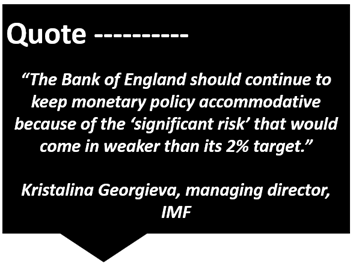
Kristalina Georgieva, managing director, IMF said that the Bank of England could enhance its purchase of the government bonds. It could consider bringing in negative interest rates only after properly understanding the benefits of such a move beforehand.
The Bank of England is expected to go in for further quantitative easing within few days. It is also contemplating on lowering the bank rate which is currently prevailing at a near zero value of 0.1 per cent.
Many British businesses continue to struggle with their balance sheets in red as a result of the ongoing pandemic led economic crisis. Georgieva emphasised that public finances should be fixed only when the national businesses get back in shape.
IMF estimated that Britain’s budget deficit could shoot up to a high value of 16.5 per cent of the national GDP for the coronavirus year 2020.
