
 AUS
AUS
 NZ
NZ
 UK
UK
 CA
CA
 USA
USA
 IND
IND






Highlights
- Australia’s dwelling approvals rebounded in February 2022 after a dip in January.
- Job vacancies significantly improved over pre-pandemic levels, with the RBA projecting a drop in the unemployment rate to below 4% in 2022.
- Higher operational costs have prompted businesses to expect a hike in the prices of goods and services.
At a time when the world economy is battling with the repercussions of the Russia-Ukraine war, Australia’s economic conditions seem to be showing signs of strength. The latest economic data released by the Australian Bureau of Statistics (ABS) reveals that the economy is standing in a relatively better position than feared despite war-driven uncertainties.
The ABS has recently released updated numbers on dwelling approvals and job vacancies for February 2022 and business conditions for March 2022. Here is a closer look at the economic data that is lifting investor sentiment to some extent today:
What did dwelling approvals data show?
Dwelling approvals in Australia rose by a massive 43.5% in February after a large drop of 27.1% in January. Of the considerable rise seen in dwelling approvals, only 16.5% belonged to private sector housing. In fact, private sector dwellings excluding housing increased substantially by 78.3%, majorly driven by a surge in apartment approvals in New South Wales and Victoria.
Lack of adequate housing has been a significant issue in Australia, especially after buyer demand broke all records in the previous year. Meanwhile, with private housing becoming increasingly unaffordable, apartments have attracted individuals who wish to live on rent. The construction of apartments and townhouses has taken centre stage to help alleviate the housing shortage in Australia.
Sydney Housing Prices Set for Volatility
Amidst robust property market conditions, the value of total buildings approved also rose in February. The value of total buildings approved soared by 67.5% in February to AU$14.28 billion. Moreover, the value of non-residential buildings surged by an astonishing 132% last month following a fall in January.
This was fuelled by many public developments during the month, which included approval for 14 projects valuing over AU$30 million. These strong numbers for non-residential buildings made February data the second-highest on record after March 2021.
DO NOT MISS: When will Australia’s petrol prices come down?
Which jobs were in demand in Australia in February 2022?
Interestingly, February 2022 was also a month of rising job vacancies across Australia. As per ABS, a total of 423,500 job vacancies in February made up for about a 7% increase from November 2021. Moreover, the level of job vacancies increased by a colossal 86% over February 2020, before the pandemic-related lockdowns.
Job vacancies in February 2022 were 200,000 more than in February 2020. According to some experts, the robust vacancy data backs the case for a sustained drop in the unemployment rate below the 4% threshold, which was last seen in the early 1970s. These speculations are fuelled by the generous budget announcement by the Federal government. Meanwhile, the Reserve Bank of Australia expects the unemployment rate to hit 3.75% this year, breaking the norm set over decades.
February’s job vacancies accounted for 2.7% of all jobs in the December quarter of 2021, representing the highest share in the series in about three decades. It is worth noting that the December quarter laid the foundation stone for a drastic improvement in the employment statistics.
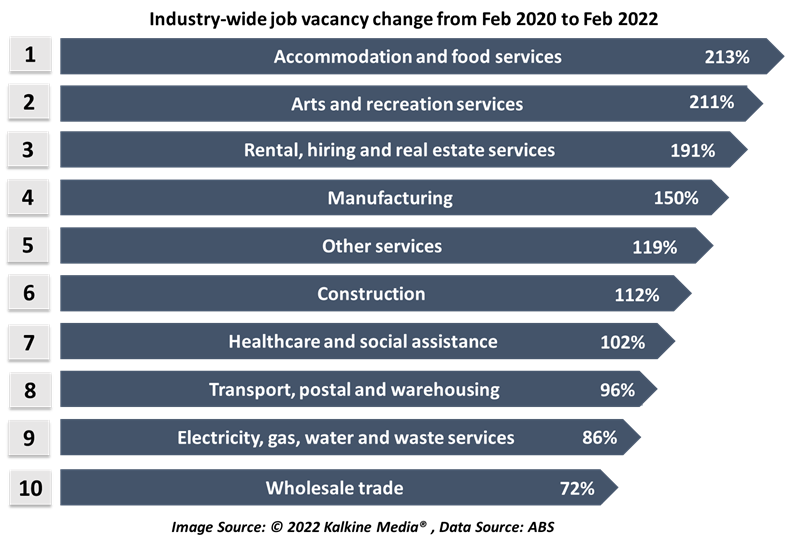
Despite an improvement in job demand, many businesses continued to report difficulties in filling their vacancies. The highest growth was seen across consumer-facing industries, which have drastically rebounded since the pandemic ensued. All states and territories also showcased a large bounce back in job vacancy data from pre-pandemic levels, with public and private sector vacancies rising over the three months to February.
ALSO READ: Australians borrow more via BNPL, payday lenders as living costs spike
Is inflation expected to rise in Australia?
The momentum gained in business conditions towards the 2021 year-end seems to have been disrupted due to the Russia Ukraine war. Heavy sanctioning and severing political ties with Russia have worsened global supply chains, fuelling inflationary concerns.
Ongoing pressures have forced businesses to incur higher production costs, forcing them to increase the prices of their goods and services. The ABS data on Business Conditions and Sentiments for March 2022 reveals that 39% of all businesses expect the price of their goods and services to increase more than usual in the next three months. Additionally, 40% of businesses reported higher operating costs over the last month. As staff shortages became more pronounced, 19% of employing businesses had their staff unavailable due to COVID-19.
Interestingly, business expectations were much better during the same time last year. In March 2021, 24% of businesses reported higher operating costs over the previous month, almost half of the current proportion. In addition to operating costs, staff-related costs, salaries, fuel prices, business overheads, and consumer demand have been impacting the prices of goods and services offered by businesses.
ALSO READ: Australia Budget 2022: How much paternity leave are fathers entitled to?
