
 AUS
AUS
 NZ
NZ
 UK
UK
 CA
CA
 USA
USA
 IND
IND








Summary
- Australia’s trade balance swelled to A$6.7 billion in December, up from A$5 billion in November.
- The surplus for the December quarter rose by 28 per cent to A$17.4 billion, a timely positive for the economy recovering from slowdown due to coronavirus pandemic.
- The dip in coal exports to China was offset by rise in iron ore exports to the world’s second-largest economy.
Despite its unpleasant trade ties with the world’s second-largest economy, Australia has managed to chalk up an impressive trade surplus in December.
According to the data released by the Australian Bureau of Statistics (ABS) on Thursday, the country’s trade balance swelled to A$6.8 billion in December, up from A$5 billion in November, as exports surged 2.8 per cent and imports fell 2.4 per cent. The surplus for the December quarter rose by 28 per cent to A$17.4 billion, signalling a positive sign for an economy recovering from the pandemic-induced slowdown. The rise in trade and services surplus was on account of the larger fall in imports than that of exports, according to the ABS.

Image Source: © Cmmeraydave | Megapixl.com
The dip in coal exports to China was offset by the rise in iron ore exports to the world’s second largest economy. The export of goods to China soared 21 per cent in December to hit a six-month high of A$13.3 billion, with iron ore jumping both in value and volume. In December, the iron ore receipts were at a record A$12.57 billion, surpassing the previous record of A$11.18 billion in October.
Notably, Australia is the largest exporter of iron ore and hard coking coal in the world.
READ MORE: ABS data revealed surge in International trade and housing loan commitments
In the wake of trade tensions with China, Australia’s coal producers are caught in the crossfire and have become collateral damage, especially after Beijing's ban on the Australian coal. In the past year, China banned various Australian products and commodities such as barley, wine, and lobsters.
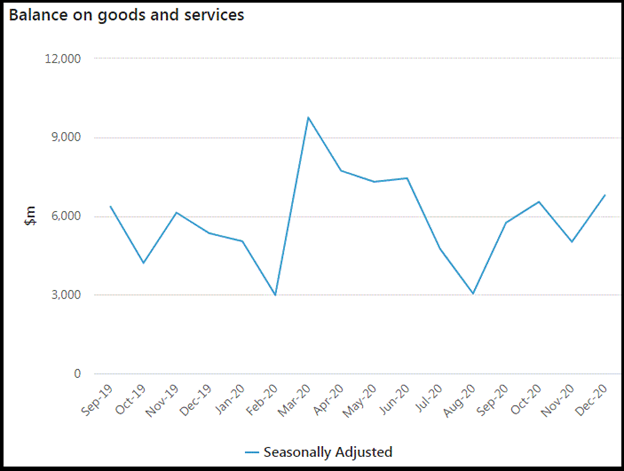
Image Source: ABS data, 4 February 2021
While Australia’s coal shipments found new buyers, the iron ore receipts rose due to strong demand for steel production in China amid iron ore supply disruptions in Brazil. However, the export revenue for combined Australian thermal and coking coal and LNG saw a decline during the period. Despite the coronavirus pandemic-led disruptions, the exports jumped 12 per cent for all of 2020.
READ MORE: ABS Reports A 0.3% Contraction In The Australian Economy
