
 AUS
AUS
 NZ
NZ
 UK
UK
 CA
CA
 USA
USA
 IND
IND






Summary
- Australian trade surplus rocketed to $8.2 billion in June 2020, driven by rising export of iron ore to China where surged steel production culminated in high iron ore demand.
- The robust trade statistics come at a time when severe lockdown restrictions in Victoria seem to affect Australian economic recovery and job market scenario.
- Australia’s trade dependency on China, however, has also been garnering concerns with the rise in trade and political tensions between the two countries.
Australian trade appears to be back in the saddle in the face of several COVID-19 impediments that tend to thwart the pace of economic revival. The latest data by the Australian Bureau of Statistics (ABS) suggests that exports to China has picked up steam, contributing to nearly half of the total exports from Australia.
The official figures indicated that Australian exports to China in June 2020 were worth $14.6 billion, which rose from $13.54 billion in May 2020. The all-time high exports to China, expanding consecutively for fourth months in a row, has brought the 12-months total export value over $151 billion.
Meanwhile, the Australian trade surplus rose by $861 million from May 2020 to $8.2 billion in June 2020. The noteworthy trade performance took place against the backdrop when Australian businesses suffered significant worries, with Victoria experiencing a spike in the COVID-19 cases.
The sterner lockdown measures in one of Australia’s most populous states has left the revival in the lurch as people forebode the second wave of infection. The economic impacts of the pandemic seem to be visible writ and large on a plethora of aspects, impinging the pace of recovery for many sectors and industries.
While Prime Minister Scott Morrison indicated that the strict level four restrictions in Victoria could negatively impact the job market, Reserve Bank governor Philip Lowe expects the unemployment rate to rise to 10% at the end of 2020.
Amidst such a situation, the rise in the export value comes as a silver lining for the country.
ALSO READ: Policy rates remain unchanged, RBA expects 6% fall in GDP
Export Volume Driven by Robust Iron Ore Demand
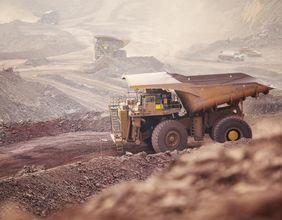
Iron ore exports largely remained at the forefront amidst the crisis, driving exports volume to China. As the world’s second-largest economy emerges out of the pandemic induced crisis, it has been primarily focused on seizing a large portion of the global steel industry. The demand from the Chinese steel manufacturers has spiralled lately, contributing to a large share of Australia iron ore exports.
Australian iron ore rival, Brazil is grappling the harsh effects of the pandemic amidst skyrocketing virus cases that have crossed 2.8 million-mark, wreaking havoc in the South American country.
Australia, which is faring far better than Brazil in terms of COVID-19 infections, seems to leverage its position to grab sizeable chunk of Chinese iron ore export.
ALSO READ: China Poised to Grab the Global Steel Trade as Economies Open up for Trade
Furthermore, the soaring iron ore prices have significantly enabled Australian iron players to relish higher growth in the equity market. Notably, iron ore miner, Fortescue Metals Group Limited (ASX:FMG) witnessed terrific growth in its stock price, which rose by over 30% in the past month. FMG indicated record iron ore shipments of 47.3 million tonnes for the June Quarter, totalling the total FY20 shipment to 178.2 million tonnes. The shipment value, which was 6% higher compared to FY19, has surpassed the Company’s top-end guidance of 177 million tonnes. The company has leapfrogged big fours ANZ and NAB in terms of market capitalisation recently.
Meanwhile, BHP Group Limited (ASX:BHP) and Rio Tinto (ASX:RIO) in the past one month have also witnessed an increase in their share prices by more than 6% and 10%, respectively.
Australian trade Interconnection with China
Australian trade linkage with China has been profound for the last few years, contributing significantly to the GDP growth of the country. Free Trade Agreement between the two counties in 2015 injected new vigour to the bilateral trade and investment relationship, allowing significant value of Chinese investments and trade in Australia.
ALSO READ: The milieu between China and Australia when it comes to trade talks
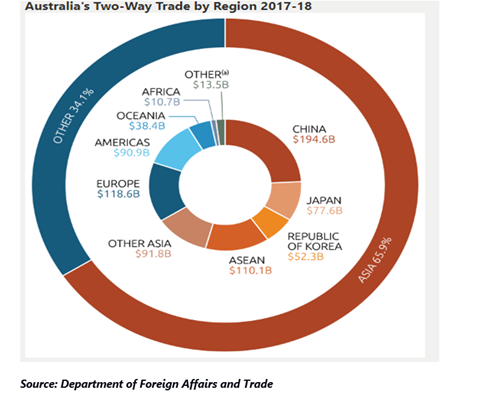
China is the most significant trade partner of Australia in terms of both exports and imports, contributing to over $252 billion trade value, including $169.1 billion exports for the financial year 2018-19. The value of exports to China has continuously increased with the average growth of 14.1% in the five years, while the exports rose by 23.8% in 2019 over 2018.
China’s formidable march towards unparalleled manufacturing and infrastructure development has primarily driven the demand for iron ore and coal from Australia, which enjoys substantial geographic proximity compared to its rival Brazil.
Australian trade to China has also risen on the back of deploying educational services, tourism, and agricultural produce.
A dilemma Concerning Australian trade dependency on China
The spat between Australia and China has renewed the debate on diversifying the Australian exports market. The bilateral tensions were already existing owing to controversies such as the growing influence of China on Australian export scenario, dispute on the South China Sea and the escalating Hong Kong Crisis.
Furthermore, Australian apprehensions regarding the origin of the virus in China did not go well with the Asian country, that appears to retort with the introduction of several trade barriers.
Australian barley exporters seem to witness the ripple of political tensions as China introduced 80% tariff on Australian barley exports in the country. At the same, beef and coal exports from Australia also suffered restrictive response from China.
Nevertheless, the rising trade figures, especially concerning the export of iron ore, suggests that China still depends substantially on Australia for realising its infrastructure development objectives. But the question that overrides the current trade statistics is how long the Asian country will continue its dependency.
Lately, China seems to provide substantial backing to Guinea-based iron ore production, signalling that the world’s second-largest economy is attempting to reduce or eliminate its critical steel industry’s reliance on Australia. At the same time, the outbreak in the early months of 2020 when the steel production suffered a significant setback in China, the Australian miners confronted a difficult situation.
The recent incident pinpoints a grave need for the diversification of the Australian exports so that Australia may not be heavily reliant on the Chinese economy in the coming time.
