
 AUS
AUS
 NZ
NZ
 UK
UK
 CA
CA
 USA
USA
 IND
IND







Summary
- Rate cuts have been a “go-to” measure for central banks to heal deep cuts in the economy during the pandemic.
- The labour market still needs assistance, having witnessed the unemployed population notch up by 1.2% from August to September 2020.
- The unemployment rate also increased from 6.8% to 6.9%.
- AUD/USD has been facing resistance from upper levels and trading sideways for the last two months
- With CPI inflation falling to a few decades low of -0.3%, annual target to meet 2-3% inflation seems difficult without a rate cut.
The coronavirus pandemic has made a deep cut in the financial robustness of the economies and businesses. By now, it has been made clear by the central banks across the globe that they are willing to go beyond the lines to save and revive their economies.
Since the pandemic started, there have been numerous speculations regarding the rate cuts by the Reserve Bank of Australia (RBA). By now, the RBA has adopted quite a lot of measures, with a primary focus on the jobs market and inflation.
The labour market still needs more support.
According to a recent report on Labour force, released by the Australia Bureau of Statistics in October, the unemployed population has increased from 926,200 in August to 937,400 in September, an uptick of 1.2%. The unemployment rate has inched up from 6.8% to 6.9% in the same period.
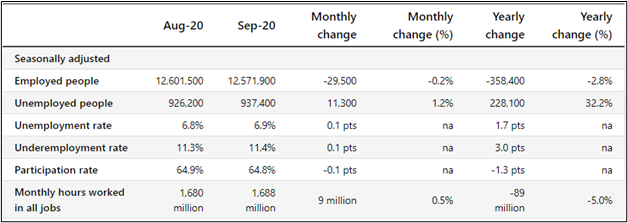
Image Source: Australia Bureau of Statistics
The monthly hours worked in all jobs also saw an increase of around 8 million, from 1,680 million to 1,688 million. However, an increase in total working hours isn’t in sync with the increase in employment which decreased from 12,601,500 to 12,571,900 from August to September.
With coronavirus once again spiking in Victoria and New South Wales (NSW), the clouds of uncertainty are still hovering over the labour market which could pave the way to another rate cut.
Technical outlook on AUD
AUD/USD has recovered quite well from the lows of March and has given one good rally. However, AUD is now facing some selling pressure restricting it to continue the previous rally. The tussle between the buyers and sellers has led to a sideways movement for the last two months.
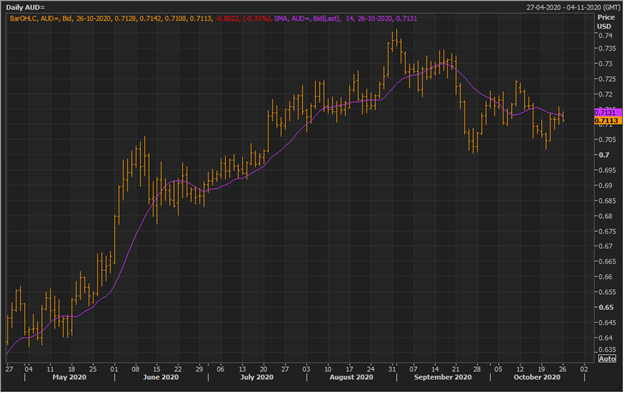
Image Source: Thomson Reuters
On the daily chart, AUD/USD is trading below its 14 days moving average, as the market participants are trying to discount the odds of rate cut ahead of the RBA’s policy which is further signalling to the downward bias.
As rate cut will likely to make AUD denominated currency less attractive, more selling is expected to be witnessed.
Subdued Inflation
In the last meeting, the RBA governor Philip Lowe expressed concerns regarding high unemployment and underemployment, especially after the second wave of the Coronavirus outbreak in Victoria.
Due to the second wave, a further level of contraction in the output has been witnessed, which has lowered the pressure on wage and inflation.
The Governor and the Treasurer have an agreement to target an annual inflation rate of 2-3%, on average. Seeking to achieve this rate helps in the monetary policy, which serves as an anchor for private-sector inflation expectations.
As per the recent CPI data, the current inflation is at a few decades low, at -0.3%. In order to meet the average target of 2-3%, Pulling up the trigger for a rate cut seems possible.
