
 AUS
AUS
 NZ
NZ
 UK
UK
 CA
CA
 USA
USA
 IND
IND







Summary
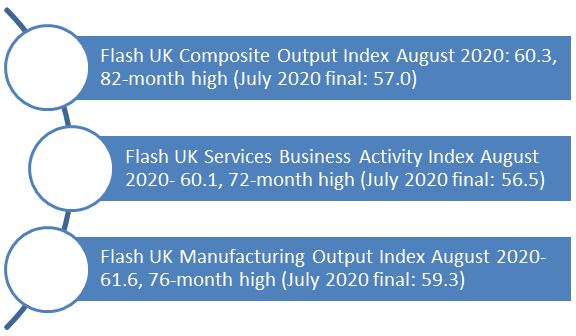
- In August 2020, business activities in the UK’s private sector, including both manufacturing and services rose sharply in last seven years or since 2013.
- The composite purchasing managers index (PMI) data from IHS Markit’s survey put the numbers for August 2020 at 60.3, more than last month’s numbers of 57.
- If the PMI is recorded above 50, it indicates growth, any number below is an indication of contraction.
In August 2020, the private sector companies in the UK saw a significant increase in business activities since 2013. Demand from customers rose for both the manufacturing and service sectors, suggesting an accelerated pace in recovery. The latest statistics signified that recovery from the coronavirus-led economic crisis was quicker than estimated in both the manufacturing and services sectors. The composite purchasing manager’s index (PMI) data from IHS Markit’s survey put the numbers for August 2020 at 60.3, more than last month’s numbers of 57. The data for the manufacturing sector 61.6 was marginally higher than the statistics for the services sector which was put at 60.1. As opposed to the positive trends for output and new orders, latest data for August 2020 indicated the fastest pace of decline in employment numbers since May 2020, when majority of the businesses were shut due to the lockdown.
Also read: UK Services and Manufacturing Sectors Display High Growth
Stating that that the August numbers showed that over the last month, recovery has accelerated across both the manufacturing and service segments, Tim Moore, economics director at IHS Markit, observed that the expansion of UK’s private sector output was quickest for almost seven years. This followed a sharp rebound in improvements in business and consumer spending from the lows that were recorded during April, when businesses were shut due to coronavirus-induced lockdown.
It is to be noted that a vast majority of the businesses were allowed to reopen from July 2020 as part of the government’s lockdown easing measures. Higher levels of private sector output noticed in August and July were because of the reopening of the British economy after almost three months of the lockdown period in the second quarter (Q2) of 2020, which led to a rise in both consumer and business spending. It is to be understood that PMIs that are given on a scale of 1 to 100, are an indicator of activities in the private sector. While the PMI quoted in excess of 50 signifies growth, any number below suggests contraction.
The government announced various measures and schemes to ease the lockdown restrictions and encourage people to rejoin work, helping the businesses to open up quickly and more confidently. Both manufacturing and the services sectors reaped the benefits, leading to an upward movement in consumer and business spending. The services sector accounts for about 80 per cent of the UK’s total economic output. Some of the key segments in service sector are finance, law, retail, engineering, and hospitality among others. One of the most recent government schemes of Eat Out to Help Out was targeted to boost the hospitality segment by bringing more consumers back to restaurants and pubs.
The fall in employment numbers during the coronavirus pandemic was a direct outcome of the redundancy programs at several businesses. Facing the coronavirus-led crisis, many companies realised the need to reduce overheads before the government’s job retention scheme winds down. A fall in backlogs of work across the private sector meant that incoming new orders fell short of business capacity.
There was a significant rise in total amount of new work in both the sectors as it increased for the second month in a row (July and August 2020). According to the IHS Markit, the latest increase was the fastest since October 2013. However, there was a continued rise in unemployment numbers across the private sector in August 2020 amid the ongoing fight against the coronavirus-led crisis. As one of the reasons for the job losses, businesses cautioned regarding the speed and duration of the economic recovery. Many companies are making an effort to reduce overheads before the government’s furlough scheme comes to an end in October 2020.
Also read: What Next For The Ailing UK Economy?
Also read: The UK economy rebounds to growth in May 2020, though at a slow pace
Observing that the UK economy is facing slow down, the Chartered Institute of Procurement and Supply (CIPS) also felt that it would be too early to rejoice as there could be more job cuts after the wage-subsidy scheme ends. CIPS stressed that many companies facing rising costs of operations find job cuts as a quick solution.
Despite the rate of inflation eased since July, there was a rise in average cost burdens at a solid pace in August, the operating expenses moved up due to increase in fuel bills and rising costs for imported items. The data for August 2020 stressed on a setback for business expectations across the private sector. Given the concerns that the recovery will be slower than the earlier expectations, the index that calculated the projections of growth for the upcoming 12 months dropped for the first time since March 2020.
Conclusion
Lockdown easing measures led many businesses and sectors to reopen. The reopening increased the consumer and household spending, which ultimately boosted the business activities as demand for products and services rose considerably. This resulted in an increase in spending from the businesses to service the consumer needs. Total volumes of new work also increased both in July and August 2020. As the new growth numbers seen to be highest since 2013 was linked mostly to the reopening of businesses after almost three months of lockdown. It remains to be seen how long this demand sustains itself in the ongoing fight against the coronavirus crisis. It needs to be noted that though there was a rise in demand after lifting the lockdown restrictions, it was well below the pre-pandemic levels. As many of the support measures by the government like the furlough scheme would soon come to an end in October 2020, businesses are increasingly concerned about the speed and duration of the recovery. Amid these fears, there were substantial job cuts across the private sector during August 2020.
