
 AUS
AUS
 NZ
NZ
 UK
UK
 CA
CA
 USA
USA
 IND
IND








Summary
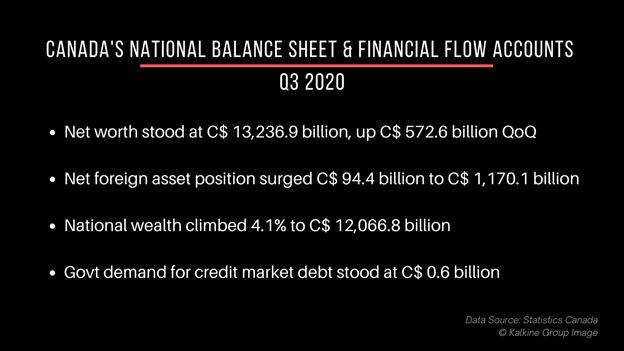
- The national net worth jumped from C$ 331,732 to C$ 344,816 on a per capita basis in Q3 2020, says StatCan in its latest report.
- Canada's net foreign asset position surged to C$ 1,170.1 billion.
- The national wealth surged by 4.1 per cent to C$ 12 trillion.
- The federal government‘s credit market debt stood at C$ 0.6 billion in Q3 2020, significantly down from the C$ 302.1 billion in the previous quarter.
Canada’s national wealth and net foreign asset position totaled to C$ 13.23 trillion in the third quarter (Q3) of 2020, reported Statistics Canada on Friday, December 11. The total amount, aka net worth, noted a quarter-over-quarter (QoQ) increase of C$ 572.6 billion, which was largely driven by the spike in Canada's non-financial assets’ value and in its net foreign asset position.
The country’s national net worth jumped from C$ 331,732 to C$ 344,816 on a per capita basis, noted StatCan.
Canada's net foreign asset position, which measures the difference between its assets and liabilities’ value with that of the rest of the world, surged by C$ 94.4 billion to C$ 1,170.1 billion in Q3 2020. The rise in this number was motored by increased equity prices for the second quarter in a row.
Key Highlights of Canada’s National Net Worth Growth
- Canada’s national wealth, which represents the value of its non-financial assets, surged by 4.1 per cent to C$ 12,066.8 billion in Q3 2020.
- The country’s residential real estate value rose 3.2 per cent, representing the biggest quarterly growth since 2017.
- As energy prices and production slowly recovered from the pandemic blows in the latter part of 2020, natural resource wealth noted a growth of C$ 237 billion.
- The value of consumer durables shot up by C$ 21.4 billion, mostly fueled by the increase in consumer spending in Q3 2020.
Household Sector Saving Remained High For Second Quarter In A Row
Household sector saving, which basically represents the funds available to boost wealth, stood at C$ 56.8 billion in Q3 2020. The number was up for a second consecutive quarter, but was lowered from the record high of C$ 90.1 billion in Q2 2020.
Canadians were reportedly less dependent on income support programs in Q3 2020, on a seasonally adjusted basis. This, along with the jump in employment in recent months, led to a near 50 per cent drop in employment insurance benefits.
Household disposable income, however, fell 3.1 per cent in the latest quarter.
The savings rate was down from a record high of 27.5 per cent in Q2 2020 to 14.6 per cent in Q3 2020.
The household sector net worth, which measures the value of all assets minus liabilities, ballooned 3 per cent to C$ 12,301.2 billion in Q3 2020.
While the value of financial assets jumped to C$ 188.6 billion in the latest quarter, that of non-financial assets spiked C$ 214.6 billion on the back of the notable gains in residential real estate.
Credit Market Borrowing Climbed in Q3 2020
Canada’s total credit market borrowing expanded to C$ 38.4 billion in the third quarter 2020 on a seasonally adjusted basis. Demand for mortgage loans grew to a record high of C$ 28.7 billion, reported Statistics Canada.
The stock of credit market debt amounted to C$ 2,417.4 billion by the end of Q3 2020. While mortgage debt stood at C$ 1,627.8 billion, non-mortgage loans amounted to C$ 789.5 billion in the quarter.
The total amount of debt in deferral, due to the COVID-related relief measures provided by lenders, declined notably in Q3 2020.
Credit market debt stood at C$ 62,971 on a per capita basis.
Federal Government Borrowing Slumped in Q3 2020
The Canadian government demand for credit market debt stood at C$ 0.6 billion in Q3 2020, significantly down from the C$ 302.1 billion in funds which were raised in Q2 2020.
Borrowing of federal bonds remained sizable in Q3 2020, with a net issuances of C$ 77.4 billion. However, these were mostly offset by net retirements of short-term paper, pointing at a shift to longer-term borrowing.
Needless to say, the support programs amid the COVID-19 pandemic brought on a notable draw down in currency and deposits, which continued in the third quarter of 2020.
Apart from social security funds, other levels of government reduced their borrowing to C$ 24.6 billion in Q3 2020.
The ratio of federal government net debt to the country’s gross domestic product (GDP) jumped to 34 per cent in Q3 2020, while the ratio of other government net debt to GDP lowered to 26.9 per cent.
Canadian Economy Continues To Recover From COVID Impact
The Canadian economy reportedly reflected signs of recovery as lesser people depended on government support measures and more Canadians returned to their jobs in Q3 2020. While government transfers noted a quarterly decline, dropped compared with the previous quarter, it still led to a quarter of strong household savings, reported StatCan.
