
 AUS
AUS
 NZ
NZ
 UK
UK
 CA
CA
 USA
USA
 IND
IND







Summary
- Canada’s payroll employment grew by 337,500, or 2.2 per cent, in the month of September, reported Statistics Canada.
- The number of payroll jobs in the country, however, declined by 1.2 million, or 7.3 per cent, since the pre-pandemic days in February.
- In September, sectors related to arts, recreation and entertainment recorded the fastest month-over-month increase in payroll employment levels
A recent study by Statistics Canada has shown that Canada’s payroll employment grew by 337,500, or 2.2 per cent, in the month of September as the lockdown restrictions eased and the economy continued to reopen in phases. However, the study pointed out that hospitality businesses such as bars, restaurants in certain places were put under coronavirus-related restrictions again as infection cases began to rise through September.
Statistics Canada published the results of the Survey of Employment, Payrolls and Hours (SEPH) for September on Thursday. The SEPH is the national data agency’s monthly report that gives an account of Canada’s employment and earnings data for a given month.
What was the status of Canada’s payroll employment in September?
Payroll employment constitutes the number of employees that were paid wages or given benefits by their employers in a given month. The 2.2 per cent jump in Canada’s payroll employment for the month of September came after an increase of around 1.8 million payroll jobs between June and August, reported Statistics Canada.
However, the number still posts a decline of 1.2 million, or 7.3 per cent, since its pre-pandemic days in February. Meanwhile, Canada’s employment climbed by 378,000, or 2.1 per cent, in September, the Labour Force Survey stated. This pulls the country’s total employment to 720,000, or 3.7 per cent, of its pre-Covid levels in February.
Around 54,900 more hourly paid employees were being paid or given benefits by their employers in September. In contrast, there was a rise of 177,700, or 3.2 per cent, in the payroll employment levels of salaried employees for the same month.
Payroll employment across provinces
Payroll employment advanced in all provinces across Canada in September, reported StatCan. The growth was highest in New Brunswick, with 10,200 or 3.3 per cent rise, followed by 1,900 or 3 per cent in Prince Edward Island, 52,300 or 2.5 per cent in British Columbia and 142,400 or 2.4 per cent in Ontario.
Employment levels in Alberta was down 9.1 per cent or 182,700, whereas Ontario and British Columbia saw a decrease of 8.5 per cent or 565,500 and 7.9 per cent or 185,600, respectively.
Canada’s employment hours and earnings
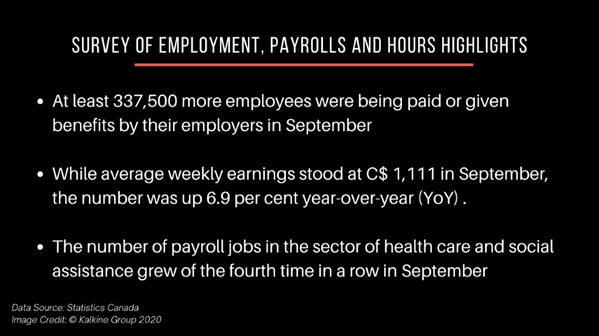
While average weekly earnings stood at C$ 1,111 in September, the number was up 6.9 per cent year-over-year (YoY). The total number of hours worked continued to rise in September, posting a spike of 1.6 per cent.
Sector performance in terms of payroll employment
Canada’s services producing sectors saw a growth of 295,000, or 2.4 per cent, in its payroll employment levels in September driven by an increase of 48,000 posts in the accommodation and food services sector.
Goods producing sectors, on the other hand, saw a slump in the monthly growth rate. From an increase of 2.1 per cent in August, the growth rate dropped to 1.2 per cent in September.
Sectors at a glance
Sectors related to arts, recreation and entertainment recorded the fastest month-over-month growth in payroll employment levels in September, up by 15,700 or 7.9 per cent. The growth was similarly high in sectors related to accommodation and food services, which saw a jump of five per cent in the number of payroll jobs in the same month.
However, the Statistics Canada report noted that employment in these sectors for September continued to dwindle way below their pre-pandemic levels.
Information and cultural sector
September registered the third-fastest growth in terms of payroll employment in the information and cultural sector, up by 14,700 or 4.6 per cent.
Health care and social assistance sector
The number of payroll jobs in the sector of health care and social assistance grew for the fourth time in a row in September, up 1.8 per cent month-over-month.
Manufacturing and construction sector
Although Canada’s manufacturing sector posted an increase of 13,800 or 0.9 per cent in its payroll employment levels in September, its recovery in employment growth slowed down in this period.
For the construction sector, payroll employment levels climbed for the fifth month in a row in September, up by 18,700 or 1.9 per cent. The Statistics Canada report said that this spike was led by the 2 per cent growth in specialty trade contractors and 2.3 per cent gains in construction of buildings.
What to expect now
A Labour Force Survey from October reflected a slump in the pace at which employment is recovering within certain sectors. This was caused due to reintroduction of lockdown restrictions in several provinces due to the second wave of Covid-19 cases.
The results of SEPH for the month of October, which are expected to be out on December 22, will give a clearer picture of how different Canadian subsectors and industries were impacted by the second round of lockdowns.
