
 AUS
AUS
 NZ
NZ
 UK
UK
 CA
CA
 USA
USA
 IND
IND








Summary
- Canada’s payroll employment growth saw a slump in the month of August, in comparison to the preceding months of July and June.
- August recorded a two per cent climb in payroll employment, which brought the total payroll employment change since February to a decline of 9.5 per cent.
- Arts and entertainment and oil and gas sectors hardest hit.
Five months into the coronavirus pandemic, Canada recorded a decline in the payroll employment growth in the month of August, noted a recent study by Statistics Canada.
The national data agency released its August results from the Survey of Employment, Payrolls and Hours (SEPH) on Thursday, October 29. According to SEPH, which churns out employment and earnings-related data for Canada, payroll employment growth was driven by employees paid on an hourly basis for the third month in August.
What was the status of payroll employment in Canada for August?
Most COVID-related lockdown restrictions had been phased out across the country by August, which saw more businesses and workplaces open back up.
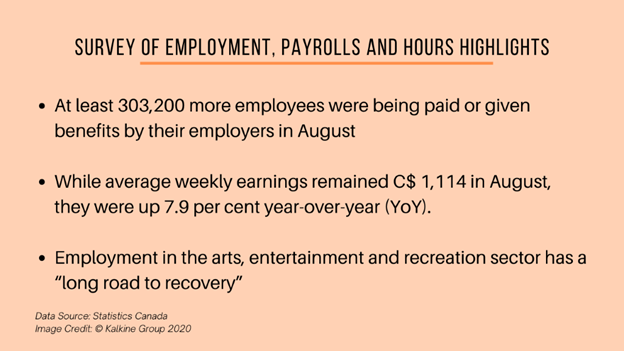
At least 303,200 more employees were being paid or given benefits by their employers in August, as per the recent StatCan report. This number amounted to a two per cent rise in payroll employment for the month, which was noticeable down from an increase of 5.3 per cent in July or that of 4.9 per cent in June.
August’s measly two per cent climb brought the total payroll employment change since February to a decline of 9.5 per cent.
Total employment in the month of August rose by 1.4 per cent, as measured by the Labour Force Survey, against an increase of 2.4 per cent in July and 5.8 per cent in June. This resulted in the total employment change since February to fall by 5.7 per cent.
While payroll employment jumped for almost every province in August, it was closest to its pre-pandemic levels from in New Brunswick.
The month also saw payroll employment climb two per cent in services-producing and goods-producing sectors each.
What were earnings and work hours like in Canada for August?
While average weekly earnings remained C$ 1,114 in August, they were up 7.9 per cent year-over-year (YoY) .
The total number of hours worked climbed one per cent in the month of August, down from 3.8 per cent in June and 5.2 per cent in July.
While some sectors rebounded noticeably from their COVID-triggered lows, others continued to reel under the challenges. Sectors related to retail, entertainment, accommodation and food services accounted for over 40 per cent of the decrease in payroll employment in August as compared to February.
Arts and entertainment sectors remain far from recovery
While payroll employment in the arts, entertainment and recreation-related industries climbed for the third month in a row in August, it still remains 36.4 per cent below its pre-pandemic levels from February.
The arts, entertainment and recreation sector recorded the fastest growth in August with a surge of 12.9 per cent. Its average earnings per week was also up over 13 per cent YoY, amounting to C$ 716, in August.
However, the Statistics Canada survey pointed that employment in the arts, entertainment and recreation sector has a “long road to recovery” as in a previous study, it had found that Canadians plan to cut down on their spending on recreational activities.
Manufacturing and construction sectors continued to recovery in August
Payroll employment registered an upward trend for the fourth consecutive month in the construction sector in the month of August. It climbed 2.6 per cent on a national level, with the highest surge of 8.4 per cent in Quebec.
The manufacturing sector also recorded a noticeable growth in payroll employment in August, up by 28,700 (or two per cent). It saw the biggest gains in the food manufacturing industry (up nearly three per cent) and among manufacturers of plastics and rubber products (up over five per cent).
However, employment in the manufacturing sector remains six per cent below its pre-COVID level from February. Its average weekly earnings stood at C$ 1,159 in August, up 1.5 per cent YoY.
Employment in Canadian energy sector remains at the lowest level in over three years
Canada’s oil and gas and energy sectors, which has been toiling under pandemic-inflicted challenges for a while now, has been suffering from employment perspective as well.
Payroll employment in energy-related fields, such as mining, quarrying, oil and gas extraction, remained unchanged for the month of August. In other words, it continues to hover nine per cent below the pre-pandemic levels in February.
What to expect now?
A Labour Force Survey from September anticipated a further recovery in employment for Canada as more businesses and officer reopen post lockdown. However, the recent spike in COVID-19 cases has brough back restrictions in many provinces. In the anticipation that the coronavirus numbers will continue to fluctuate, employment may continue to be at risk in the country.
