
 AUS
AUS
 NZ
NZ
 UK
UK
 CA
CA
 USA
USA
 IND
IND








Summary
- The Bank of Canada released its 2020 Autumn Business Outlook Survey that gauges the business activity and performance of businesses in the last 12 months.
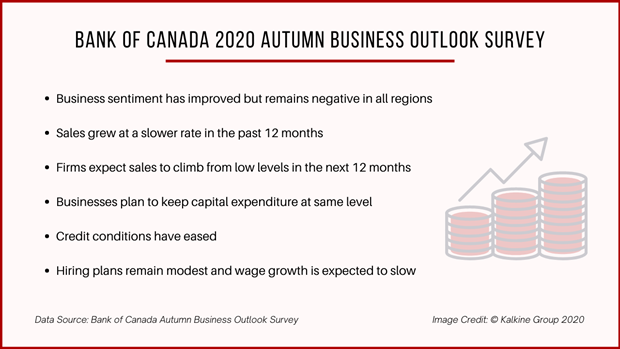
- While the business sentiment progressed following the lifting of the lockdown, it remains weak in all provinces across Canada, the survey pointed.
- About one-third of businesses don’t expect their sales to bounce back to the pre-pandemic levels at least in the following 12 months.
Business sentiment has progressed in the light of COVID-19 restrictions being phased out, but remains weak in all provinces, said the Bank of Canada’s (BoC) 2020 Autumn Business Outlook Survey. Released on Monday, October 19, the autumn survey reflected slightly better results than the one in the summer. However, the latest results for several indicators remain “below their historical averages”.
The Business Outlook Survey is a quarterly study released by the central bank that gauges the business activity, performance, prospective, etc. of Canadian businesses. The latest survey data was derived from surveying about 100 selected businesses between August 24 and September 16.
How Far Are Canadian Businesses From Recovery?
It is no new news that the coronavirus pandemic has wreaked havoc on the business world since its onset in March 2020. While its current impact is comparatively less severe than it was in the summer, it has caused an overall deterrence in sales growth for most businesses in the last 12 months. In some cases, the Autumn Business Outlook Survey added, it has led to “outright sales declines”.
Based on the response the firms gave in terms of their recovery from COVID-inflicted lows, the survey categorized the participating firms into three group:
- One-third of the firms do not expect their sales to rebound to the pre-pandemic levels at least in the following 12 months. These firms, mostly belonging to the tourism and similar sectors, reflect a notable lag in their recovery from the COVID-inflicted damages.
- Another one-third of the firms reported that they have already reached their pre-COVID levels or expect to in the next 12 months.
- The third one-third set includes businesses whose sales either remained mostly unaffected by the pandemic or were positively affected by it.
The second and third sets mostly consisted of businesses dealing with natural resources, infrastructure spending, household consumption, residential real estate, etc.
On the basis of these responses, the survey predicted that economic recovery in coming months will be uneven.
What About Their Investment and Credit Conditions?
Most Canadian businesses remain wary of investment and intend to keep their machinery and equipment-related expenditure at current levels for the next 12 months, the BoC Autumn Business Outlook Survey pointed. Some firms, especially those lagging in recovery, plan to implement cost control measures to cut down on their spending.
Credit crunch had been severe for most companies around summer following the onset of the pandemic. In the past three months (July – September), several Canadian businesses experienced a slight relaxation in the credit squeeze as their sales climbed. Some also benefitted from government support programs and favorable lender policies.
Businesses which continued to face tightened credit conditions mostly belonged to suffering industries or were tied to lenders with lowered risk appetite.
What are Canadian Businesses’ Hiring and Wage Plans?
The average opinion in terms of hiring plans was improved in the latest quarter as compared to in summer. But it remains way beneath its historical average, the BoC autumn survey pointed.
Companies that saw a spike in their business amid the pandemic have been expanding their workforce to keep up with the increased demand. An example of this would be Amazon Inc, which announced plans to hire 100,000 employees across Canada and US in September.
While some firms are rehiring after having laid off people during the pandemic, nearly one-third of the businesses in the survey said their workforce is likely to stay lower than pre-pandemic levels for at least the next 12 months. Some also feel that their employment levels will “never fully return”, said the survey.
Almost half of the firms said that they benefitted from the Canada Emergency Wage Subsidy program.
A majority of businesses expect wage growth to slow down and input prices to climb at a slightly quicker pace in the next 12 months, as per the survey. The survey also found that most businesses plan to increase their selling prices at the same rate as the one used in the past 12 months.
The firms’ expectation of inflation was dramatically low in the summer survey. In the latest autumn survey, this has somewhat rebounded, although a majority of the businesses expect inflation to remain low over the next two years.
An important factor to keep in mind is that the BoC’s Autumn Business Outlook Survey was conducted in August-September, i.e., when the coronavirus cases were relatively lower, and the second wave of infections had not hit Canada yet. In the light of the latest spike in infections, the reality of businesses may differ from what has been projected in the survey.
