
 AUS
AUS
 NZ
NZ
 UK
UK
 CA
CA
 USA
USA
 IND
IND






Highlights
- The wage price index rose 0.6 per cent during the September quarter.
- Wage and salary reviews around the end of the financial year prompted the wage hike.
- The RBA stated that wage growth is still slower than its set target for an interest rate hike to occur.
In a surprising turn of events, wage growth has shown a pattern resembling the pre-pandemic levels during the September quarter, despite parts of the country being in lockdowns over the period. After exhibiting recovery across major economic indicators, the Australian economy has finally witnessed much-awaited improvement in the wage price index.
The latest figures from the Australian Bureau of Statistics (ABS) show that the wage price index rose 0.6 per cent during the September quarter and 2.2 per cent over the year in seasonally adjusted terms. The figure trumped the analysts’ expectations of a 0.5 per cent increase in wages, reflecting the faster-than-expected recovery streak in Australia. The sector-wise results demonstrated rises in private sector wages by 2.4 per cent and public sector wages by 1.7 per cent through the year to September quarter.
The wage price index statistics have reinforced Australia’s position as a nation observing fast-paced economic growth despite several speedbumps along the way. Speculations are rife that Australia’s GDP could potentially receive a boost from the string of positive results reported lately.
ALSO READ: Will 2022 be a normal year for world economy?
What pushed wages higher?
The rise in wages has come at an unprecedented time when eastern Australia was under the influence of major lockdowns. Despite the lockdowns, wage, and salary reviews around the end of the financial year primarily boosted the overall wages in the economy.
Additionally, soaring demand for skilled workers in the construction sector built an upward pressure on wages. The nation saw pockets of wage pressure building for skilled technical, construction-related, and business services roles, resulting in larger ad hoc increases as businesses looked to attract new staff and retain experienced staff.
One can expect further rises in the wage levels during the December quarter owing to the Fair Work Commission Annual Wage Review.

DO NOT MISS: What RBA’s Philip Lowe said on inflation: Five key takeaways
Interest rate hike still a distant reality
Recent statistics by the ABS on areas such as employment, retail sales and wage growth have all shown that Australia is swiftly moving to the pre-pandemic levels. With the resumption of international travel on the horizon, the nation could see normalcy returning in all forms and observe further growth.
In this dynamic environment, interest rates are expected to stay at current levels for a few more years. The Reserve Bank of Australia’s (RBA) monetary policy has seen some tightening in the recent past. However, the RBA insists that conditions are still not appropriate for an interest rate hike to take place. According to the RBA, wage growth is still slower than its set target for an interest rate hike.
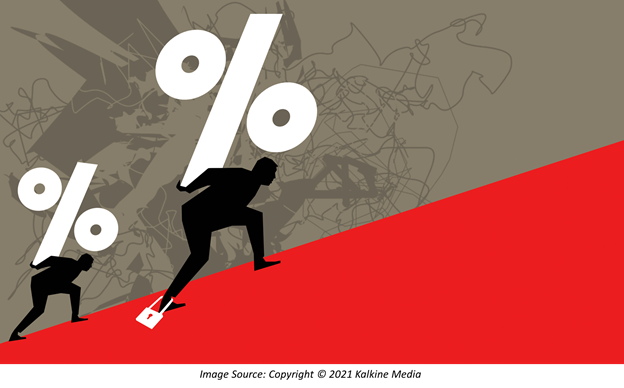
Among the pre-required conditions for an interest rate hike is also an inflation target of 2-3 per cent, which might soon be achieved based on the current quarterly results. However, the wage growth target of above 3 per cent might take some more time.
In a nutshell, Australia would have to push against a highly regulated system to increase wages just enough to prompt a rate hike by the RBA. According to the central bank itself, this shall not occur before 2024. Thus, RBA wants to tread cautiously along the path of rising interest rates.
ALSO READ: RBA Nov minutes: No rate hike until wage & inflation criteria are met
