
 AUS
AUS
 NZ
NZ
 UK
UK
 CA
CA
 USA
USA
 IND
IND







Highlights
- The big four banks have released key economic data for April, which was marked with rate hike expectations.
- The ANZ-Roy Morgan consumer confidence dipped slightly, while NAB monthly business survey showed an optimistic scenario.
- The CommBank household spending intentions saw a decline amidst rising prices and rate hike expectations.
As the economy sits on the cusp of a major transformation, the big four banks have released some crucial updates reflecting a mixed state of the economy. Consumers face a tougher road ahead as the central bank has raised the interest rates. This key decision by the Reserve Bank has inevitably impacted the consumer and business sentiment in the economy.
Some improvement is visible from the hit to consumer sentiment received from global factors. However, the threat of rising household expenditure is looming in the backdrop due to higher interest rates. The latest data from the big four banks gives a closer look at the factors leading up to the May rate hike.
Australia and New Zealand Banking Group Limited (ASX:ANZ) has recently released its monthly data on consumer confidence. Meanwhile, the Commonwealth Bank of Australia (ASX:CBA) and National Australia Bank Ltd (ASX:NAB) have released the household spending intentions index and monthly business survey for April 2022, respectively. Here is a closer glance at what the data had to say.
ALSO READ: How Australian Fashion Trademark will guide growth in national economy
ANZ-Roy Morgan Consumer Confidence remains unchanged
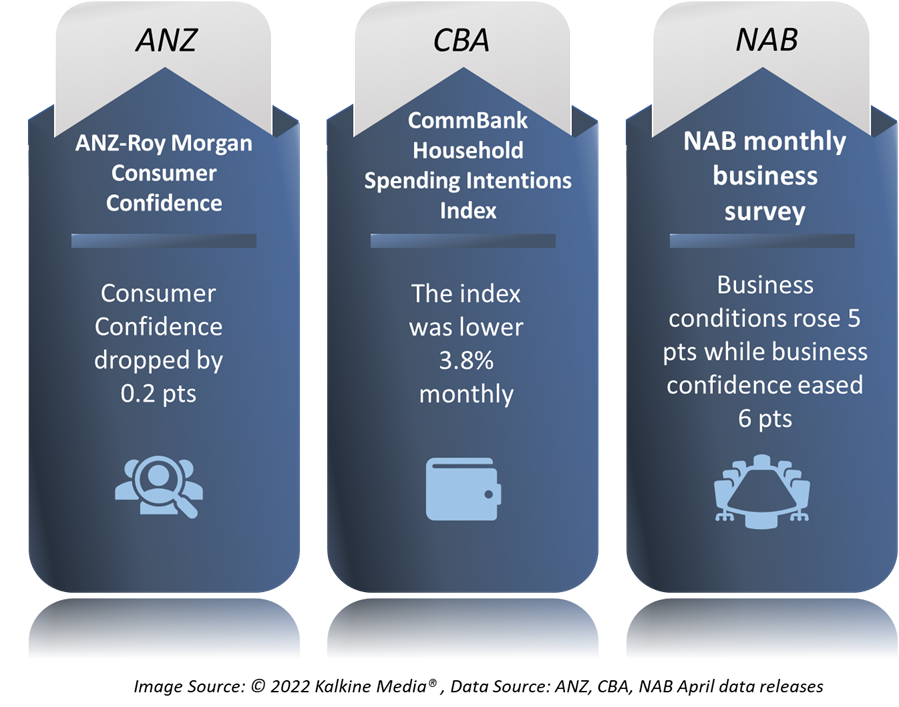
April was a month full of speculation about an interest rate hike by the Reserve Bank of Australia (RBA). The rate hike expectations filtered into Aussies’ consumer confidence, reflecting a small drop of 0.2 pts in the ANZ-Roy Morgan monthly consumer confidence data.
The drop of 0.2 pts was insignificant compared to the large drop seen last week after the Australia Bureau of Statistics (ABS) released the data on inflation. However, the recent decline has pushed consumer confidence to its lowest level since Victoria’s second wave of COVID-19 in August 2020.
Consumer confidence by housing status shows that for those paying off their home, the index was down for the second consecutive week by 4.6 pts. However, consumer confidence for those who own their home and are renting was higher this week by 1.3 pts and 2.6 pts, respectively.

State-wise data reveals that there was no uniformity in the index across states. New South Wales and South Australia recorded a slight increase in the index, while the index declined in Victoria, Queensland and Western Australia. Under a third of the total Australian population expects their family to be financially better off this time next year. On the contrary, a lesser proportion of the population believes that they will be worse off in the future.
It is worth noting that the interest rate expectations building up in April have prompted many households to delay their big purchases.
DO NOT MISS: Morrison-Albanese debate: key takeaways for markets
CBA Household Spending Intentions Index drops
In April, the CommBank Household Spending Intentions (HSI) Index fell from a record high set in March. The index was lower by 3.8% from the previous month, reaching the current level of 112.3. The recent drop from a record high value was observed due to a range of seasonal factors. Public holidays factored into the spending data for April, reflecting a lower value of the index.
How is Australian Job Market Faring?
The April fall was led by a 21.5% decline in home buying, with weaker data being observed in health and fitness, transport spending intentions and household services. However, spending intentions in travel, entertainment and retail sectors rose during the month. Overall, 8 out of 12 spending categories recorded a drop in April.
Providing some relief is the annual HSI data, which was higher by 5% over the previous year, though it also factors in the rise in prices. Despite the ongoing volatility in global factors, the bank has stated that the current data is consistent with the RBA rate hike.
CBA expects further rate hikes in June, July, August, and November 2022 and one final hike in February 2023, which will take the cash rate to 1.60%. The impact of this rate hike is most likely to be felt in the following categories - home buying, motor vehicles and retail and entertainment.
NAB monthly business survey shows an optimistic scenario
Despite a range of challenging factors, business conditions strengthened in April, while business confidence eased and remained above its long-run average. The recreation and personal services sector led the April gains, showing a much-awaited recovery.
However, rising prices have dampened the outlook for transport, and utilities and construction. But, conditions and confidence both remained overall strong. Business conditions rose 5 pts to +20 index points as trading conditions and profits drove the result.
Business confidence eased 6 pts to +10 index points, remaining above its long-run average after several months of steady increases. Forward orders also eased to +9 index points, and capacity utilization rose to 83.9%.
ALSO READ: Federal Election 2022: Healthcare needs and promises
