
 AUS
AUS
 NZ
NZ
 UK
UK
 CA
CA
 USA
USA
 IND
IND








Summary
- The changing nature of the British economy has prompted the need for new skills for many jobs.
- The CBI report highlights how the coronavirus pandemic has expedited the changes in the job world.
- Reskilling would help in boosting productivity, improving levels of job satisfaction, and enhancing opportunities of livelihood for workers.
The Confederation of British Industry (CBI) has warned that Britain could face serious threat if it does not upskill its workforce as businesses need skilled talent to stay competitive.
However, the working world is changing faster than people can develop the necessary skills.
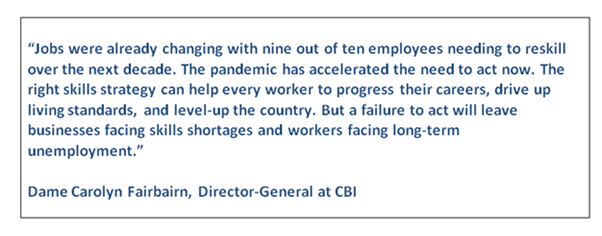
In its report, ‘Learning for life: Funding world class adult education’, which is based on an analysis by McKinsey & Company, CBI highlighted that 90 per cent of the current workforce or nine in ten employees would require reskilling by 2030 to be relevant. This reskilling programme would entail an additional cost of £13 billion on an annual basis.
The key factors that would transform the need for new skills for many jobs are the use of latest technologies and the changing nature of the British economy. The CBI’s report asserted that other roles are being lost completely. The report stated that the UK should utilise the present momentum to drive a nationwide reskilling effort to futureproof livelihoods as well as empower Britain’s competitiveness.
The study cautioned that the livelihoods of the most disadvantaged would suffer in case of lack of investment as the coronavirus pandemic has changed the basics of the job world. Terra Allas, Research and Economics Director at McKinsey & Company, said that changes driven by technology would transform both the economy and society. The coronavirus pandemic has expedited several of these trends, and some industries have shown more transformation during the past few months than they had over the past few years.
After leaving school, nearly 50 per cent of those from the lowest socioeconomic group in the UK did not get any training. Workers engaged in lower-skilled jobs faced higher risk of automation. Participation in training by this section is 40 per cent lower than that for higher-skilled workers. Regions that are known for traditionally sluggish employment growth are expected to encounter the most negative employment impacts from automation.
Britain’s mission of investing in training goes beyond the economy to include tackling wide inequalities. This formed an important component of the government’s objective to level up across the country. It is to be noted that in September, the CBI had hailed the Prime Minister’s Lifetime Skills Guarantee aimed towards solving the urgent skills challenge gripping the job market in the country. The CBI research that was conducted before the outbreak of the coronavirus pandemic presented an urgent need for going further and quicker for reskilling the UK’s workforce.
The report highlights how changes in the economy, fuelled by digitisation and automation, will dramatically change the skills sought by employers. It feared that the harsh choice that Britain needed to make was either invest in lifetime learning and upskilling of a vast majority of its workforce or remain in the business as usual. By opting for the latter, the country would risk not only a sustained unemployment rate on rise but also a widening skill gap.
Also read: Rishi Sunak offers help to check job losses as the economic recovery tapers off in August
Also read: Job Market Cheers With New Vacancies At The Highest Level Since Lockdown
Also read: Octopus Energy’s new data science and AI centre to create 1000 jobs
The coronavirus pandemic could be a potential catalyst for action as due to weaker demand in present times, many employees are not working at full capacity. The CBI noted that this time period could be utilised for training. Several employers have already started to provide this opportunity. Highlighting the need for scaling this further, the CBI recommended that business, unions, education providers, and government should work together to guarantee that the spare time is used productively.
The CBI expressed its willingness to associate and work with the unions, the government, and the education providers to guarantee that employees working fewer hours get as much opportunity as possible to retrain and reskill themselves. Dame Carolyn Fairbairn, Director-General at CBI, said that one of the most important missions that Britain needs to embark on in the coming 10 years was to ensure that people could settle in the fast-changing world of work.
Talking about the skills that British workers would need in the coming ten years, the CBI’s report stressed that the economy would be fuelled by automation and digitisation.
A vast majority of the employers in the country demand latest and relevant skill sets from the workforce. Below mentioned are some of the key skill sets that are being sought after by British employers:
- 21 million workers having basic digital skills
- 16 million employees with knowledge of critical thinking and information processing
- 15 million people to have leadership and management skills
- 14 million staff needed with interpersonal and advanced communication skills
- 9 million workforce to have STEM skills (advanced data analysis, mathematical, IT and programming skills, technology design, engineering and scientific research)
Conclusion
While upskilling could be understood as developing skills to remain updated with new aspects in technology and business, reskilling is commonly defined as updating skills through advanced training or upskilling. In order to capture the future skills opportunity, there is a need to encourage stronger partnership between businesses, government, academic sector, and workers. This would not only boost productivity and improve job satisfaction but will also enhance livelihood opportunities.
