
 AUS
AUS
 NZ
NZ
 UK
UK
 CA
CA
 USA
USA
 IND
IND








Highlights
- While investing and speculating are often used interchangeably, investing involves a considerably lower level of risk than speculation.
- Investing is often associated with a stable or guaranteed stream of returns in the future, while speculation has equal chances of loss or failure.
- Both investing and speculating are mere choices that market players must choose from, depending on their risk appetite and financial constraints.
Several people unknowingly use the terms - investment and speculation - interchangeably. However, both these terms have a separate meaning in the world of finance. While it is understandable why investors mistake one to be the other, it is essential to chart out the differences between the two.

Broadly speaking, investing refers to a less-risky endeavour in which the investor expects a profit in return for the money that he invests. However, speculation is a riskier venture in which there is a high probability of failure. A speculator enters the world of speculation knowing that he is subjecting himself to high chances of failure, which is beyond his control.
Thus, a fundamental difference between the two arises due to the varying intensity of risk among them. However, both investors and speculators take calculated risks during any transaction and are aware of the various possible outcomes awaiting them.
Interestingly, modern investment tools have made the line separating the two thinner. However, there are still certain ways in which investing and speculating can be distinguished. Let us understand the major difference between the two terms:
Investing for stable returns
An individual putting his money in a venture where the returns are expected to be stable or at the very least guaranteed at some point in the future is said to be investing for a profit. Investing involves purchasing an asset that will bring a future income stream, making the investor better off.
Broadly, any mechanism that brings returns to the investor can be defined as an investment. In financial markets, you can find investors buying stocks, bonds, mutual funds, or even physical assets such as gold or real estate.
INTERESTING READ: A Guide to Gold Financial Investments

Often investing is a gateway for individuals to execute a business plan or pay off a personal financial obligation. Most investments deliver cash flows like interest, dividends, or coupons. Meanwhile, investors can also reinvest profits to obtain higher returns in the future.
In daily life, investment is somewhat of a loosely interpreted term. For instance, consider a family where the parents save up money for their child’s education. In this case, the education provided is an investment for the family, with the parents expecting future returns in the form of a high-paying job and the development of necessary skills in their child. However, in financial terms, investment strictly pertains to assets that are either tangible like real estate or intangible like stocks.
RELATED READ: 6 Investing Tips When Thinking About Buying A Property
Speculating to gain from volatile market conditions
Speculating involves making use of the fluctuating market conditions to earn profits. These fluctuating conditions pose a considerably high risk for speculators as it may happen that the market does not turn in their favour, and they lose out on all their money.
In one way, speculating can be understood as a bet with high stakes. However, it is not the same as gambling or betting, where decisions are purely made on intuition, and the outcome is highly dependent on fate. In speculation, individuals make informed decisions with prior knowledge about the asset of their interest.
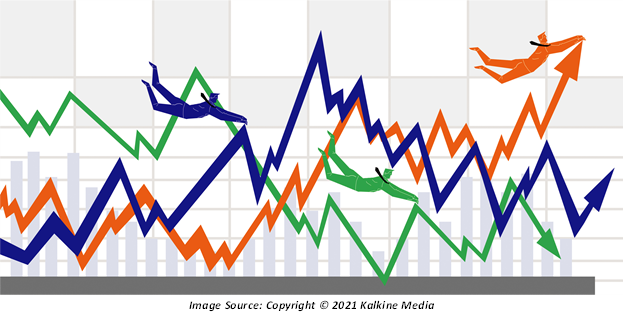
Speculators buy securities only to hold them for a short period before selling them off for a profit, or sometimes, even loss. For instance, stock market investors who are especially drawn towards penny stocks or low-cap firms that may grow in the future, take over a speculative risk in doing so. The possibility of such stocks becoming or not becoming high-paying investments is usually equal. However, the investor who puts his money into them has based this decision on his understanding of the market or some valuable information about the company issuing the stocks. Sometimes, the motivating factor for a speculator might just be a hunch or a premonition.
ALSO READ: Why shouldn’t you buy penny stocks?
Investment vs speculation
Given the basic understanding of both, it is now time to delve into the difference between investment and speculation. Here are the key distinguishing features between the two aspects:
- Risk intensity - which is higher for speculation
- The time period for holding the funds - which is much more for investing, and
- The reason behind profitability – which is the change in the value of the asset in the case of investment, and the market fluctuations caused by forces of demand and supply in case of speculation.
Moreover, investment is made with an individual’s own money, unlike speculation. Nevertheless, speculators majorly use borrowed funds and leverage them to earn profits. This causes a fundamental difference in the approach taken by speculators and investors. Using funds from their own pockets, investors often tread carefully in the market. However, speculators have a more aggressive approach as they prefer to take large financial strides that can even result in high losses.
Another interesting factor is that while investors may conduct an intensive analysis of the asset of their choice, speculators often rely on technical charts and opinions received by them while forming their decisions.
DO NOT MISS: What does the S&P/ASX 200 measure? What is the sector-wise breakdown of the index?
Thus, it is safe to say that investing and speculating are two simple choices that individuals can take up based on their risk appetite and financial situation. An individual can have both investments and speculative assets in his portfolio simultaneously, with a major factor affecting his returns being his knowledge of the market.
