
 AUS
AUS
 NZ
NZ
 UK
UK
 CA
CA
 USA
USA
 IND
IND








Summary
- The coronavirus outbreak and the accompanying travel restrictions threw a deep impact on airline companies worldwide.
- Despite financial losses and COVID-related operational setbacks, Canada’s top air carriers Air Canada (TSX:AC) and WestJet (TSX:ONEX) remain popular among investors.
- Both the airlines have been incorporating passenger safety measures such as COVID test campaigns in an attempt to change the Canadian government’s mind about travel restrictions.
The global airline industry has taken quite a beating in the wake of the COVID-19 outbreak. Lockdown restrictions, coupled with the falling demand in air travel, led to carriers incurring massive losses in their business. This, in turn, caused job losses and pay cuts. But despite all this gloomy news, stocks of two Canadian airlines Air Canada (TSX:AC) and WestJet, which is owned by Onex Corporation (TSX: Onex) continues to register high stock activity.
Both the airlines drew attention for mass layoffs and flight cancellations recently, especially with WestJet announcing a pay cut over 50 per cent. However, Air Canada’s track performance on the Toronto Stock Exchange (TSX) and WestJet Airlines’ slow but steady recovery since its March market lows have triggered interest among investors.
Onex Corporation (WestJet Stock/ TSX: ONEX)
Current Stock Price: C$ 59.07
WestJet Airlines made headlines last week when it announced a pay cut of up to 53 per cent starting September 27. In a company memo, the airlines company said that its furloughed employees who avail the Canada Emergency Wage Subsidy (CEWS) could face a reduction from C$ 847 to C$ 400 in their maximum weekly payment. This decision came days after the Canadian government announced its call to update the extended federal wage subsidy.
The airline also attracted some attention earlier this month when a toddler not wearing a mask onboard led to police being summoned and the flight being ultimately cancelled.
WestJet Airlines, which formerly traded on the TSX under the ticker ‘WJA’, was acquired by investment and asset management company Onex Corporation in December 2019. Apart from WestJet, Onex’s diverse portfolio of investments includes companies like Advanced Integration Technology, ASM Global, Celestica, etc.
In the beginning of the year (January 21), shares of Onex Corporation were trading at C$ 89.25, their highest level so far in 2020. As the markets tanked amid the coronavirus pandemic in March, Onex’s stock price dived to C$ 40.6 (March 19). Between January and March, it plunged nearly 55 per cent in value. The scrips are currently down 28 per cent year-to-date (YTD).
While Onex Corporation’s stock price is still below its pre-pandemic levels, it has rebounded since the March lows. Its shares grew about 23 per cent in value in the last six months and currently have a 10-day average trading volume of 314,512.
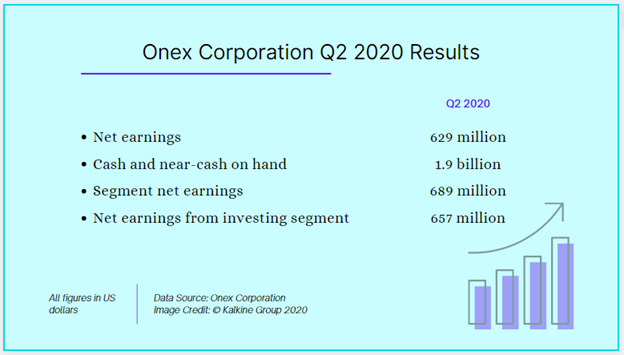
Onex Corporation recorded net earnings of US$ 629 million in its second quarter ending 30 June 2020. By the end of the latest quarter, its cash and near-cash on hand amounted to US$ 1.9 billion. The company saw segment net earnings of C$ 689 million in Q2 2020, which included net earnings of US$ 657 million from its investing segment and US$ 32 million from its wealth and asset management segment.
Onex declared a quarterly of dividend of C$ 0.10 on September 17 and has a current yield of 0.677 per cent, as per the TSX data. It has a market cap of C$ 5.6 billion, a price-to-book (P/B) ratio of 0.674 and a price-to-cash flow (P/CF) ratio of 9.8.
Air Canada (TSX:AC)
Current Stock Price: C$ 15.8
Air Canada has been on the news for things like furloughs, pay cuts and flight cancellations for a while now. But at the same time, it is trying to up its game in the face of the coronavirus pandemic, which has rained special troubles on airline companies worldwide. Air Canada implemented voluntary COVID-19 testing campaign for international passengers at the Pearson Airport in Toronto earlier this month. It also recently announced an unlimited domestic travel offer called Infinite Canada Flight Pass.
In the midst of all the COVID-inflicted setbacks, shares of Air Canada continue to garner much attention amid investors. Ranked high among stocks with heavy trading activities on the TSX, Air Canada shares recorded an average trading of 4.7 million in the last 10 days.
From the highs of C$ 52.09 (January 14), Air Canada stock price sank to C$ 12.15 during the pandemic-triggered market crash (March 20) — a decline of nearly 77 per cent. It recorded a decrease of 67 per cent YTD and down nearly 10 per cent in the last six months.
Coming to its latest quarterly earnings, the impact of the pandemic was quite clear. Air Canada recorded total revenues of C$ 527 million in its second quarter ending 30 June 2020, an 89 per cent YoY decline. It saw an operating loss of C$ 1.5 billion in Q2 2020, a massive drop from an operating income of C$ 422 million in Q2 2019. With all the lockdown and travel restrictions in place, the airline saw the total number of passengers carried drop by a whopping 96 per cent in Q2 2020.
Air Canada’s latest stock movements, weak financial report and continued operational hiccups aside, its popularity among investors remains strong. It currently has a market cap of C$ 4.68 billion, a price-to-book (P/B) ratio of 2.293, and a price-to-cash-flow (P/CF) ratio of 18.70, as per the TSX data. Air Canada also records a debt-to-equity (D/E) ratio of 2.06 and return on equity of 115.86 per cent.
