
 AUS
AUS
 NZ
NZ
 UK
UK
 CA
CA
 USA
USA
 IND
IND


.jpg)



Commercial airline companies around the world suffered a major setback in the wake of the COVID-19 outbreak after governments implemented strict measures to contain the spread of the virus. Even as limited flying was eventually allowed to resume, it was not enough to make up for the losses. Despite this, stocks of Canadian airlines such as Air Canada (TSX:AC) and WestJet (TSX:ONEX) have been in demand among investors.
Air Canada and WestJet recently made headlines after the carriers were forced to cancel hundreds of flights in the wake of spike in coronavirus cases. In order to keep up with the losses, Air Canada laid off about 20,000 employees, while WestJet let go off over 4,000 employees since the March market crash.
The airline companies have been implementing various initiatives such as voluntary COVID-19 testing at airports since the resumption of its flights around August. WestJet started offering complimentary coronavirus insurance for eligible customers, and Air Canada soon followed its footsteps.
Air travel, however, continues to be under the shadow of stringent restrictions put in place by the Canadian government. The International Air Transport Association (IATA) recently wrote to the federal government to reconsider its travel restrictions, suggesting that it opts for a less strict protocol for air travel.
Air Canada’s track record of performing well at the Toronto Stock Exchange (TSX) and weathering tough times like the 2003 SARS pandemic continues to draw investors. For WestJet, its steady recovery after losing ground amid the March market crash has been drawing attention on the stock market. Here is a closer look at these companies and their recent performances on the TSX.
Air Canada (TSX:AC)
Current Share Price: C$ 17.98
Shares of Canada’s largest carrier Air Canada are currently outperforming the market on the TSX, having garnered an average trading volume of over 5 million in the last ten days. Its stock price had plummeted about 82 per cent between January and March during the coronavirus pandemic-triggered market crash, falling as low as C$ 9.27 on March 18. It also saw a nearly 63 percent year-to-date (YTD) decline in share value. In the last six months, however, Air Canada’s scrips have climbed by about 39 per cent.
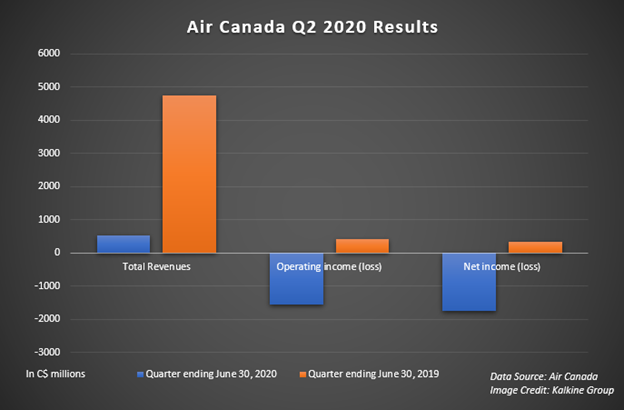
The pandemic’s impact echoed in Air Canada’s second quarter financial results for 2020, which reported an 89 per cent YoY fall in total revenue. The operating loss for Q2 2020 was over C$ 1.5 billion, and the airline saw a massive drop of 96 per cent YoY drop in the number of passengers it chartered in this quarter.
Despite its losses and continued disruption in functioning amid the pandemic, Air Canada remains much popular among Canadian investors. The company’s market cap stands at C$ 5.33 billion. Its current price-to-book (P/B) ratio is 2.61, its price-to-cash-flow (P/CF) ratio is 18.70, and its debt-to-equity (D/E) ration is 2.06, as per the data on the TSX. Air Canada's return on equity is 115.86 per cent at present.
Air Canada has been in news lately for its recent flight cancellations and the announcement of its Infinite Canada Flight Pass – a limited-time offer for unlimited domestic travel at a fixed rate. It has also been receiving attention for its voluntary COVID-19 testing initiative at Toronto’s Pearson Airport.
Onex Corporation (WestJet Stock / TSX: ONEX)
Current Stock Price: C$ 61.22
Publicly traded WestJet Airlines (Formerly TSX: WJA) became a private company after investment and asset management group Onex Corporation purchased it in December 2019. Onex Corporation currently has a market cap of C$ 5.8 billion and a diverse portfolio of investments, including industrial automation company Advanced Integration Technology, venue management firm ASM Global, electronics manufacturer Celestica, etc.
Onex Corporation’s stock price dropped to C$ 40.6 on March 19, its lowest point in five years, during the pandemic-inflicted market crash. It also registered a 25 per cent year-to-date decline in its share price. Between March and September, however, Onex Corporation scrips saw a steady climb of over 50 per cent in value. Though it is far from its pre-pandemic levels, its share price is climbing that way.
Onex Corporation saw total segment net earnings of US$ 689 million in its second quarter ending 30 June 2020. Net earnings from the investing segment alone was US$ 657 million, primarily driven by its net gains on private equity and credit investments. As on 30 June 2020, the company had US$ 1.9 billion cash in hand.
Despite the trying times of COVID-19, Onex Corporation pays a quarterly dividend of C$ 0.10 and currently has a dividend yield of 0.65 per cent, as per TSX data. Its current price-to-book (P/B) ratio is 0.70, its price-to-cash-flow (P/CF) ratio is 9.80, and its debt-to-equity (D/E) ration is 0.69. At the moment, Onex Corporation stocks have a 10-day average trading volume of 655,637.
