
 AUS
AUS
 NZ
NZ
 UK
UK
 CA
CA
 USA
USA
 IND
IND


.jpg)





Summary
- Canadian stock markets tumbled after the finance department forecast C$ 381.6-billion budget deficit for the FY 2020-21.
- TSX Composite doffed over 206 points or 1.185 per cent; Energy and finance stocks were the biggest losers on Monday.
- Investors are also awaiting the results of the six biggest banks of Canada, which are expected to post a drop in earnings.
Stock markets tumbled on Monday following the C$ 381.6-billion budget deficit projected by the finance department for the fiscal year 2020-21. Toronto Stock Exchange (TSX) Composite, the Canadian benchmark index, lost over 206 points or 1.185 per cent to 17190.25.
Energy and finance indices were the top losers, doffing 6.45 per cent and nearly 2 per cent, respectively. The industrials sector also fell by 0.7 per cent while the materials sector lost 1.1 per cent.
However, the information technology index added 0.36 points or 0.2 per cent to 176.34. Ecommerce giant Shopify Inc (TSX:SHOP) was the biggest price gainer of the day, up 4.08 per cent to C$ 1,397.77.
Other top gainers included Kinaxis Inc (TSX:KXS), Cargojet Inc (TSX:CJT) and Ritchie Bros. Auctioneers Incorporated (TSX:RBA).
Suncor Energy Inc (TSX:SU), Bombardier Inc (TSX:BBD), Aurora Cannabis Inc (TSX:ACB), and HEXO Corp (TSX:HEXO) were the most active stocks on Monday.
Junior Canadian index TSX Venture Composite gained 1.22 points or 0.16 per cent to settle at 750.42. Gold futures (Feb 2021) fell 0.48 per cent to $1,780.90 an ounce.
The biggest price decliners included Constellation Software Inc (TSX:CSU), E-L Financial Corporation Limited (TSX:ELF) and Canadian National Railway Company (TSX:CNR).
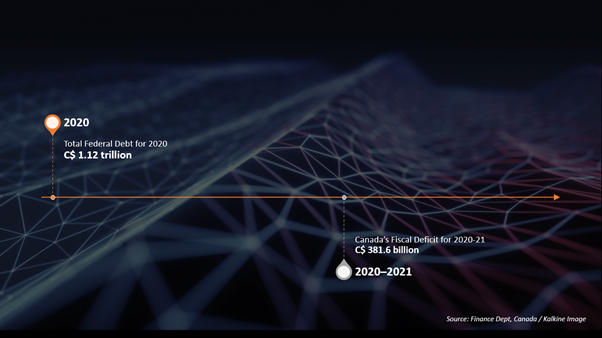
The Canadian economy’s budget deficit is projected to touch C$381.6 billion this year due to extensive COVID-19 recovery and support plans, the finance department informed on Monday. The deficit is over 11 per cent higher than projected in July, taking the overall federal debt to C$ 1.12 trillion this year.
So far, Canada has spent C$1 billion to secure 429 million doses from seven potential COVID-19 vaccine candidates.
However, this deficit is likely to “fall significantly” to C$ 171.9 by 2022-23 as the economy recovers. The federal government will deploy additional fiscal support to speed up the economic recovery till the coronavirus is under control. To ensure the road back to recovery, the government will set aside 3 to 4 per cent of the Gross Domestic Product (GDP), up to $100 billion, in the next three fiscal years.
Meanwhile, investors are awaiting the results of the six biggest banks of Canada, which are expected to post a drop in earnings. The lenders have been setting aside massive amounts as provisions for credit losses since the pandemic struck the economy in March. The S&P/TSX Composite Index Banks index lost 2.29 per cent on Monday.
On Wall Street, the Dow Jones lost 271.73 points at 29,638.64. The S&P 500 was down by 16.72 points to 3,621.63 while NYSE Composite plunged by 192.03 points or 1.35 per cent to 14,006.46. The NASDAQ was also down marginally by nearly 0.0.6 per cent or 7+ points to settle at 12,198.74.
