
 AUS
AUS
 NZ
NZ
 UK
UK
 CA
CA
 USA
USA
 IND
IND


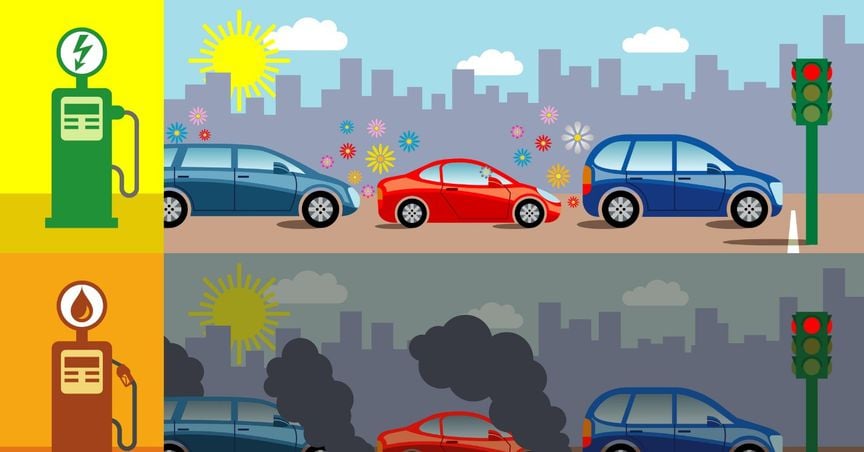





Highlights
- Australia's prime minister is pushing for Electric Vehicles.
- Led by Luxury brands, mainstream auto companies are investing in the EV transition.
On Tuesday, Australia's prime minister, Scott Morrison, announced plans to encourage electric vehicle buying. The plans came weeks after the Australian Federal Government was accused of lagging in the climate change response. PM Morrison has offered subsidies on EVs for now and believes that as the technology becomes cheaper with time, provided subsidies would be taken back.
What does the Federal EV subsidy mean?
As of now, less than two per cent of new vehicles sold in Australia are electric. The AU$250 million plan seeks to include private enterprises to accelerate the rollout of 50,000 charging and hydrogen fuel stations in Australia. With this move, Government expects a 30% rise in passenger EVs, passenger and light commercial trucks by 2030.
PM Morrison’s EV policy: 10 electric cars Aussies can choose
Although the Federal Government won't force Australians to buy EVs, subsidies may influence their choice. Even car manufacturers are speeding up electric production. It ultimately indicates availability and affordability of EVs for Australians are to rise in the near future.
Which are the best electric cars in Australia?
Since the cost of producing electric cars is high, luxury brands are leading the race. However, even mainstream model companies are investing in the transition. So, here are the top 10 electric cars in Australia.
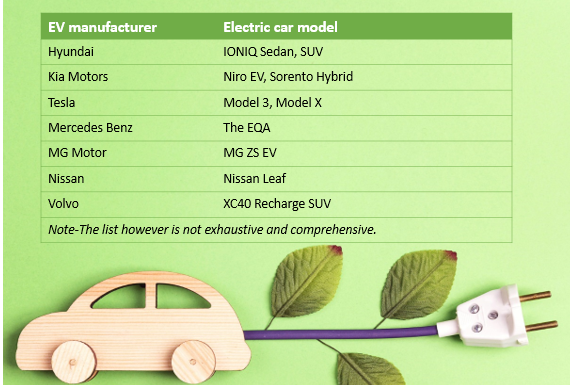
Image Source: © Windnight | Megapixl.com, Table: © 2021 Kalkine Media
- Hyundai's IONIQ Electric sedan – this EV has a jazzed up exterior styling, with a 38.3 kWh battery; Hyundai's engineers claim it as an efficient performance car, with an energy consumption rate of 13.8 kWh per 100 km. Priced at AU$49,970, it is the second-cheapest EV on sale in Australia. Features include a touchscreen infotainment system, smartphone mirroring, and an intelligent key with a push-button start.
- Another EV is Hyundai's SUV with an all-wheel-drive (AWD). It comes with a 1.6-litre petrol engine alongside a 44.2kW electric motor. The combined output is also sound. The PHEV version is not available as of now in Australia but can be bought overseas.
- Kia's Niro EV comes with a longer wheelbase and body and is suitable for families. It is available in two models; a Niro EV S and an EV Sport. Both are endowed with a 150 kW/395 Nm motor from Hyundai. The Niro EV offers a 7-year unlimited-kilometre warranty, alongside an 8-year battery warranty.
- Kia's Sorento Hybrid is also set to launch in Australia in early 2022. The EV will add on to Kia's portfolio offerings in Australia, including petrol, diesel, PHEV, and hybrid version.
- Next on the radar is the Tesla Model 3; the brand is enough for this battery-electric vehicle. It comes in Tesla's trademark 'Spartan' interior and is known for its user interfaces and seamless mobile vehicle control. Tesla also offers supercharger network benefits in Australia. Model 3 comes with a 4- year/80,000 km in Australia.
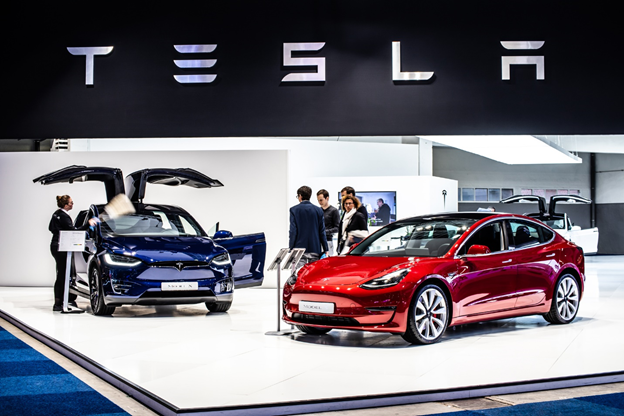
Image Source: © Pzx941 | Megapixl.com
- Tesla Model X is a seven-seater from Tesla's electric car range, it comes with a significant interior upgrade. However, it is to arrive in Australia by late 2022, so probably with the subsidy benefits. Tesla offers a stalk-less steering wheel and no gear selector. It has a 17-inch front touchscreen and an 8-inch for rear occupants.
- The EQA from Mercedes-Benz is similarly sized to Kia's Niro EV. It allows the driver to reach 0-100 km/h in 8.9 seconds. The distinctive Mercedes-Benz EQ design gives it an electrified A-Class look compared to any other high-riding crossover. Car embellishments include a gloss-black front that will command attention and a twin-screen MBUX dashboard. In Australia, the Mercedes-Benz EV comes with a 5-year/unlimited km warranty alongside a battery warranty of 8-year or 160,000 km.
- MG ZS EV – it is the cheapest battery EV sold in the Australian EV market. It is price begins from AU$40,990. The EV comes from the Chinese auto king-SAIC's subsidiary MG Motor. It charges at a 50kW peak rate, meaning an 80 per cent battery level in just 45 minutes. A 7- year/unlimited km warranty covering lithium-ion battery is available.
Do Watch- How to maintain Electric Vehicles(EVs) for better performance? - Expert Talk with Mr Edward Renardo
- Next on the list is the Nissan Leaf. The car comes with good aerodynamics, visibility and interior cabin space. It carries a 62 kWh battery having an older air-cooled battery design. The Leaf gets charged in 52 minutes with a Japanese design plug. Nissan Australia provides a warranty of 5-year on unlimited km and an 8-year/160,000 km for battery defects.
- Volvo's XC40 Recharge SUV- is Volvo's most powerful car, covering 100 km/h in 4.9 seconds. It comes with a 78 kWh battery with twin electric motors. Volvo's usual high-quality interiors are inside the vehicle, with a new Android infotainment system, keyless entry, and satellite navigation. Volvo in Australia offers a 5-year/unlimited km warranty with an eight-year battery warranty.
Bottom line
Electric adoption is prominent amongst automotive companies in Australia. The all-new subsidy to push EV infrastructure has the potential to add on sales. Aussie consumers will in future be able to choose from an expansive range of EVs.
Want to know- Are these the 10 hottest electric vehicles of 2021?
