
 AUS
AUS
 NZ
NZ
 UK
UK
 CA
CA
 USA
USA
 IND
IND


.jpg)





Summary
- Besides being widely accepted in traditional industrial applications such as steel, demand for manganese is growing for clean energy and energy storage applications.
- Eclipse Metals’ Mary Valley Manganese Project holds substantial potential for bulk shallow high-grade mineralisation, especially in the historical mining centres.
- Magnetometer survey at the project is scheduled to be completed ahead of drilling expected to commence in the second half of September 2020.
- The survey over the main area of manganese workings is anticipated to indicate hidden lenses of high-grade manganese mineralisation more definitively.
Manganese, a silvery-gray metal quite similar to iron, is predominantly used for improving the quality and workability of the finished steel product. In fact, steel with 8% to 15% manganese exhibits extremely high tensile strength of up to 863 Mega Pascals or in simpler terms can handle pressure up to ~8500 times the atmospheric pressure.

Almost 80-90% of the global manganese supply accounts for steel making, while remaining is used in the manufacturing of electrical components, fertilisers, batteries and non-ferrous alloys, especially aluminium. The application of manganese in commercial battery packs with major application in the electric mobility and renewable energy sectors has been under spotlight for quite some time now.
With electric vehicle pioneer, Tesla already using the nickel-manganese-cobalt (NMC) battery packs for the Powerwall energy storage device. The increased focus on renewable energy segments bolsters the potential for future demand for manganese.
In that backdrop, let us discuss multi-commodity focused explorer, Eclipse Metals Limited (ASX:EPM), which is advancing on the highly prospective Mary Valley Manganese Project in the Gympie district of southwest Queensland. Additionally, the explorer owns key mining projects focussed on uranium, vanadium, gold, and palladium in its portfolio.
Mary Valley Manganese Project with Potential for Bulk Surface Rich Lodes
The Mary Valley Manganese Project stretches over a 31 square kilometre area with long heritage of manganese mining dating back to late 1910s.
The largest historical mine is located at the Amamoor No.1 Manganese Deposit, which opened in 1920 and operated erratically until 1961, when it was finally closed down producing over 19,630 tonnes of ore with 51% Mn and 10% silica. The aggregate recorded production at the Mary Valley project is estimated at 31,477 tonnes of ore with extremely high manganese grade ranging from 42% to 51%.
Magnetometer Survey and Drilling Program to Target Shallow High-Grade Mineralisation
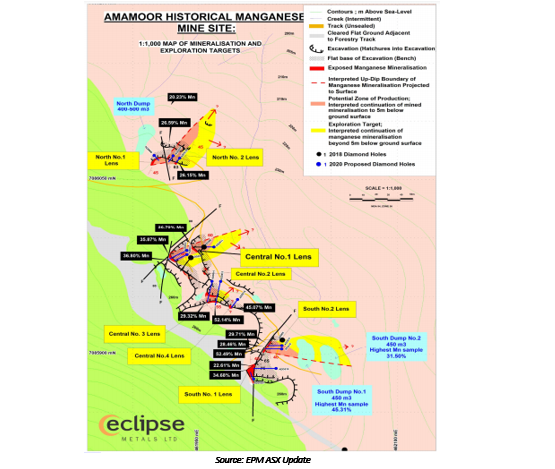
Magnetometer Survey - An extensive ground magnetometer survey is scheduled to be completed prior to the commencement of the second phase diamond drilling program in the latter half of September at the Amamoor Manganese Project.
The magnetometer survey will focus on the manganese workings to facilitate better siting of the drill holes. The petrophysical studies on the core samples from the 2018 drilling program displayed high-grade manganese mineralisation with substantial magnetic susceptibility.
The dominating minerals hosting manganese minerals included hausmannite and braunite. Moreover, the International Mineralogical Association (IMA) accepted a new manganese mineral known as Amamoorite, as identified during the petrological studies.
The 2018 reconnaissance diamond drilling program had intersected high-grade manganese mineralisation with grades up to 62% MnO. The surface technical evaluation had indicated potential for substantial high-grade mineralisation outcropping to the surface.
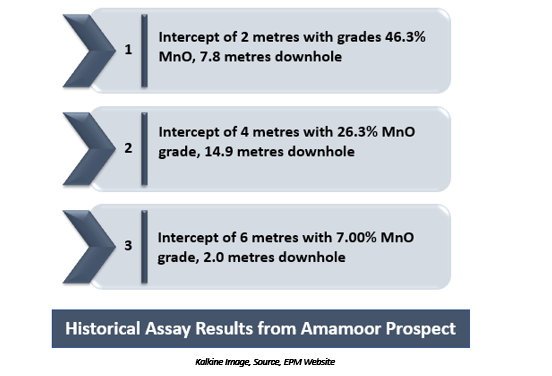
Upcoming Diamond Drilling Program - Eclipse Metals plans to commence a 500-metre diamond drilling program at the project to extend the known high-grade manganese mineralisation in the historically mined Amamoor district.
Further, several drilling holes with depths up to 60 metres have been planned to test the extensions of high-grade manganese mineralisation. The drilling contractor has been finalised and supervisory personnel have already been engaged.
Shallow and high-grade manganese mineralisation with potential for commercial applications in the battery, steel and alloy industries enhances the suitability of a “Direct Shipping Ore” (DSO) operation at the Mary Valley Project, according to Eclipse Metals’ Executive Chairman Carl Popal.

Stock Performance - EPM stock traded at A$ 0.007 on 10 September 2020 with a market capitalisation of A$ 9.9 million. In the last six-month period, the stock has delivered a return of 40%.
For Detailed Discussion on Eclipse Metals’ Devil’s Elbow U-Au-Pd Project, please read Eclipse Secures Negotiations for Tenements Adjacent to Devil’s Elbow U-Au-Pd Prospect
