
 AUS
AUS
 NZ
NZ
 UK
UK
 CA
CA
 USA
USA
 IND
IND








Australia’s biotechnology sector has grown from a niche space into a bona fide growth engine for the local market. From blood-plasma therapeutics to radiopharmaceuticals, implantable medical devices, wound-regeneration scaffolds, and rare-disease drugs, the ASX now hosts a rich collection of companies targeting global healthcare markets.
Whether you’re a long-only investor building a healthcare allocation or a research-driven trader chasing catalysts, understanding the structure, key players, and risk profile of ASX-listed biotech is essential.
What “Biotech” Means on the ASX
The term “biotech” is often used as a catch-all for life sciences, but ASX-listed companies span multiple GICS sub-industries: Biotechnology, Pharmaceuticals, Life Sciences Tools & Services, and Health Care Equipment.
In practice, market participants tend to group them into four broad buckets:
- Biopharma – Therapeutics, gene therapies, and vaccines (CSL, Neuren, Mesoblast, Clinuvel)
- Medtech/Devices – Implantable and surgical devices (Cochlear, Nanosonics, PolyNovo)
- Diagnostics – Risk tests and biomarker platforms (Proteomics International)
- Radiopharma/Theranostics – Imaging and targeted radionuclide therapy (Telix Pharmaceuticals)
Australia punches above its weight globally. According to AusBiotech, as of March 2024, there were 178 ASX-listed life sciences companies with a combined market cap above AUD 250 bn—a testament to decades of investment in science translation and commercialization.
Why Biotech Captures Investor Imagination
Biotech investing offers asymmetric payoffs—a single positive clinical result, regulatory approval, or reimbursement win can re-rate a company dramatically, while a failed trial can erase half the market cap overnight.
Typical drivers of biotech returns include:
- Regulatory catalysts: IND clearances, Phase 2/3 readouts, FDA/EMA/TGA approvals
- Commercial inflection points: First profitable year, U.S. launch milestones, partner royalties
- Platform leverage: Once validated, platforms (e.g., plasma, radiopharma, polymer scaffolds) can be extended to new indications, multiplying value
The flipside is just as important: clinical risk, capital intensity, and shareholder dilution remain part of the biotech journey.
3) The ASX Biotech Landscape by Segment
- A) Biopharma Leaders & Profitable Mid-Caps
CSL Limited (ASX:CSL)
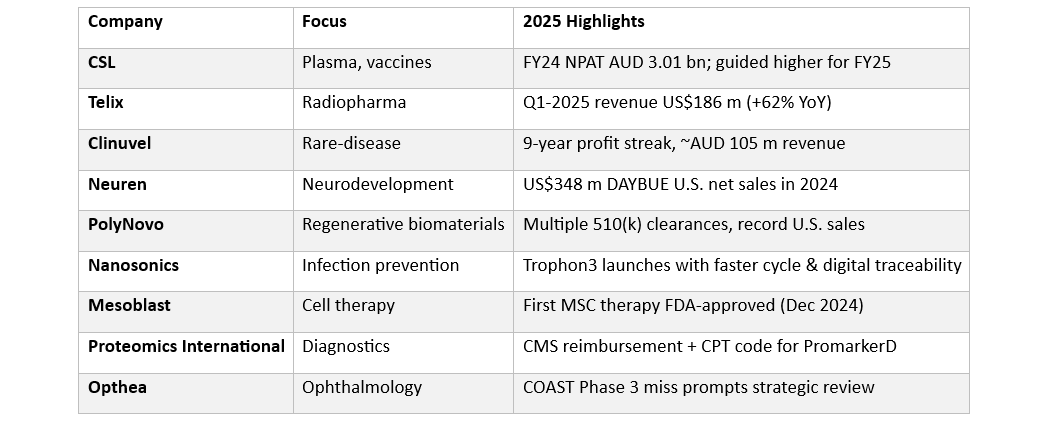
CSL Limited, Australia's premier biotechnology company, reported a net profit after tax of US$3.0 billion for the fiscal year ending June 30, 2025, marking a 17% increase on a constant currency basis. The company's underlying profit (NPATA) rose 14% to US$3.3 billion. This growth was primarily driven by CSL Behring, which achieved a 7% increase in immunoglobulin sales, totaling AUD 6.06 billion. Additionally, CSL's influenza vaccine division, Seqirus, and its nephrology unit, Vifor, contributed to the overall performance. Looking ahead, CSL projects higher profits for FY25, underscoring its position as a stable, low-risk biotech leader.
Telix Pharmaceuticals (ASX/Nasdaq:TLX)
Telix Pharmaceuticals has emerged as a notable player in the radiopharmaceutical sector. In Q1 2025, the company reported unaudited revenue of approximately US$186 million, a 62% increase year-over-year. This growth was largely attributed to its flagship product, Illuccix®, a Ga-68 PSMA-PET imaging agent for prostate cancer, which achieved US$151 million in global sales during the quarter. The strong cash flow from Illuccix® is enabling Telix to fund its pipeline of therapeutic radiopharmaceutical assets, accelerating its path to profitability. The company has reaffirmed its FY25 revenue guidance of AUD 1.18–1.23 billion.
Clinuvel Pharmaceuticals (ASX:CUV)
Clinuvel Pharmaceuticals continues to demonstrate consistent growth, reporting AUD 105.3 million in revenue for FY2025, a 10% increase from the previous year. The company's net profit after tax was AUD 36.2 million, marking its ninth consecutive year of profitability. This performance is driven by the commercial success of SCENESSE® (afamelanotide 16mg), a treatment for erythropoietic protoporphyria (EPP), which has a strong market presence in Europe and the U.S. Clinuvel is also advancing its Phase III clinical program for vitiligo, reflecting its commitment to expanding its therapeutic portfolio.
Neuren Pharmaceuticals (ASX:NEU)
Neuren Pharmaceuticals has achieved significant milestones with its Rett syndrome treatment, DAYBUE™ (trofinetide). In 2024, U.S. partner Acadia Pharmaceuticals reported net sales of US$348.4 million for DAYBUE™, nearly doubling from the previous year and aligning with the top end of guidance. Neuren earned approximately A$213 million in royalties from these sales. Looking forward, Acadia anticipates full-year 2025 net sales of US$380–405 million, which would further bolster Neuren's financial position and support the development of its second drug candidate, NNZ-2591, targeting multiple neurodevelopmental disorders.
- B) Medtech & Biomaterials
Cochlear Limited (ASX:COH)
Cochlear stands as a global pioneer in implantable hearing solutions, with a portfolio spanning cochlear implants, bone conduction devices, and acoustic implants. In FY24, the company reported revenue of AUD 2.26 billion, up approximately 15% year-on-year, reflecting sustained demand across both mature and emerging markets. Underlying net profit rose around 27% to AUD 387 million, underscoring strong operational leverage and disciplined cost management.
The acquisition of Oticon Medical strengthened Cochlear’s position in bone conduction solutions, adding both complementary products and expanded geographic reach. Meanwhile, Cochlear continued its substantial investment in research and development, committing AUD 270 million in FY24 to innovation programs. This ongoing R&D spend supports next-generation device development, software enhancements, and integration with telehealth and remote programming capabilities, positioning the company to capture growing demand for hearing implants in aging populations globally.
Cochlear’s recurring services and aftermarket revenue, including processor upgrades and warranty programs, enhance margins and reduce reliance on new device sales alone. With strong brand recognition, global clinical networks, and scale-driven economics, Cochlear represents the “blue-chip” medtech exposure on the ASX, a combination of innovation, growth, and defensive cash flow.
Nanosonics Limited (ASX:NAN)
Nanosonics is a specialist in infection prevention, particularly in ultrasound probe disinfection. Its flagship product, trophon®, provides automated high-level disinfection, improving patient safety and compliance with hospital infection-control standards. The company has recently launched trophon®3, featuring faster disinfection cycles, enhanced operational efficiency, and digital traceability to log compliance, an increasingly important factor for hospital administrators and regulatory bodies.
Revenue growth is being supported by expanded adoption in hospitals and diagnostic centers, driven by both safety concerns and cost-efficiency incentives. Nanosonics’ products also reduce human error in manual disinfection processes and allow healthcare institutions to meet stringent accreditation requirements. The recurring consumables component of the business—cartridges and related maintenance—generates high-margin annuity-like revenue streams, complementing device sales and improving overall unit economics. The combination of innovative infection-control technology, workflow integration, and strong regulatory compliance positions Nanosonics as a leading Australian medtech growth story.
PolyNovo Limited (ASX:PNV)
PolyNovo specializes in advanced biomaterials, particularly NovoSorb®, a synthetic polymer used for complex wound care, burns, and surgical applications. The company has achieved several FDA 510(k) clearances in 2025, expanding the indications for both its NovoSorb® dermal regeneration templates (BTM) and its surgical adjuncts (MTX products). This regulatory progress has opened new hospital markets and broadened clinical adoption.
The U.S. market has been particularly strong, with record monthly sales reflecting both increasing clinical awareness and hospital procurement. PolyNovo has also scaled its manufacturing capabilities to meet growing demand, with production expansions allowing faster supply and geographic diversification. Strategic investments in product training, surgeon education, and digital integration ensure clinicians are able to maximize outcomes with NovoSorb®, reinforcing brand loyalty and repeat use. With a combination of regulatory momentum, commercial traction, and robust manufacturing scale, PolyNovo exemplifies how Australian medtech companies can achieve global impact in specialized therapeutic segments.
- C) Cell Therapy & Advanced Therapeutics
Mesoblast (ASX/Nasdaq:MSB)
Mesoblast achieved a major milestone with FDA approval of Ryoncil® (remestemcel-L) in December 2024 for pediatric steroid-refractory acute graft-versus-host disease (SR-aGVHD), marking the first U.S. approval of a mesenchymal stromal cell (MSC) therapy. This breakthrough establishes regulatory precedent, enabling future label expansions, broader indications, and reimbursement negotiations, while validating the company’s regenerative medicine platform after years of clinical and regulatory challenges.
- D) Immuno-Oncology, Dendrimers & Diagnostics
Imugene Limited (ASX:IMU)
Imugene is focused on developing CF33, a chimeric vaccinia oncolytic virus, alongside a broader immuno-oncology portfolio. CF33 is designed to selectively infect and destroy cancer cells while stimulating anti-tumor immune responses. The company is advancing multiple clinical trials in solid tumors, including combination therapies with checkpoint inhibitors. Intellectual property developments and recent patent grants continue to strengthen Imugene’s platform, positioning the company to capture value from both early clinical success and potential partnerships.
Starpharma Limited (ASX:SPL)
Starpharma leverages its DEP® dendrimer drug-delivery platform, enhancing the efficacy and safety of chemotherapeutics. The company reported positive Phase 2 results for DEP® docetaxel, showing encouraging anti-tumor activity across multiple cancer types. These data support progression to Phase 3 trials, with Starpharma actively seeking strategic partnerships to co-develop or license DEP®-based therapies. The platform’s modular design allows application to a variety of drugs, offering scalable potential and differentiation in the oncology landscape.
Proteomics International Laboratories (ASX:PIQ)
Proteomics International is commercializing PromarkerD®, a blood-based test that predicts diabetic kidney disease (DKD) progression. The company achieved a major milestone in the U.S. in July 2025, with CMS assigning national reimbursement and the AMA issuing a PLA CPT billing code (0579U) for PromarkerD®. These steps significantly reduce adoption friction and de-risk the U.S. commercialization path, enabling broader uptake in clinical practice while enhancing visibility with payers and healthcare providers.
Opthea Limited (ASX/Nasdaq:OPT)
Opthea faced a setback with the Phase 3 COAST trial in wet age-related macular degeneration (AMD), which failed to meet its primary endpoint in March 2025. The outcome has forced the company to reassess its financial structure and development strategy, highlighting the inherent binary risk of late-stage biotech programs. Future funding and strategic partnerships will be critical to determine the company’s path forward, while investors are reminded of the high stakes involved in single-asset, clinical-stage biotech ventures.
What Really Moves ASX Biotech Share Prices
- Pivotal data readouts: Positive Phase 3 trials can double enterprise value, while failures can halve market cap overnight.
- First U.S. approval: FDA clearance can transform a company (e.g., Telix Illuccix 2021, Mesoblast Ryoncil 2024).
- Commercial traction: Revenue beats are often underestimated catalysts, as seen in Telix and PolyNovo’s sales updates.
- Reimbursement milestones: CMS pricing and CPT codes (as with PromarkerD) are “de-risking” events.
- Label expansions: New indications compound value for existing products.
A Practical Framework for Analyzing ASX Biotechs
- Science & Clinical Strategy: Is the mechanism validated? Are endpoints clinically meaningful?
- Regulatory Path: Watch for orphan, fast-track, or breakthrough designations that accelerate timelines.
- Market & Reimbursement: Assess TAM, SOM, and pricing codes.
- Commercial Model: Direct vs. partnered launches affect cash burn and risk.
- Financials: Match cash runway to catalysts, watch for dilution triggers.
- Governance: Experienced leadership reduces execution risk.
Deep-Dive Spotlights
- Telix Pharmaceuticals: Theranostics flywheel—diagnostic adoption drives therapy uptake.
- Mesoblast: First-in-class MSC approval sets precedent for regenerative medicine.
- Neuren: Royalty-funded growth with pipeline optionality.
- Clinuvel: Rare-disease commercial durability.
- PolyNovo: Expanding indications and manufacturing capacity fuel record sales.
- Nanosonics: Infection-control automation as a secular growth driver.
- Proteomics International: Reimbursement milestones lower friction for U.S. adoption.
Building a Biotech Watchlist
- Balance catalysts: Mix commercial names (CSL, Telix) with binary event plays (Mesoblast, Imugene).
- Anchor liquidity: Large caps provide ballast; micro-caps should be sized like options.
- Track the catalyst calendar: Pivotal data readouts, FDA decisions, reimbursement rulings.
- Scenario plan: Model upside/downside before results.
- Manage risk budget: Set max portfolio exposure and per-name caps.
- Use primary sources: ASX announcements, FDA press releases, peer-reviewed data.
Key Risks Unique to ASX Biotech
- Scale & coverage gaps: Many names lack deep analyst coverage, increasing information asymmetry.
- FX exposure: U.S. launches introduce USD volatility.
- Single-asset risk: Portfolio construction should account for binary outcomes.
- Capital raises: Dilution is common until companies reach sustainable profitability.
- Regulatory cliffs: Trial readouts compress years of risk into a single day.
Looking Ahead to 2026
- Radiopharma beyond prostate cancer (Telix, Clarity peers)
- Label extensions for cell therapies (Mesoblast adult programs)
- Digitization in infection control (Nanosonics trophon3)
- PolyNovo expanding into surgical applications with thicker matrices
- Royalty-driven funding models (Neuren)
- Diagnostics adoption curves post-CPT coding (Proteomics International)
Company Snapshot Cards
ASX biotech in 2025 offers a barbell of opportunity: on one side, cash-flowing leaders like CSL, Cochlear, and Telix compounding steadily; on the other, high-volatility developers like Mesoblast, Imugene, and Starpharma offering asymmetric optionality.
A thoughtful approach blends these elements, anchoring portfolios with profitable names while allocating measured risk capital to binary events. Above all, keep your analysis grounded in primary data, track catalyst timelines, and update your views quickly when the facts change.
