
 AUS
AUS
 NZ
NZ
 UK
UK
 CA
CA
 USA
USA
 IND
IND






Summary
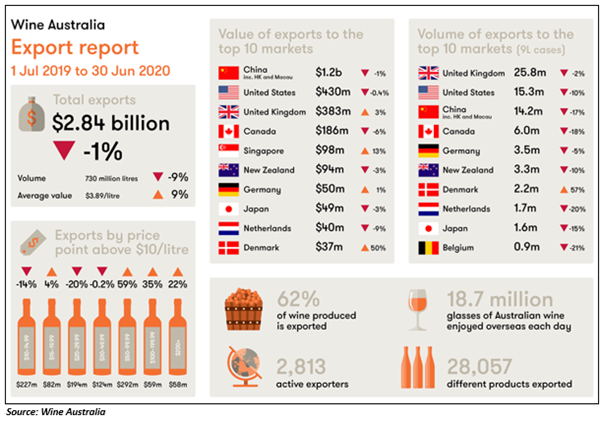
- Australian wine exports stood at $2.84 billion for 2019-20, with substantial recovery in the last quarter.
- While wine exports from Australia to China declined only marginally (1%) in value at $1.2 billion, volumes decrease by 17%. Australian wine exports also witnessed strong growth from markets including the UK, US, and Singapore.
- The Oceania wine industry serves to almost all markets and enjoys less dependency on any particular consumer market. Wine companies are already taking cost reduction measures and forwarding the unsold stocks into future years.
- Major impact from the pandemic on the wine market was driven by the closure of on-premise channel but new avenues emerged and grew across the globe through online sales.
Similar to several other sectors, the wine market did face its fair share of challenges mostly arising from the pandemic, which infected many and brought economic activity to a near-standstill. Owing to the coronavirus outbreak, governments implemented restrictions, which led to the closure of restaurants and bars, resulting in an unprecedented disruption of the wine market, globally.
As the lockdown measures are being relaxed in phases in most parts of the world, governments and inhabitants are adapting to the new normal circumstances, which is leading to some recovery. It seems the wine market is also regaining momentum, with annual volumes reflecting strength.
How has 2020 been for the Australian Wine Market?
“Presently, Australia is the 5th largest exporter of wine, globally, with exports accounting for almost 60% of the total production levels”.
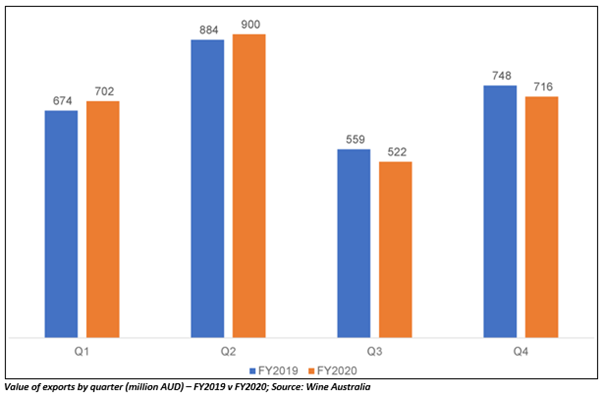
As per the Australian Government statutory authority, Wine Australia, the Australian wine exports for the year 2019-20 stood at $2.84 billion, registering a nominal 1% decline, owing to short supply and measures implemented to contain COVID-19. The last quarter of the year FY2019-20 experienced a solid rebound in the export market from lows during the third quarter.
While the impacts of the pandemic can not be denied, it is essential to note how the demand was impacted and which channel showed promises even during the adverse situations. The most impacted segment was the on-premise channel, which served wines at cafés, restaurants and hotels while some of the wine traffic switched to buying wine online.
The pandemic emerged as an accidental catalyst to the online wine segments. A strong growth has been observed in the retail liquor segment across all price points.
The Australian government rolled out a $50 million Export and Regional wine support package for 2017-2020, aimed to transform the Australian grape and wine industry by driving the demand for Australian wine exports.
The grant programs under the package include the following-
- Wine export grants
- International Wine Tourism State Grants
- International Wine Tourism Competitive Grants
Good Read: Latest Developments Shaping up Australian Wine Sector's Future
China Exports Stood at $1.2 billion Despite Decline in Volumes
Exports to mainland China declined by 1% to $1.2 billion in terms of value while wine volumes decreased by 17% to almost 121 million litres (13 million 9-litre case equivalents). The average value increased by almost 22% to $9.07 a liter FOB.
While the much-discussed growing geopolitical tensions between China, Australia and New Zealand may lead to shortfalls in the near term, strong growth is anticipated in the medium to long term.
Must Read: The milieu between China and Australia when it comes to trade talks
Growth in the average value of exports has been attributed to growth in exports at higher price points and a decline in the low-end segments. The exports of wine with value equal to or higher than $10 a litre, the FOB increased to $670 million, registering a growth of 11%.
Despite the recent decline in the value of exports to China, Australian wine holds the podium position in the entire imported wine category in the Asian country. Also, Australia’s exported wine dynamics in the Chinese market performs much better in comparison to other markets.
The Australian wine also received positive signals from multiple markets including the United States, United Kingdom and emerging importers such as Singapore. Despite the limitations on the industry related to the pandemic, strong growth from markets like the United Kingdom and Singapore has been observed. Australia is focussed on serving wine to the existing markets and new growth markets.
As China is experiencing geopolitical issues with almost all neighbouring countries including India, Taiwan and Japan and the far away nations including the United Kingdom, United States, New Zealand and Australia, a change in dynamics in the imported wine industry in China may be anticipated in short term.
Must Read: Goods exports to China are now nearly half of the total Australian Exports
In that backdrop, let us discuss one major player in the Australian wine industry.
Treasury Wine Estates Limited (ASX:TWE), one of the world's largest wine companies, recently appointed new Chief Executive Officer, Tim Ford, effective from 1 July 2020. Its business update, including preliminary performance outcomes for FY20, highlighted that FY20 EBITS declined by almost 21% year-on-year with regional declines of 14% in Asia, 37% in Americas, 18% in EMEA, and 16% in Australia and New Zealand. The business segments at Treasury Wines experienced a shock in the form of decline in sales during H2 of FY2020 across all geographies.
However, the company is well positioned through the flexibility of its luxury wine allocation program, enabling the business to manage through short-term changes in demand or single vintage variation. This is aided by TWE’s multi-regional sourcing strategy. Using this flexible allocation model, the company intends to take forward unsold wines from H2 and reallocation of luxury wine that had been previously allocated to F21 and beyond into future years.
The company, which is expecting EBITS between $530 million and $540 million for FY20, is due to make FY20 full-year results announcement on 13 August 2020.
On 6 August 2020, TWE settled at $10.750, up by 0.844% from its previous close.
Read: Growth-Driven and Tailored Approaches in Wine Industry - Accolade Wines vs Treasury Wine Estates
