
 AUS
AUS
 NZ
NZ
 UK
UK
 CA
CA
 USA
USA
 IND
IND







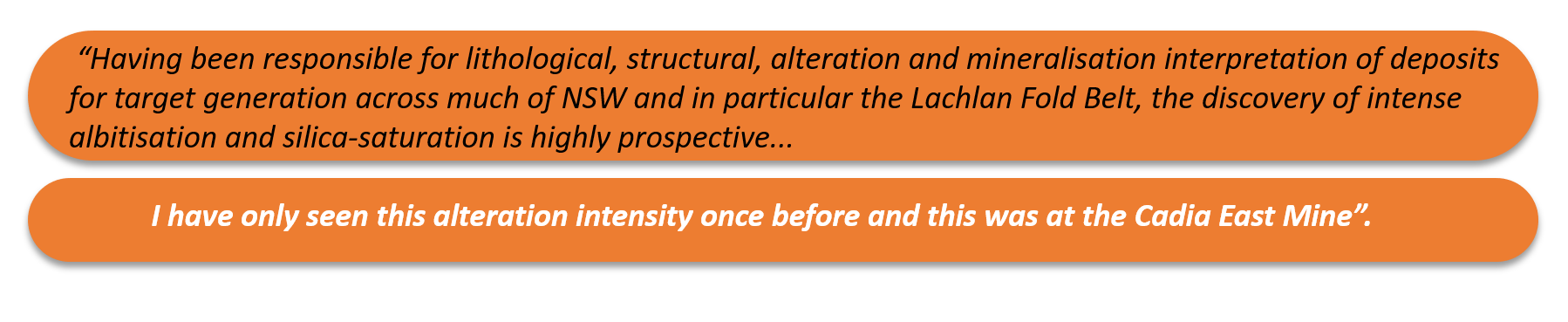
Australian exploration company, Krakatoa Resources Limited (ASX: KTA) reported that the geology at Belgravia consists of Intense proximal albitisation and silica-saturation, similar to zonation seen at Newcrestâs Cadia East Mine by experienced porphyry geologist and mining engineer Mr Ian Cooper.
Site-based due diligence has now confirmed the highly prospective geology at KTAâs Belgravia project. KTA has a current mkt cap of only $7m.
Belgravia is located between Newcrestâs Cadia and Alkaneâs Boda Projects only 20 Km from Orange in the central Lachlan Fold Pomphrey Belt. See KTAâs map below:
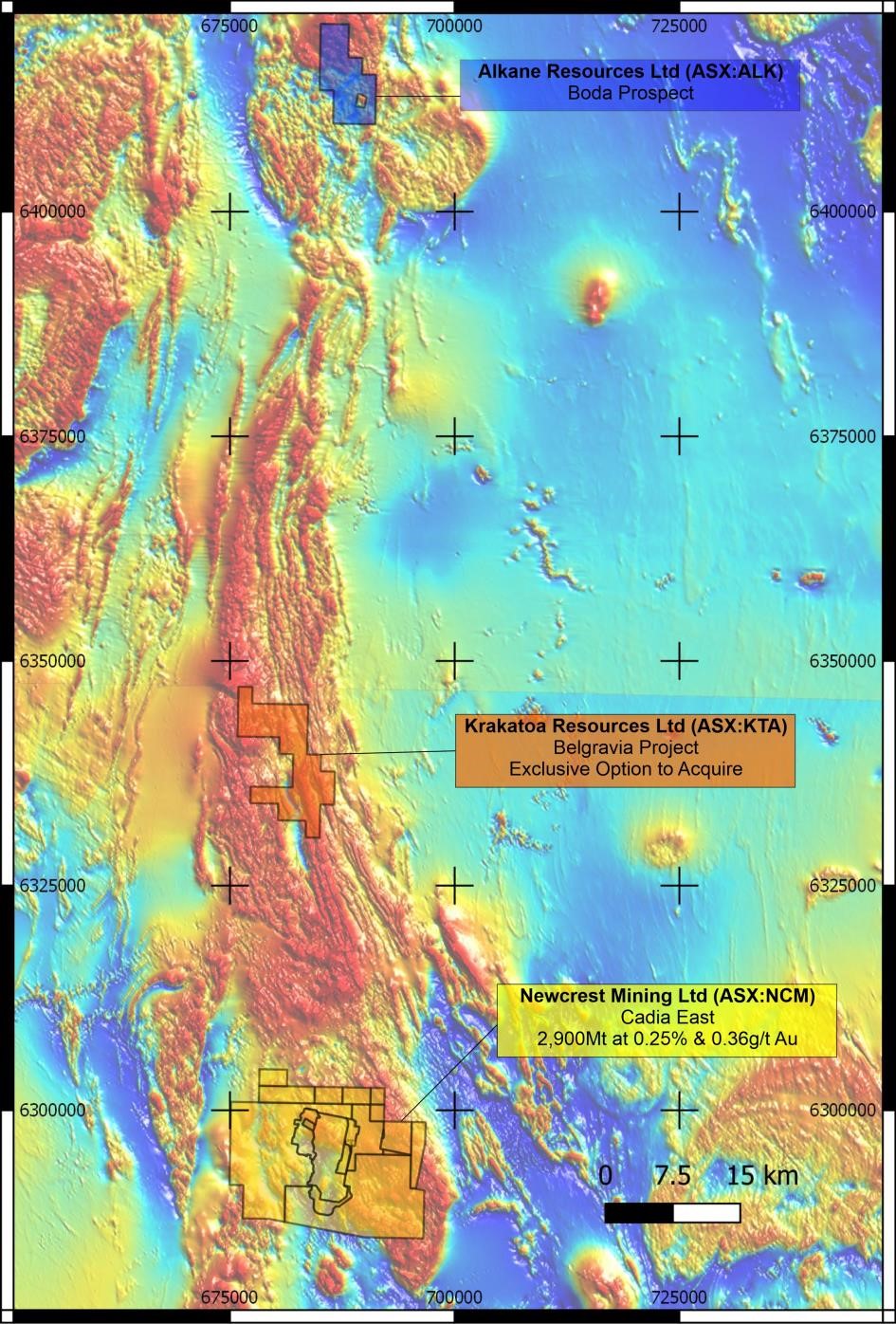
Regional TMI RTP Map of Molong Volcanic Belt. Note: Alkane (ASX:ALK) ~70Km North of KTA in Blue and Newcrest (ASX:NCM) ~ 40Km to the South in Yellow. (Source: Company Reports)
Investors will be keen to take a look at this comment from Mr. Ian Cooper, experienced local porphyry geologist and mining engineer below.
Large-scale and pervasive alteration was also identified by KTA, particularly at the Bell Valley Target, which lies over the eastern parts of the Copper Hill Igneous Complex.
Further, KTA revealed that Belgravia lies in a very fertile metallogenic province, âwhere copper-gold porphyry deposits typically occur in clusters, providing considerable potential for more discoveriesâ.
Significantly KTA also just announced and introduced the Bella Prospect to investors. Bella features a doughnut-shaped magnetic pattern considered characteristic of a porphyry intrusion and lies within 1km of noted alteration.
Encouragingly, âdoughnutâ magnetic patterns considered characteristic of porphyry intrusion are present in the project area.
The Bella prospect within the Bell Valley represents such a pattern. Bella, which has a diameter of approximately 500m, was outlined after reviewing and reprocessing the regional airborne geophysical data. The Bella Prospect sits near the edge of the CHIC, in a juxtaposition to the Copper Hills Deposit. Much of the widespread chlorite-epidote ± carbonate alteration lies within 1 or 2 km of the interpreted magnetic pattern.
Bella coincides with an interpreted WNW-trending structure thought to control the emplacement of the porphyry bodies. Similar oriented structures are seen as controlling emplacement of the porphyry-related mineralised systems at Cadia and Copper Hill.
See illustration below:
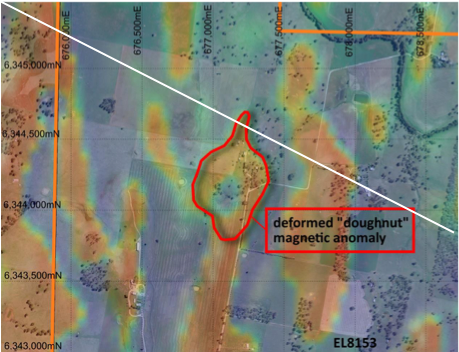
The Bella prospect, a deformed âdoughnutâ magnetic anomaly (Source: Companyâs Report)
Project Geology and Copper Hill
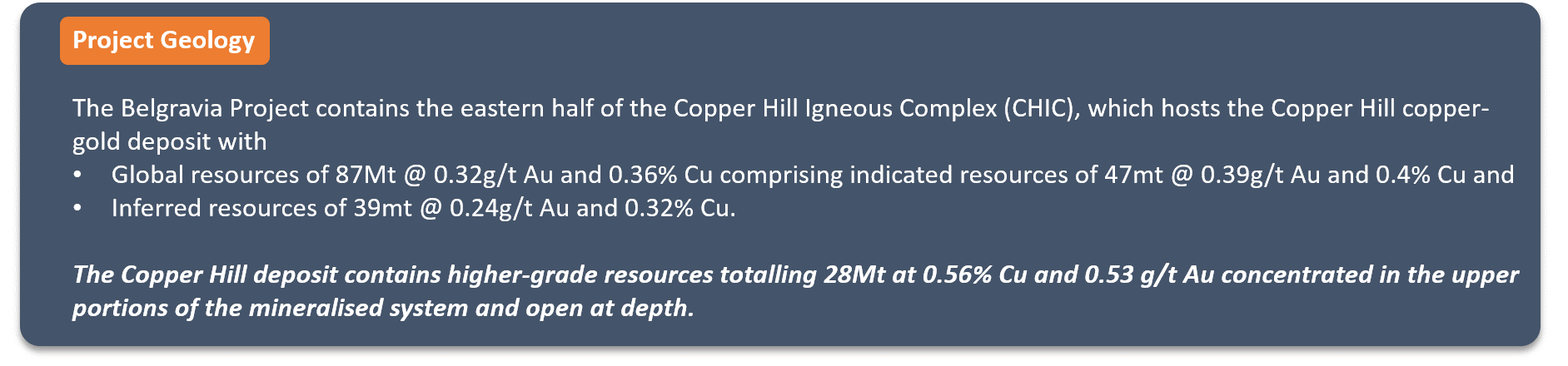
Consequently, the bulk of this resource is potentially extractable by open-pit mining and has a strong potential for further resource growth through exploration.
During KTAâs field due diligence, large-scale and pervasive alteration was identified across most targets including Guanna Hill, Shades Creek, Nandillyan, Strathmore and especially Bell Valley, which lies over the eastern half of the CHIC. The widespread chlorite- epidote ± carbonate alteration is consistent with intersecting the outer propylitic zone of a porphyry copper-gold system.
KTA also identified intense proximal albitisation and silica-saturation in the projects north, near the Shades Creek target. The observed alteration is characteristic of mineral zonation typically associated with the emplacement of porphyry intrusions.
Regional Geology and Mineralisation
The Molong Volcanic Belt (MVB) represents one of four outcropping volcano-intrusive belts of Ordovician volcanics within the Macquarie Arc. Each belt is dominated by Ordovician to Early Silurian volcanics, subvolcanic intrusives and minor volcaniclastic rocks separated by Early to Late Silurian sag-rift basins comprising quartz-sediments, granites and felsic volcanics.
The Macquarie Arc developed above a west-dipping subduction zone and represents a world- class porphyry copper-gold province. Within the Arc, major Late Ordovician volcanic centres are concentrated along two main WNW-trending structural zones in the belts, known as the Lachlan transverse zone (LTZ) and the Hunter River transverse zone (HRTZ).
The MVB, which includes Belgravia, is considered highly prospective for alkalic and calc-alkalic porphyry gold-copper mineralisation.
About Belgravia Project:
The Belgravia Project covers an area of 80km2 and is located in the central part of the Molong Volcanic Belt (MVB), which forms as part of the East Lachlan province within the Lachlan Fold Belt, NSW. The East Lachlan region constitutes the largest porphyry province in Australia.
The Project lies approximately 7km east of the township of Molong and 20km northwest of the regional centre of Orange, providing excellent road, rail, power, gas and water infrastructure.
The Belgravia Project has 6 initial targets considered highly prospective for porphyry Cu-Au and associated skarn Cu-Au.
Historical exploration appears to have failed to adequately consider the regolith and tertiary basalt (up to 40m thick) that obscures much of the prospective geology.
By AEST 2:48 PM, Krakatoa had a market cap of only $7m with shares trading at $0.053, up by 29.20% intraday.
Disclaimer
This website is a service of Kalkine Media Pty. Ltd. A.C.N. 629 651 672. The website has been prepared for informational purposes only and is not intended to be used as a complete source of information on any particular company. The above article is sponsored but NOT a solicitation or recommendation to buy, sell or hold the stock of the company (or companies) under discussion. We are neither licensed nor qualified to provide investment advice through this platform.
