
 AUS
AUS
 NZ
NZ
 UK
UK
 CA
CA
 USA
USA
 IND
IND








The ongoing global risks have taken a toll on economic developments across countries. Lately, there has been a drop in consumer confidence. There are predictions for slow growth in the international economy, while the already troubling coronavirus continues to hinder the Chinese as well as the global economy.
However, recent AU and NZ unemployment data has gained the confidence of global community posting decent job market scenario.
It was recently brought to the public knowledge that the seasonally adjusted unemployment rate of Australia dipped by 0.1 per cent to 5.1 per cent in December 2019. The underemployment rate was steady at 8.3 per cent, and employment rose by 28,900 people to 12,981,600 people. The encouraging data lowered the likelihood of a rate cut in February, in line with which, RBA held the interest rate at 0.75% in yesterday’s meeting.
For New Zealand as well the unemployment rate has been reported to fall slightly, while wage growth has remained close to its best in a decade. This has reduced the market expectation of NZ rate cut expected in next week meeting.
However, the number of jobs being created has slowed down in the month of December.
Source: Stats NZ
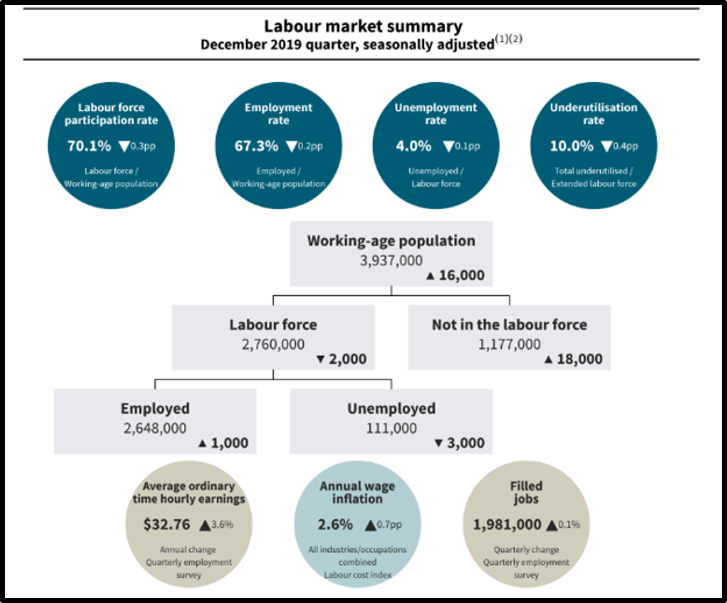
On 05 February 2020, the New Zealand Government’s Stats NZ reported that the seasonally adjusted unemployment rate was down from 4.1 per cent in September 2019 quarter to reach 4.0 per cent in the December 2019 quarter. The decrease in the December quarter’s unemployment rate indicated 3,000 fewer unemployed people, which was propelled entirely by 3,000 fewer unemployed women, and
- The unemployment rate for women dropped to 4.3 per cent in the December 2019 quarter, down from 4.5 per cent last quarter;
- The unemployment rate for men remained unchanged at 3.8 per cent;
Employment rate dips
However, during the December 2019 quarter, the seasonally adjusted employment rate dropped to 67.3 per cent, down from 67.5 per cent last quarter.
Upon classification based on sex, the employment rate for men during the December quarter dropped a little to 72.2 per cent from 72.3 per cent in the previous quarter, and for women, the same fell to 62.5 per cent, down from 63.0 per cent in the last quarter.
Stats NZ indicated that there were 1,000 more employed people during the December 2019 quarter, up to 2,648,000, which mirrored a rise of 6,000 more employed men and was compensated by 5,000 fewer employed women.
It also indicated the number of employed people, which was up 1,000 and increased at a slower rate than the working-age population, which was up by 16,000.
As measured by the Quarterly Employment Survey (QES), filled jobs increased 0.9 per cent (unadjusted), which translates to 17,200 new jobs on an annual basis comprising the growth of 11,900 jobs held by men, and the increase of 5,200 jobs for women.
Read: ANZ’S Job Ads Posted Modest Gain for October Month
Wage Rate Grows 2.6 per cent
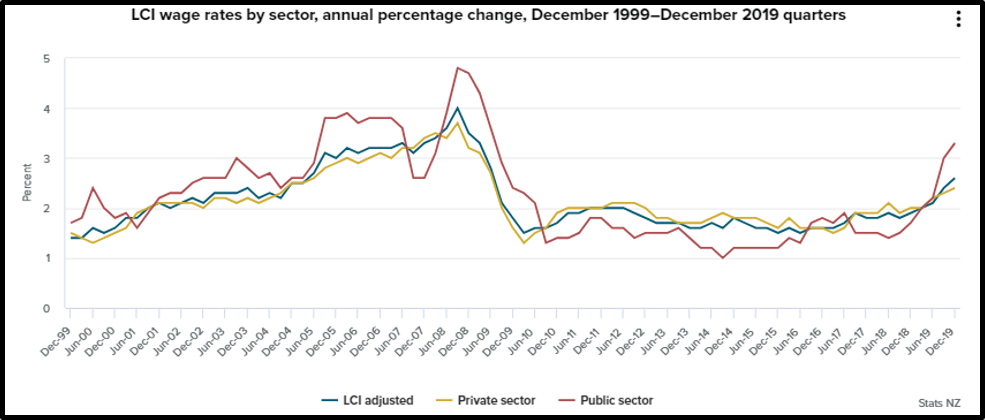
Also, there was a rise in Labour Cost Index (LCI) salary and wage rates by 2.6 per cent in the December 2019 quarter representing the biggest rise since the June 2009 quarter where it rose by 2.8 per cent.
Source: Stats NZ
As measured in the Quarterly Employment Survey (QES),
- Average ordinary time hourly earnings increased by 3.6 per cent over the year to attain $32.76;
- Average weekly earnings (including overtime) for full-time equivalent employees (FTEs) also increased, up 3.6 per cent over the year to the December 2019 quarter to reach $1,272.12;
As stated by Stats NZ, public sector wage growth, which increased 3.3 per cent in the year to the December 2019 quarter, was shaped by the collective agreements across industries including the main drivers such as health care and social assistance; public administration and safety; and education and training, reflecting the pay settlements for nurses, police, and teachers, respectively.
The LCI salary and wage rates gauge the changes in wages for a fixed quantity and quality of labour which entails the elimination of adjustments in pay rates due to promotions or the performance of employees in the index.
The increase in pay in the last LCI was led by the growth in ~61 per cent of wages.
With the highest percentage of wages that have witnessed expansion since September 2008, the wage growth across the LCI is currently acknowledged, with 61 per cent of wages showing pay increases compared to last year.
More minimum wage effects are expected in the LCI as it continues to rise in annual increments and is expected to attain $20 per hour by 2021.
QES average ordinary time hourly earnings increased to $32.76, up 3.6 per cent in the year to the December 2019 quarter, while the public sector average ordinary time hourly earnings rose to $41.34 (up 4.6 per cent) and rose to $30.56 (up 3.0 per cent) for the private sector, with key influencers being the following:
- health care and social assistance (up 4.9 per cent);
- public administration and safety (up 5.3 per cent);
- retail trade (up 4.2 per cent);
On an annual basis, the private sector wage rates increased 2.4 per cent with the largest contribution from the private sector health care industry and partly swayed by hospital staff receiving pay settlements over the year.
Another significant event for the annual increase in private sector wages was the increase in minimum wage during April 2019, especially for the retail trade and accommodation industries.
Underutilisation Rate at 11-year low
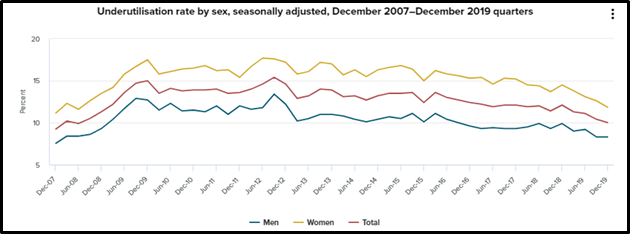
In addition to the above, the Underutilisation rate fell to 10.0 per cent in the December 2019 quarter, down from 10.4 per cent last quarter, and is the lowest since reaching an 11-year low of 9.9 per cent in June 2008 quarter.
The rate of underutilisation for men has remained relatively low over the past few years, while women have primarily been driving the decrease in underutilisation.
Underutilisation offers a broader gauge of untouched capacity in the labour market of New Zealand, and the following are included as the underutilised people in New Zealand who:
- currently have a job and want to work for more hours;
- are available to work but aren’t looking;
- are looking for work but aren’t available to start within the next month;
For the December 2019 quarter, the number of underutilised people fell to 285,000, representing a fall of 11,000. The decline was led completely by 12,000 fewer women who were underutilised.
The underutilisation rate remained unchanged at 8.3 per cent for men during the December quarter, while the same fell to 11.8 per cent for women, down from 12.6 per cent last quarter. Since the June 2008 quarter when the underutilisation rate for women was 11.6 per cent, this is the first time the rate has gone so low.
Moreover, the underutilisation rates, for both genders, have been closest to each other since December 2011.
Source: Stats NZ
